Oct 16, 2025
The 1970s marked a dramatic turning point for cinema in Libya. What was once a thriving industry on the cusp of regional leadership entered a new phase, one defined by the dimming lights of its movie halls.
This shift began with the government’s decision to nationalize all cinemas, transferring the entire film industry from private hands to state control. For the public, the change was jarring; they were suddenly confronted with restrictions on the films they could watch. The consequences, however, ran much deeper than just production and exhibition. This move fundamentally reshaped the relationship between the Libyan people and the big screen, profoundly influencing their cinematic tastes and visual culture for years to come.
The General Cinema Organization:
According to director Abdullah Al-Zarruq, the decision to nationalize cinemas robbed the Libyan viewer of access to films with real intellectual and artistic value, which had previously been shown exclusively by the private sector. He explains that after 1969, the state began imposing stricter censorship, a process that ended with the 1973 decision to abolish private cinema ownership and establish the General Cinema Organization.
From that moment on, cinematic activity entered a gradual decline. Showings were reduced to commercial films, and theaters began to close, one by one. This trend worsened until the 1990s, when most venues shut down for good.
“Ending the private sector’s role made the General Cinema Organization the only authority responsible for importing films,” Al-Zarruq adds, “and it selected movies that aligned with its own ideology, without considering their artistic or intellectual quality.”
He continues, “This created a huge gap between the state and the audience. Viewers, who were used to seeing the world’s most celebrated films, lost hope of ever seeing them in local theaters again. Where private owners had once competed to bring in the best and newest releases, audiences now found themselves limited to watching Indian cinema and karate movies, which famously inspired a generation of young men to imitate stars like Bruce Lee.”
When asked about the role of the General Cinema Organization after the nationalization, he said it was extremely limited. Its work was confined to producing a few short films that weren’t even shown in theaters, alongside a handful of co-productions and a small number of feature films. The state’s control and its refusal to entertain any idea that didn’t align with its own is incredibly dangerous, because it robs the audience of their freedom of choice.
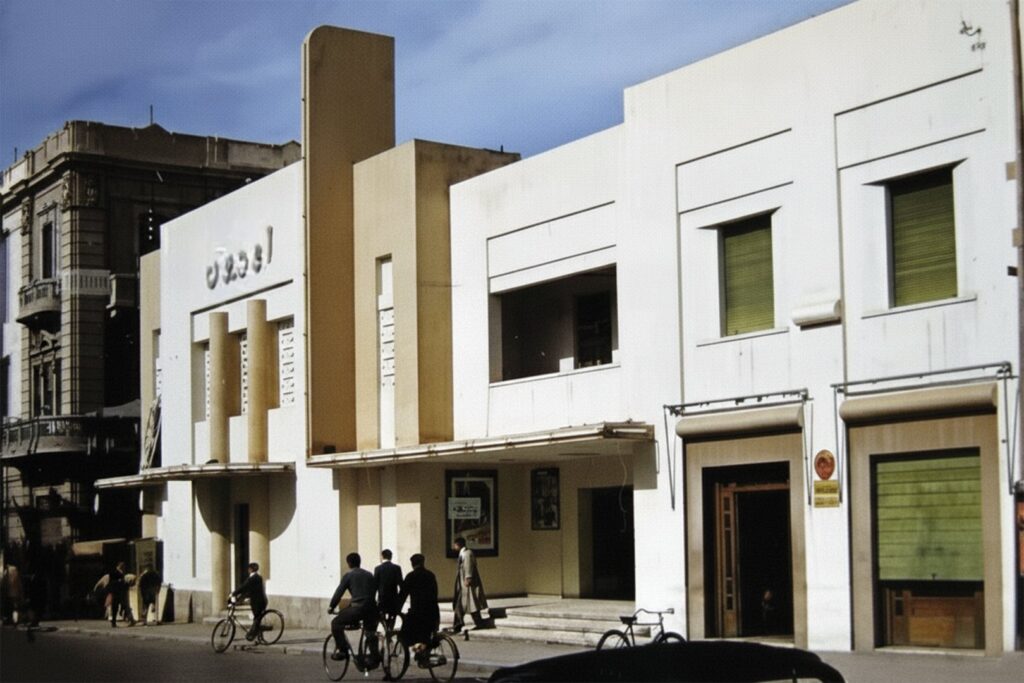
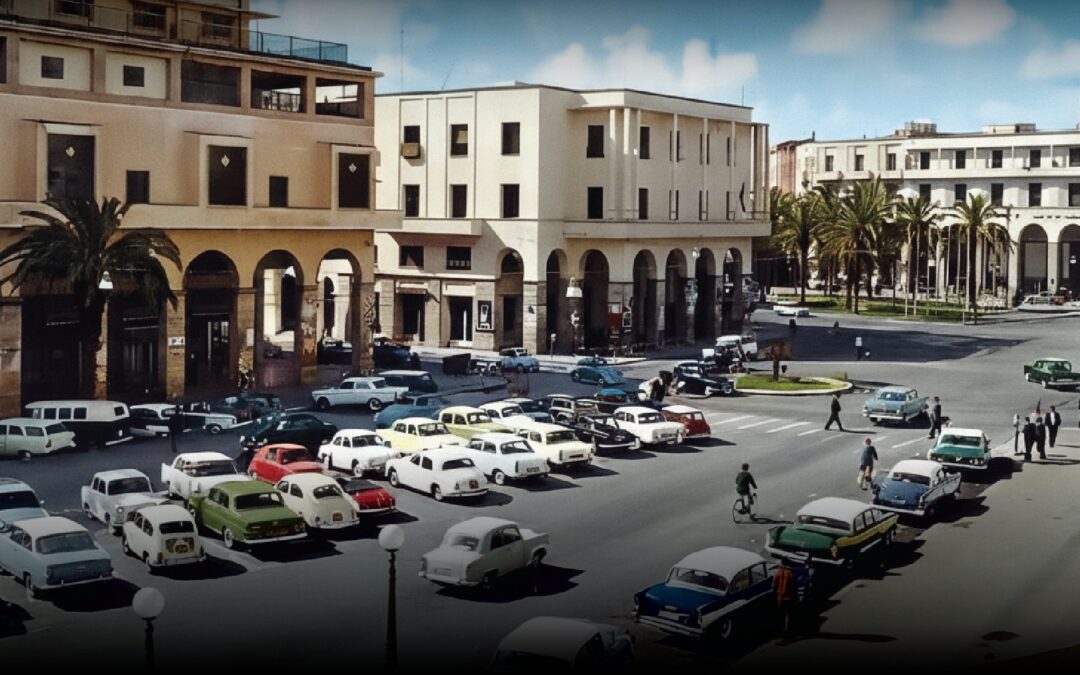
Al-Zahra Cinema in the Libyan capital, Tripoli, also known as “Odeon,” in 1957.
Abandoned Theaters:
Writer Muftah Ganaw explains that the next chapter in Libyan cinema’s history began with the establishment of a new entity, the General Company for Cinema. This state-run company officially took ownership of all the newly nationalized private theaters. Ganaw notes that the company didn’t last long and failed to achieve its objectives, neither in producing Libyan films nor in properly managing the theaters it had inherited.
Like many public sector enterprises, the company eventually crumbled. When it was officially dissolved, the cinemas ceased operating entirely, becoming abandoned, locked-up spaces. For a time, no one dared touch them, until some of the original owners began filing lawsuits to reclaim their properties. The heirs of Khalil Al-Ja’ouni successfully regained ownership of the theaters their family had once owned, only to sell them. The new buyers then demolished these historic venues, including the Al-Jumhuriyah, Al-Rasheed, and Royal cinemas in the city center.
Ganaw points out that the chaos following the 2011 revolution made things worse. With state security weakened, individuals seized the remaining cinema buildings and converted their facades into small storefronts selling cigarettes, clothes, and trinkets. Today, it’s easy to forget that behind these makeshift shops lie vast auditoriums, spaces that both the Libyan state and its people desperately need. He cites the Al-Hamra Theater as a prime example, a venue capable of hosting major plays and cultural events, just as it did during its glory days in the 1960s and 70s.
Director Abdullah Al-Zarruq adds another perspective. “The nationalization order also made it illegal for anyone else to purchase films,” he says, “making the theaters captives of the state organization that now controlled their content.” This was a stark contrast to the era of private companies that competed to import the latest Egyptian, Syrian, and international productions, sometimes even before they premiered in their countries of origin. “In fact,” he recalls, “Lawrence of Arabia was screened in Libya before it was shown anywhere else in the Arab world. Those companies were connected to global cinema, ensuring the theaters were clean and the films were promoted with elegance. But after nationalization, it all fell apart. The halls turned into ruins, and the movies shown were trivial, failing to meet the cultural standards we aspired to.”
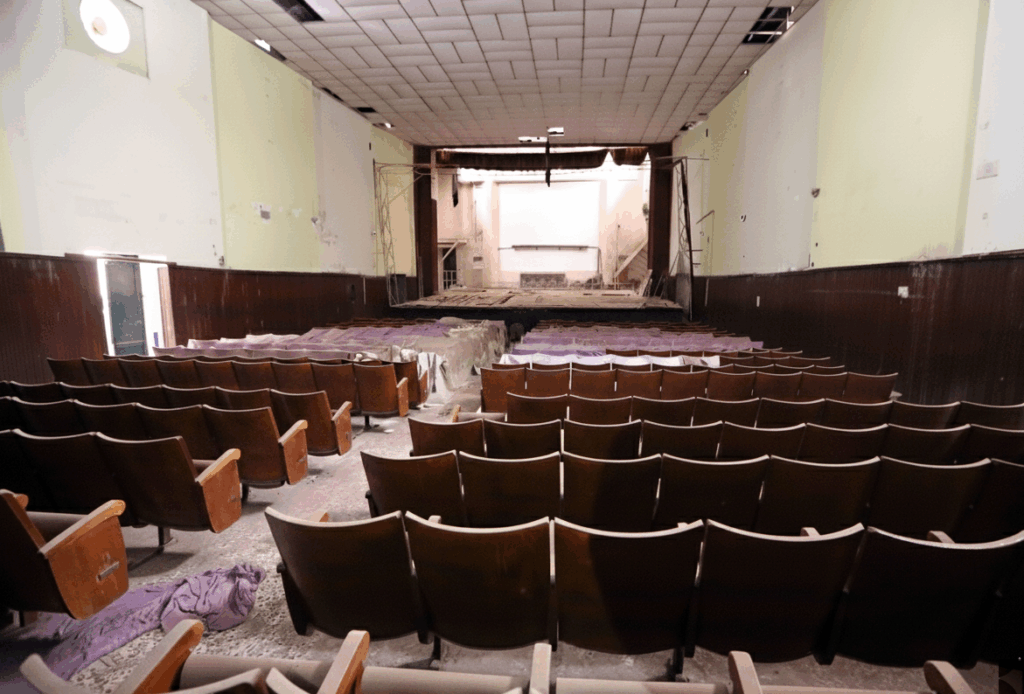
Al-Zahra Cinema in the Libyan capital, Tripoli, also known as “Odeon,” in 2015.
The Sorrow of Libyan Cinephiles:
Reflecting on a cinematic history that spans over a century, Abdullah Al-Zarruq recalls a time of great promise. “Before the nationalization, specifically in 1968, we had assembled all the necessary film technologies. We established labs for developing and printing, and purchased modern cameras from Germany. Preparations were underway to build a true national cinema at a time when most Arab countries lacked our resources.” He credits this vision to the late Ahmed Salheen Al-Houni, then Minister of Media and Culture, who established a film production department and supported early works.
“That momentum was a sign that Libya could have been a leader in the field,” Al-Zarruq continues, “especially with the rise of private companies and visits from Arab producers. But the winds of change blew in an unwelcome direction. With the establishment of the state-run organization, all private companies – the only real hope for a genuine Libyan cinema – were shut down.”
“The public sector seized control of every aspect of the industry,” he says. “And just like that, the dream of Libya becoming a filmmaking nation like Egypt, Syria, or Lebanon was lost. For us filmmakers, it was a profound sorrow.”
After a long journey of pioneering success and subsequent silence, Libyan cinema now stands at a crossroads. Today, a new generation of creators is filled with the ambition to restore the glow of the silver screen and return the moving image to its rightful place in the nation’s cultural memory.

Oct 9, 2025
1
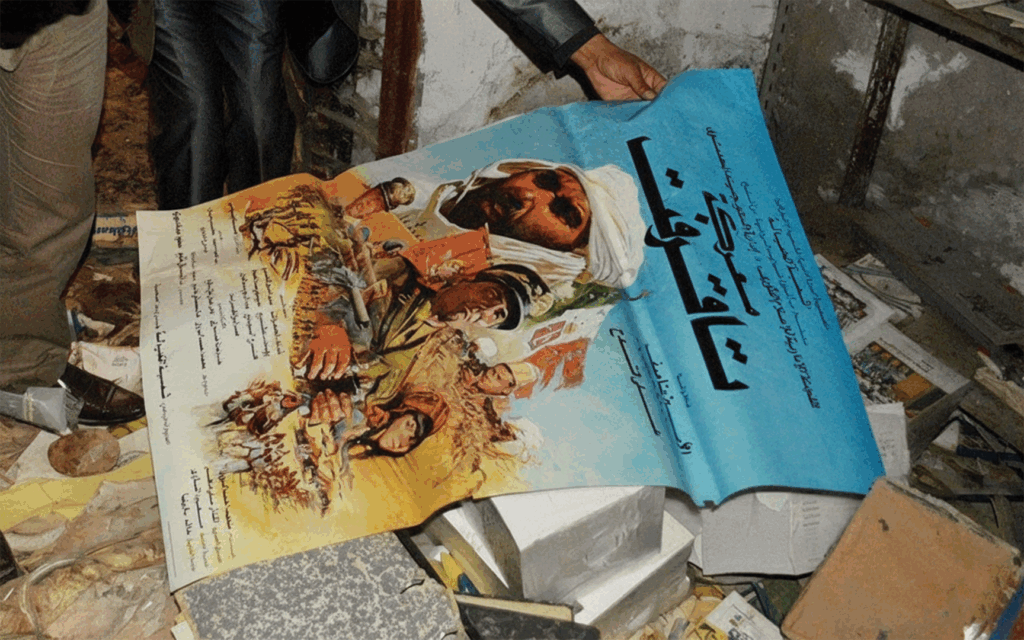
In the winter of 2022, as football fans awaited the Qatar World Cup, an old yet persistent thought crossed my mind: how can one watch Libyan feature films? I had previously watched “Ma’arkat Tagrift” (The Battle of Tagrift) and “A’shaziyya” (The Shrapnel) on YouTube shortly after the uprising in February. But where are the other five/six/seven films we keep hearing about? I didn’t expect to find masterpieces after bearing the brunt of having to watch both films — but my desire to seek them out didn’t come from expecting to find hidden treasures; rather, it was like someone searching for a lost sock, simply to know how it got lost.
I kept having the same thought as the World Cup approached, although this wasn’t entirely a coincidence. My passion for cinema began just as my addiction to football waned in my late teens, when I began to discover films from around the globe, from Georges Méliès to a multitude of contemporary filmmakers. We obviously exclude some countries from “The Cinema of the World”, especially one in particular.
I rang my film companion and friend Abdulmajid Djerbi, to shoot a short documentary that would humorously investigate the fate of lost films. I had the title in mind: “The Hunt for the Six” I used the term “missing film” instead of “lost film,” which is internationally used for movies that have vanished from cinematic history. The number didn’t matter, since there’s little difference between five or eight feature films produced by a country in a century.
Abdulmajid owned a car and a good camera; more importantly, he was eager to take part in the experiment. I flew from Al-Bayda to (The Mermaid of the Mediterranean) Tripoli that had lost its cinemas decades ago (for those who don’t know, Alexandria also bears the same nickname, but unlike Tripoli, it hasn’t lost its cinemas). We began shooting without “development,” funding requests, or even a filming permit (we’ll return to that later). Years earlier, I had already accepted that I would never be able to make my own feature films — so I decided to make a documentary about the reasons.
I’m still dissatisfied with the film; sometimes I even hate it. The reasons are obvious: scarce material, weak editing, and the inevitable consequences of inadequate production. The film, however, was screened at several festivals without a producer, distributor, or promoter. It was shown, for instance, at the Ismailia Documentary Film Festival, and it received a “Special Mention” award at the Casablanca Arab Film Festival, where the jury noted “the uniqueness of the director’s style” — a phrase that helped me laugh at myself.
2
Abdulmajid and I graduated from Visual Arts from the Faculty of Arts and Media at the University of Tripoli. Naturally, we thought of meeting and including our old mentors. We contacted Mohamed Al-Mesmari and Dr. Nour Al-Din Al-Werfali.
Mohamed, himself a filmmaker, spoke to us about his films and those of his colleagues, while Dr. Nour Al-Din discussed Fascist cinema in Libya (notably “Alfirqa Albayda”(The White Squadron) and the semi-Libyan cinema of Mustafa Akkad.
We also met Ahmed Bilal, Libya’s first film sound engineer, who began his career in 1968 and retired in early 2000’s. I began my film with our meeting in the silent film style to create an ironic contrast that embraced both sound and image. I had planned to film the interview at the “Sound Studio” in the Damascus District of Tripoli, using that same approach, but like most institutions, the studio was closed at the time. I wasn’t aware until our meeting that Mr. Ahmed had lost his sight years ago as a result of daily exposure to studio equipment without protection. The memory of his death last year still hurts especially since I hadn’t prepared the audio version of his interview for him to hear.
We were referred to filmmaker Salah Gwaider by our friend Faraj Mayouf, also a filmmaker, to talk about his experience in short films, which received a lot of attention. One of his works won an award at the Carthage Film Festival a year before the uprising. We sat down with Abdallah Zarrouk to delve deeper into independent cinema beyond the state-run ‘Foundation of Cinema’ “Al Khayala Foundation/Company“. He began his career with the film “When Fate Hardens” in 1971. We discussed in detail the hopes of those beginnings and the harshness of their endings.
Our investigation wasn’t limited to filmmakers — we also spoke with cinephilic intellectuals. The final conversations were with novelist and playwright Mansour Bushnaf and the poet Khaled Mattawa. The first offered his perspective as an observer and critic, while the second founded the Arete Cinema Club, which was the first to screen films from the aforementioned ‘Cinema of the World’ in Libya. (In the film, I included a note: a moment of silence for the souls of the women who weren’t here for these interviews).

3
What hit me the most in all the interviews was the graciousness and the open-mindedness of the people I spoke to, some of them didn’t know who I was or what would become of the documentary and yet, they all sat for hours to discuss everything without any refreshments. I remember that we didn’t even offer Abdallah Zarrouk a glass of water, and yet after the interview he asked: “Do you want me to help you find someone — a number, an address…?
But all of those we interviewed were helpless to “The Hunt for the Six”. Salah Gwaider told me that he had lost the negatives of his first film are, and Zarrouk too didn’t have a single negative of any of his feature films.
The tragedy of the archive lies at the very heart of Libyan cinema. It is through it that our scarce “national” film material can be released — to lay a foundation for what might come after. Today, that archive is divided among gangs (in the literal sense), each holding part of it. Every member of the group keeps a portion of the material in his house or on his “farm,” as Gwaider told me.
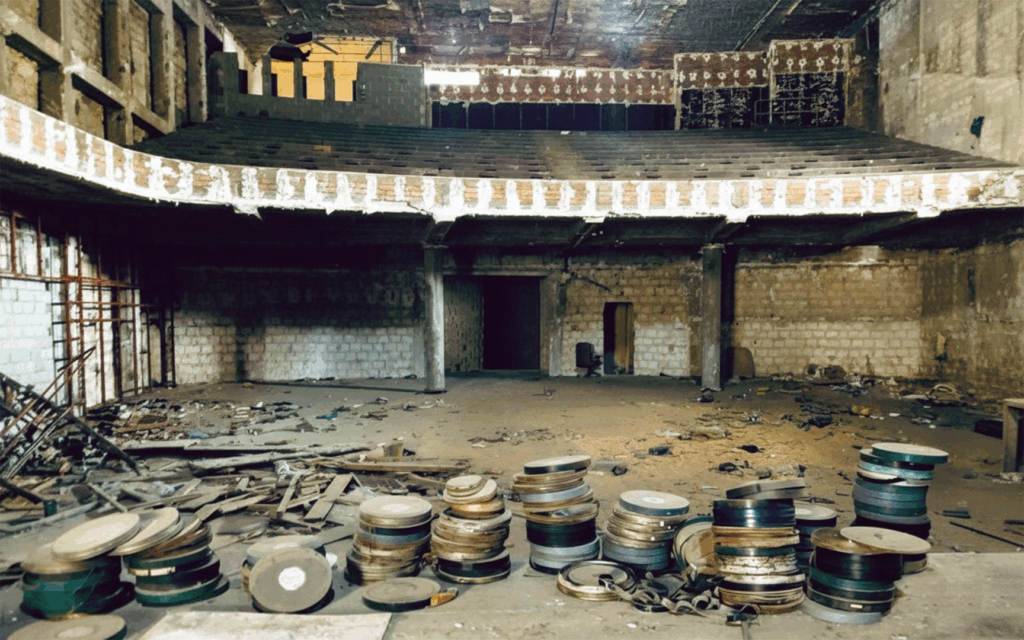
As for the cinema halls themselves, we dedicated our last day of filming — in Tripoli — to visiting theatres that were closed, demolished, or repurposed. Our colleague and fellow filmmaker, Saqr Al-Hawat, joined us.
Since we didn’t have filming permits, a mischievous idea crossed my mind:
First, to close the camera lens and use only the microphone — to record the answers we wanted to capture. (If the authorities succeed in suppressing the freedom of image, they can’t suppress the flow of sounds.)
Second, to throw Abdulmajid “into the line of fire” — let him ask the questions and hold the camera. After all, he’s from Tripoli; if his camera got confiscated, his family and friends could get him out.
Our audio investigation managed to document some of the repurposed cinemas, and Saqr – owning the same skill most Libyan cameramen often develop to avoid being noticed by Big Brother — managed to capture a few quick video shots. Rarely does repression produce such talents.
By coincidence, that day was a Friday — a “Black Friday,” imported from our “mother America,” with crowded malls and heavy shopping discounts. The city was almost free of police, luckily.
We found Cinema Al-Hamra completely sealed off, no way in. Cinema Odeon had its dark entrance open to pedestrians behind iron-meshed gates, under renovation by the “General Authority for Cinema (Al Khayala), Theatre, and Arts.” (We got rid of Gaddafi, but not the word Al Khayala.)
Cinema Lux had turned into small shops.
On my way back to Cyrenaica, I filmed Benghazi’s Berenice Cinema with my friend Khaled Mattawa’s phone, only months before it was demolished — just like Rex Cinema and Al-Khums Cinema in Al-Khums.
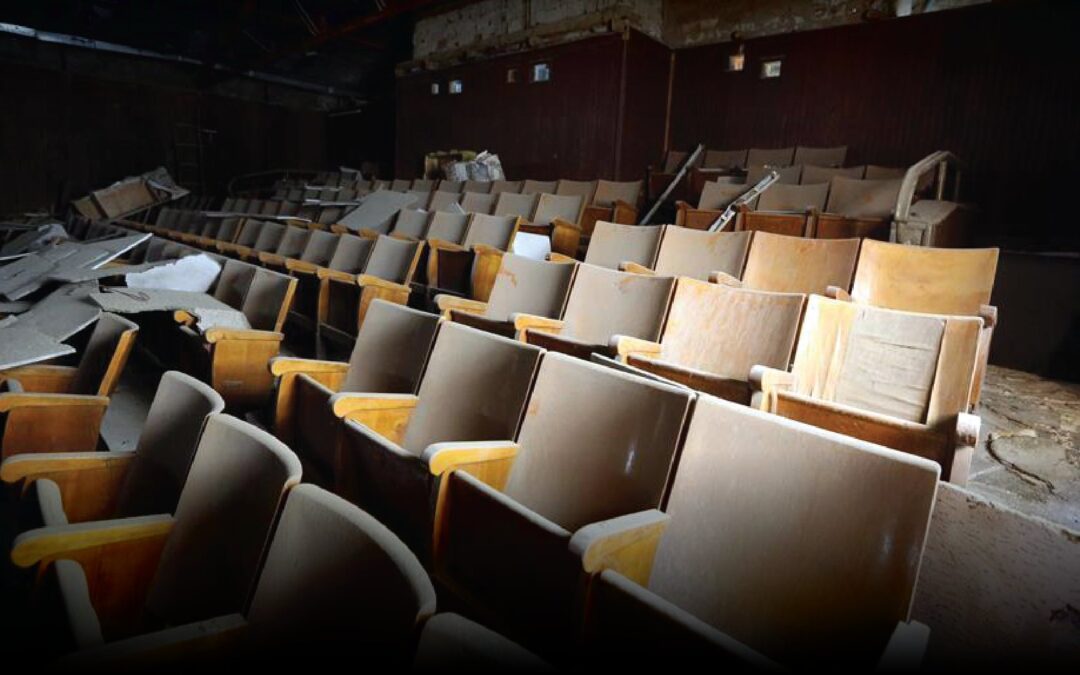
In Al-Bayda, one old theatre still keeps its seats and screen — behind locked doors, for obvious reasons.
At the end of that miserable shoot I titled the film, “Cinema, and Nothing More”, inspired by Abbas Kiarostami’s masterpiece “Life, and Nothing More”, which blends reality and imagination in a village destroyed by an earthquake — inseparable from the filmmaker’s and his crew’s history. Here, too, lies the same destruction and the same determination.
4
I believe that cities, like humans, have a life cycle that end with death. I do not mourn the ruins of the Berenice Cinema (already destroyed by the war), or over the ruins of the opera houses built by the fascist ruler and never open to public. This remark does not stem from a postcolonial stance that dismisses all things Italian in Libya; on the contrary, it is always possible to transform Italian occupation facilities into vital institutions, and examples abound. The ultimate goal is to build the present, regardless of the ruins of the past. Libya does not have cinematic ruins, whether we like it or not.
When we call for state intervention in building a national cinema, it’s not out of hollow patriotic fervour, but from a clear-eyed awareness that the state lacks the will to act on such projects. The society itself doesn’t care about cinema -otherwise public pressure would have at least brought about a single functioning movie theatre.
That’s why change must come “from above” — from those with financial means, namely the state. Yet that state is represented by the “Cinema Authority,” which employs thousands -while, as Mansour Bushnaf told me, you’d be lucky to find two or three actual directors among them.
In conclusion, we mustn’t compromise with the sceptics—those who question the economic value of cinema and its ‘industry.’ Cinema must be embraced in its entirety, not à la carte: with all its challenges, provocations, and ‘controversial’ audacity, as well as its capacity to entertain.
We shouldn’t think of cinema or art, only in terms of utility or purpose. Everything that touches the soul is essential — and therefore “useless.” Especially when “usefulness” is measured by a nation’s GDP.
“These are things money can’t buy.”
Oct 2, 2025
I don’t know what came to mind when the idea of writing an article on cinema based on the memories of a cinema-going generation struck me, before its complete disappearance. Perhaps it was a sense of resisting the thought of us starting from scratch and that we had a history, whether it was a history of going to cinemas or a history of the industry itself. Every time I heard someone nostalgically tell their story of experiencing a movie theater, I envied them. At least they knew what it meant, while we, as a generation, never had that experience—except for those who traveled abroad and had that opportunity.
The social history of cinema and its audiences cannot be separated from the history of its theaters, their creation, transformation, and disappearance.
As a start of a social project for those who are interested, I attempted to pose a reminiscing question to a group of intellectual citizens which actually was nostalgic, and ultimately hopeful. They weren’t selected for any particular research or bias, but rather because they would be more acknowledging towards this short article.
The questions were: What is the moment you most remember from your visits to the cinema? Do you remember the theater where it happened? And which was your favorite cinema hall?
Hussein Al-Mazdawi
He began by saying that “Cinema was daily bread and butter for my generation.” He then added: “The Film Foundation used to screen films at schools periodically. As I grew, I began going to the cinema. I remember that I used to journal each film, from its name to its cast and the screening location. I would specifically go to the cinema before my final exams as a habit.” It was a way to relax and cheer myself. We used to watch a variety of Arab, foreign, and Indian films. I clearly remember the screening of Khali Balek min Zuzu (Take Care of Zuzu), the street was jammed with crowds buying tickets. It was Al-Khayyam or Al-Zahra Cinema if I remember. There was a film theater called Al-Nasr and another one called Al-Hamra Super Cinema, which later was renamed Al-Khadra.
The balcony (upper floor) was reserved for families: women in their traditional veils along children.
We even learned the Egyptian dialect from watching films and then, in the blink of an eye! Cinema disappeared. The crowds, the chatter, and the cinema culture—all gone!
Hauwa Al-Qamoudi
Should I be embarrassed to mention that I entered a movie theater for the first time in 2019 at the age of 62? It was during my visit to Cairo, attending the book fair. The thought of going to the cinema did not cross my mind during my trip at all (November 2018 until mid-February 2019). I faced an embarrassing incident which I’m not sure if I should disclose just because I belong to the (Al-Sania) family in (Souq Al-Juma) on the coast of Tripoli. This area was ridiculed. We are talking about a period of cinema during which my brothers grew up; I, as a child, began to pick up names of films along the name of a cinema, especially when The Message was screened, and I remember how surprised my brother was by seeing women in their traditional veils attending the films!
I learned about cinema through Egyptian films that were broadcasted on national TV. In most films, friends and beloved ones would accompany each other to watch films in cinema halls. When I, along with other students, saw a large white cloth, I was amazed as we sat there quietly waiting. Our teacher then told us that it was a “hygiene awareness” film. We were left speechless as we saw people moving and talking on that cloth. I then wondered: When was the last time I heard from a friend about their experience of going to the cinema on a specific day designated for families in Tripoli and they had to be well dressed and behave politely while being seated? They used to clap when the movie ended, just like I did that night when the movie ended, which marked the milestone of my entrance to a movie theater in February 2019 for the first time, in Cairo.

Omar Khayyam Cinema, Tripoli – 2006
Noureddine Omran
I used to regularly attend Al-Najma, Al-Hilal, and Al-Mujahid cinemas. My bond with cinema grew stronger between 1996 and 1998 when I started studying the Principles of Film Production, which required frequenting movie theaters and writing papers on the subject. Every Saturday, we went to a movie theater owned by the Cinema Committee, which operates as a supervisory committee. In the third year, we conducted a survey of moviegoers in three or more theaters and distributed survey questionnaires.
Huda Sabri
As a child, I went to the cinema with my aunts a few times. There were exclusive screenings for women. In the late 1960s and early 1970s as I remember, cinema was not combined between men and women. The most memorable incident that occurred in the theatre was an organizer scolding mothers that brought children, giving them warnings not to bring children again. I remember feeling upset that day. Watching a film in a theater makes you a part of the story, unlike the cold projection of a television screen.
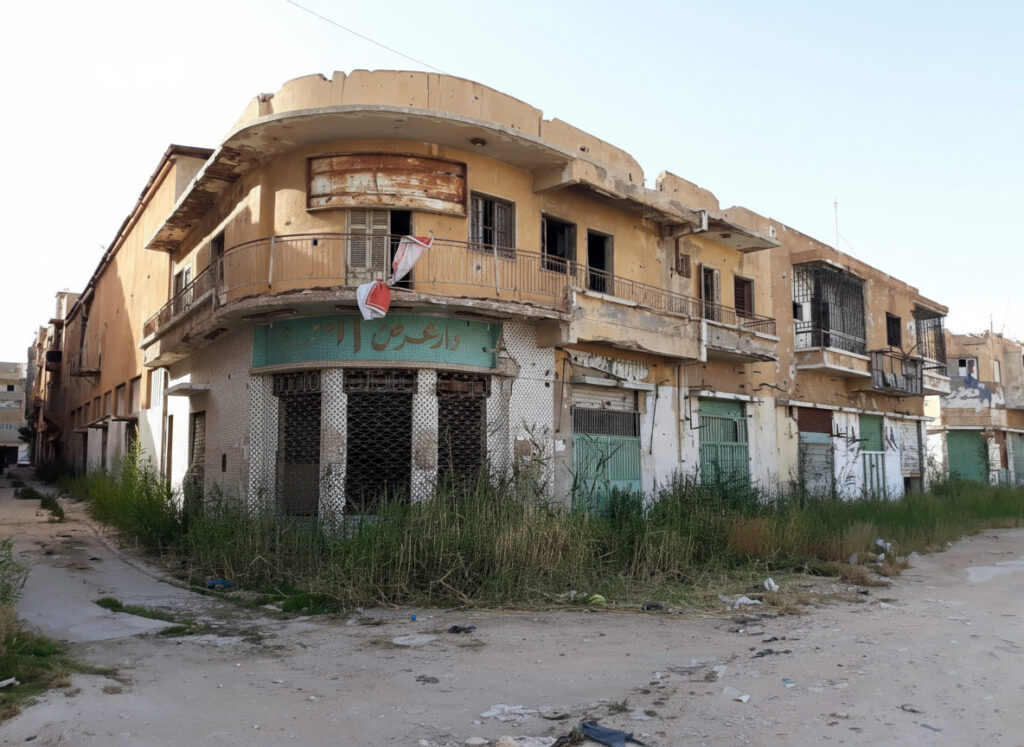
Al-Nasr Cinema building, which was one of the most important landmarks of the city of Benghazi
Sunusi Isteta
I remember watching an American film titled Hush… Hush Sweet Charlotte as a teenager in Dernah at the Shabab cinema. This film got stuck in my mind because of the two foreign girls, perhaps a little older than me, who sat in the same row and were overwhelmed with fear. Out of the corner of my eye, I saw them crying and sobbing. I later learned that no one under the age of eighteen was allowed to watch the movie. I realized that memory isn’t always reliable, as I had read about the film beforehand and it didn’t match the events in the movie. Perhaps I, too, was overwhelmed by the terrifying scenes, as the two girls sitting near me.
Aida Al-Kabti
Behind our house on Al-Andalus Street was Al-Ghazal Cinema, where our father used to take us every Thursday to watch a movie. We didn’t pay any attention to the movie; rather, the cartoons shown to us. As for the movie, we’d be bored to the point that we would fall asleep during the screening. My grandmother Halima (who was deaf) used to visit us and she loved cinema even though she could not hear, but the films inspired her days. She would ask us to tell my father to take us to the cinema and the hall was usually empty. We had a dog called Bella that would follow us around and enter the cinema for free without paying a ticket. The attendants at the gates would let her in, and she would enter walking victoriously.
Sakina Bin Amer
The first time I attended cinema was for the screening of The Message. I was in middle school at the time, and my uncle had reserved the entire balcony for us. Our family and relatives all went to watch the movie and since there weren’t any strangers among us we all felt at home. As soon as Hamza appeared with his majestic presence on screen, mothers cheered and aunts ululated, accompanied by our laughter and the rebuking voices of our uncles, telling us to be quiet!
Theatre name: Bernici Cinema, at the beginning of Omar Al-Mukhtar Street, downtown.
I don’t exactly remember the film’s releasing year, but I think it was between 1976 and 1978.
As for the best movie theater, girls weren’t allowed to go to movie theaters, so the movie theater was in our house in Al-Baraka. In the summer, my older brother would let us watch movies in our courtyard, with the scent of jasmine in the air, and my mother’s popcorn for snack.

Bernice Theater in Benghazi was established in 1928 and was demolished in 2023
Azza Al-Maqhour
I belong to a generation that never had access to the red velvet cinema seats in Tripoli. Generations before me had lived this experience, specifically my aunts, who used to tell stories about it.
But I experienced something beautiful and different… The cinema was in our house since we were very young. My father is an art lover that includes cinema, so we had a movie theater at home and a big screen. My father would open the screen to the wall, put the tape in, and we would hear a soft click, and then the movie would come on. We watched cartoons, Charlie Chaplin movies, and many more.
Because my father was a movie buff, he bought us a VCR early on, and we would enjoy watching the movies he brought back from his trips. We watched The Godfather, Steve McQueen’s Papillon, The Great Escape, and other films. He would sit up front and control the remote control to avoid any unfamiliar scenes.
After each film, there would be a short session where we would discuss the film, its scenes and the artistic value or the idea behind it.
We attended the Oscars with him late at night due to the time difference.
My father is to be credited for my love of cinema!
These are just a handful of the experiences I collected. I did not wish for the memories to end, for they clearly reveal one common fact: Cinema is not just entertainment. It is a memoire, a culture, and a part people’s hearts.
Sep 25, 2025
Writing about the early start of cinema in Libya isn’t an easy task. Sources are few, with varying dates and conflicting accounts. Sometimes it feels like chasing a thin thread in a maze of memory, but my passion for discovery and the adventure of research kept me going.
The Ottoman Empire and the Italian Invasion
Cinema arrived in Libya in the late years of the Second Ottoman Rule, just before the Italian invasion in 1911. Silent film screenings were held inside the Arch of Marcus Aurelius overlooking the sea, in a hall known as Tograph Bab Al-Bahr Cinema. Audiences included members of the Italian and Greek communities, Jewish merchants, and a small number of Libyans.
Smaller and remote towns never experienced cinema due to the absence of foreign communities, the focus of Libyans on resisting the Italian invasion, and difficult economic and social conditions.
Although Italy referred to Libya as its “Fourth Shore,” it emerged from World War II exhausted and unable to advance development in its colony. By the early 1930s, limited efforts were made to serve the Italian community, including urban expansion in Tripoli and Benghazi, construction of administrative buildings, schools, and shops, and the establishment of cinemas exclusively for settlers.
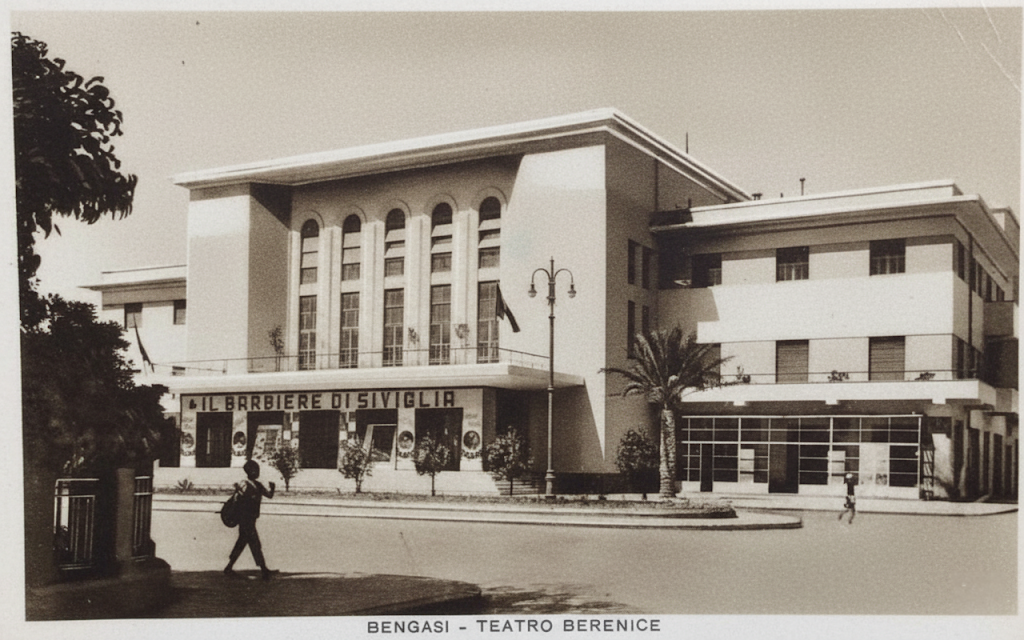
Bernice Theater in Benghazi was established in 1928 and was demolished in 2023
Press, Culture, and Early Cinematic Venues
At the beginning of the twentieth century, after the Young Turk Revolution of 1908, freedom of expression was allowed. Newspapers and bulletins appeared in the Governorate of Tripoli, revitalizing intellectual and cultural life to some extent until the Italian invasion ended the second Ottoman era (1831-1911). The final years of Ottoman rule were marked by an emphasis on culture and literature, including the establishment of the School of Islamic Arts and Crafts to enrich education and crafts.
The Libyan director Mohamed Al-Farjani, in his book The Story of the Libyan Arab Cavalry 1919-1990, states that the first movie theater in Tripoli dates back to the Second Ottoman Era. This theater, called “Cinematograph Bab Al-Bahr,” had its entrance through the famous Arch of Marcus Aurelius. Later, the Italians demolished it along with neighboring houses to prevent blocking the view of the historic Roman arch. With Italian colonization, cinema halls expanded in Tripoli and Benghazi.
Early shows included shadow plays and “illustrated newspapers,” eventually developing into main cinemas like Al-Rashid, Al-Ghazala, Royal, Al-Nasr, and Al-Qabi. Later, cinemas such as Al-Ghiryani in Tripoli and Old Khoms extended cinematic access beyond major cities. Other notable cinemas of the period included Miramare Theater, Al Hamra, and Berenice Theater in Benghazi.
From Popular Spectacle to Theater
Before the arrival of modern theatre, Libyans enjoyed traditional shadow theatre brought by the Ottomans in the mid-19th century, known as Karakoz. Over time, it became an integral part of festive celebrations, especially during Ramadan and religious holidays. Prominent performers included Hamza Mohamed Al-Wasiti in Tripoli and Salim Al-Makhlal and Bazama in Benghazi. This art form flourished until the early 1950s.
Researcher Abdul Salam Al-Madani, in his study From Theatrical Performances to Emergence of National Cinema, noted that early cinematic attempts were mostly amateur, influenced by Egyptian cinema, which dominated Libyan audiences with dramatic, historical, and religious themes.
He raised the question: why weren’t early pioneers able to contribute to developing Libyan cinema, even in small ways? One example is Fouad Al-Kabbazi, who worked in cinema while studying in Italy and designed the set for The Black Tent, starring Sophia Loren.
A group of young enthusiasts founded the “Libyan Arab Amateur Film Union” in 1968 and produced short 8mm documentary films. However, they faced obstacles such as the policies of the General Organization for Cavalry and a lack of funding.

A still from the film The Black Tent (1961), starring Sophia Loren.
The Beginnings of Cinematic Attempts
During his studies in Italy in the 1930s, Fouad Al-Kabbazi gained firsthand experience in film production. In the late 1940s, he collaborated with Italian directors on documentaries, including a film about the zawiyas in Libya.
Between 1963 and 1970, organized cinematic efforts emerged through the Ministry of Information’s film production department, producing documentaries and “illustrated newspapers.”
Feature Film
In the early 1970s, Libyan cinema expanded from documentaries to feature films. This phase tested the local cinema’s ability to produce long-form narratives, despite limited technical resources.
Al-Mughamar (1971), directed by Taher Omar, is one of the earliest narrative films in Libya, representing a serious attempt to develop feature-length storytelling. Further attempts in the 1970s and 1980s sought to establish Libyan cinema, though the industry never fully matured.
Nevertheless, these efforts uncovered young talent in directing, acting, and cinematography, highlighting the urgent need for cinematic institutions and infrastructure, which were still lacking.
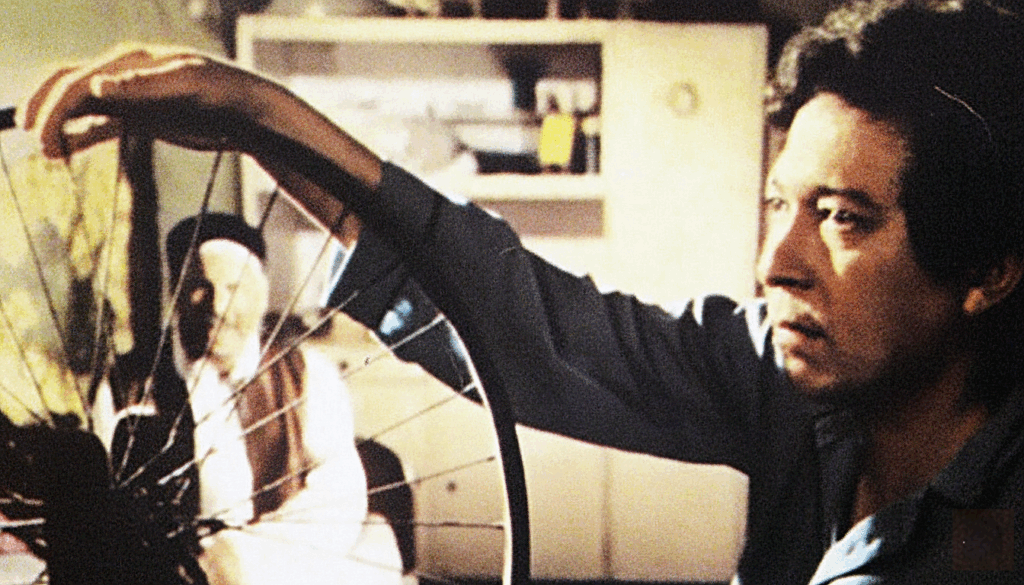
A still from the film The Green Light (1976), starring Taher Al-Qibaili
Local Beginnings of Film Production
After independence in the 1950s, the Ministry of Information established a department to document cultural, political, and social activities. In the 1960s, director Mohamed Al-Farjani, who studied cinema in Egypt, produced his first feature film in 1967, though it was never completed.
The Libyan Arab Film Production Company produced films like When Fate Is Cruel and The Road, addressing challenges such as connecting remote cities with paved roads to facilitate transportation.
According to Abdul Salam Al-Madani, the General Organization for Cavalry, starting in the 1970s, relied on foreign and Arab talent for directing and cinematography. Notable productions included The Ambassadors (Libyan-Tunisian-French), directed by Nasser Al-Qattari, which depicted migrant workers in France. Moroccan director Ali Al-Masbahi also contributed melodramatic musical films, including The Green Light and Where Do They Hide the Sun?.
Conclusion
The history of cinema and the arts in Libya highlights major challenges caused by colonial occupation, politics, and a weak cinematic infrastructure. Nevertheless, early experiences in theater, popular arts, and cinematic experiments laid a foundation for understanding the development of Libyan cultural and cinematic identity.
Sep 18, 2025
Introduction
Cinema isn’t just a means of entertainment; it reflects identity and provides a space that expresses the pulse of societies. In Libya, cinema has not been part of cultural life for years, almost a forgotten chapter in urban life.
Today, the question of cinema’s return goes beyond reopening closed theaters. It is a national issue tied to culture, stability, and building a different future for the coming generations.
A glimpse into the past
Cinema was customary in Libya since the beginning of the twentieth century; it prospered in the fifties and sixties. Cinemas in Tripoli and Benghazi were part of daily life. However, policies adopted in the 1970s, especially nationalization decisions, led to the closure of most cinemas and pushed this art out of the public space. Many theaters were converted into storage facilities or government offices. Meanwhile, an entire generation grew up without experiencing what it felt like to sit in a dark hall watching a movie on a big screen. After 2011, even though theaters were not formally closed, ongoing political and security chaos further hindered any serious attempts to revive cinema.
Challenges restraining the Return of Libyan Cinema
The path to bringing cinema back is crammed with obstacles: infrastructure is completely absent, with neither theaters nor production studios. Funding is also a dilemma, relying on individual initiatives with little institutional support or long-term investments. Political and security instability make investors hesitant to venture. On the audience side, generations have grown up with individual viewing experiences through digital platforms, losing the habit of communal cinema-going. Rebuilding this link is another challenge.
In addition, technical skills are limited, with a lack of specialized institutes to train directors, cameramen, scriptwriters, and technicians, who are the backbone of any film industry.

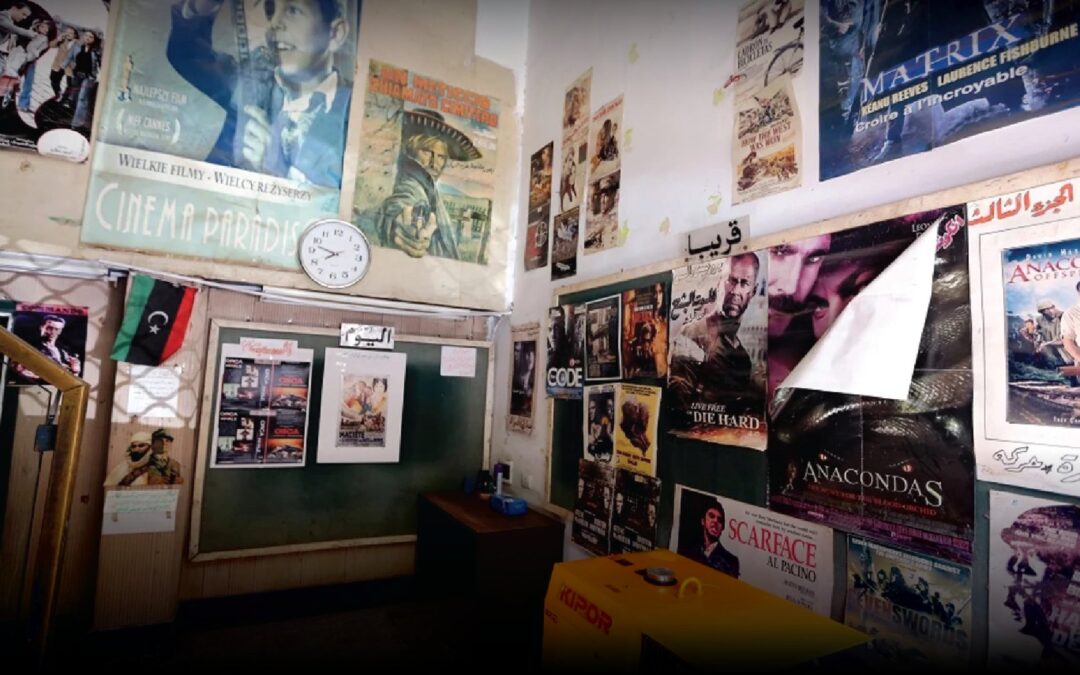
Omar Khayyam Cinema, Tripoli – 2006
The Way Forward: How Can Libyan Cinema Return?
Despite the bleak outlook, the revival of cinema is not impossible. It starts by recognizing that cinema is a national project requiring comprehensive support rather than individual initiatives. Libya could start by launching strong national film festivals—not just as screening platforms, but as bridges connecting creators and investors. Local and regional digital platforms can serve as transitional spaces while the necessary infrastructure is built. Investing in human resources is crucial, by establishing training institutes and exchanging expertise with successful Arab countries. Encouraging the private sector to establish modern movie theaters could be a practical start, especially if combined with economic support programs and incentives.
Glimpses of Inspiring Arab Experiences
Libya isn’t the only country facing a decline in cinema. Algeria also experienced a long hiatus, but leveraged its revolutionary history to produce films with universal human appeal. Morocco suffered periods of stagnation too, but invested in infrastructure and offered incentives, eventually becoming a top international filming destination. Jordan, despite its young cinema experience, attracted major productions like The Martian and Star Wars through supportive policies.
These examples show that cinema can recover even after decades of inactivity if vision, political will, and institutional support are present.

On location in Jordan, director Ridley Scott supervises actor Matt Damon’s performance in The Martian.
Photo credit: Aidan Monaghan
Cinema is part of a national project
In Libya, cinema should not be considered a luxury, but rather an aid in rebuilding society. A theater isn’t just a place for screenings; it is a civic space that restores trust among people. It is a cultural outlet opposing violence and division. Cinema is a tool for strengthening national identity; Libyan films can present a different image to the world, beyond the usual conflict-driven images.
Economically, the film industry can contribute to diversifying the national economy by opening job opportunities in technical and creative fields. Reviving cinema in this sense is not merely a cultural issue, but a pivotal national project as crucial as infrastructure and education projects.
Conclusion
Libyan cinema has been absent for decades, but its absence does not mean the end. What was closed in the 1970s can be reopened with a clear vision and strong will.
The challenges are clear, but the solutions are not far. With political will, community support, and investment in youth, the return of cinema can move from dream to reality.
When the screens are lit again across the country, it will not only be a cultural event, but also a declaration of the revival of art and culture in Libyan cities, demonstrating Libya’s determination to show that art is not a luxury, but a necessity for building a better, conscious future.
Writer:
Muhammad Ben Saoud
Sep 11, 2025
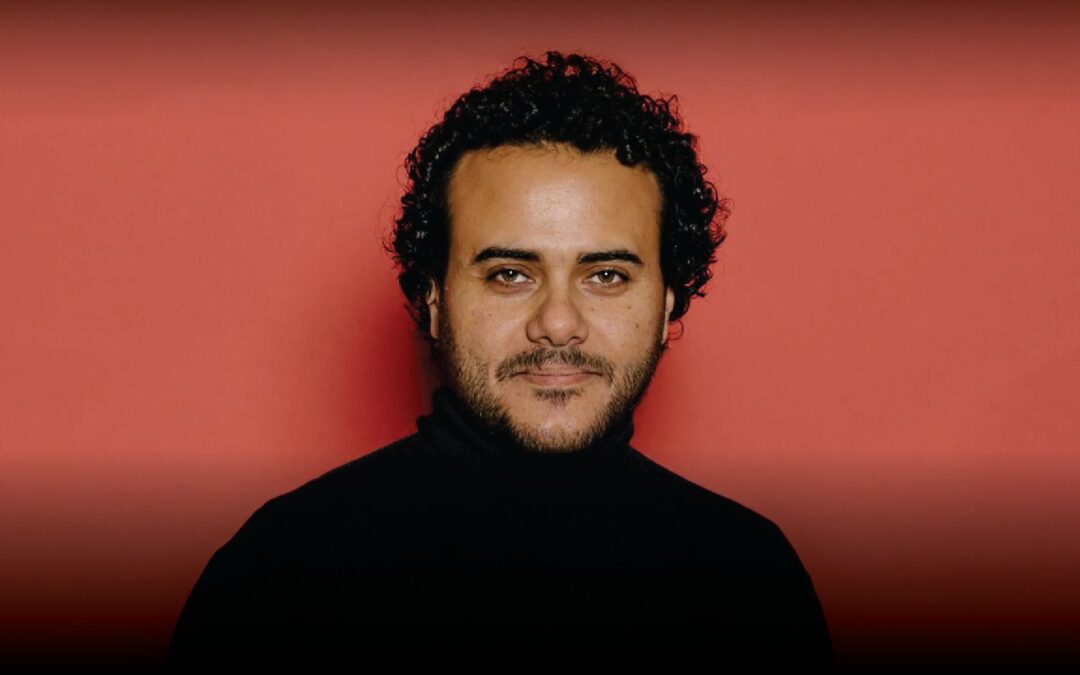
We met with the Libyan filmmaker Muhannad Lamin to discuss his films that have been screened at major festivals, such as the International Documentary Film Festival (IDFA) in Amsterdam, the Locarno Film Festival, and the Clermont-Ferrand International Short Film Festival, as well as Arab festivals including the Carthage Film Festival (JCC) and the Red Sea Film Festival.
The discussion grazed on several topics, including Muhannad Lamin’s first cinematic experience, the most prominent challenges facing Libyan filmmakers given the lack of funds and obtaining support grants from Arab and foreign funds including the importance of thorough preparation before applying for these grants.
The question is, do these grants impact the film’s concept or the director’s vision, especially since they are sponsored by foreign entities?
1- You’ve previously spoken about your experience producing a short film uploaded to Vimeo. Do you think you’d become a filmmaker without this experience?
“Before this experience, the idea of directing or pursuing a career in cinema never crossed my mind. I don’t think I would have become a director without it, the reason being the society and culture in Libya does not support film direction or the field of cinema.”
“This film motivated me to seek academic cinema training in Tripoli. I chose The Advanced Institute of Art Techniques – Tripoli, that’s when I started developing my skills in the world of cinematography and directing.”
“From 2011 to 2014, Libya witnessed growth in the field of cinema, with activities and workshops led by specialists from various countries. Attending these workshops polished my cinematic concepts and deepened my understanding of creative directing techniques. I worked to produce awareness films that provided practical experience in filming and production, thus, marking the real beginning of my cinematic career.”
2- The experience that was the first spark which pushed you into the world of cinema. Can you tell us more about your subsequent work?
“I still consider myself at the beginning of my career. I remember my first project; I entered into a competition held by the Tropfest Festival in 2012, a short film festival with strict conditions for production and participation. It was a simple experience, but it strongly motivated me to continue and helped build confidence in my abilities.”
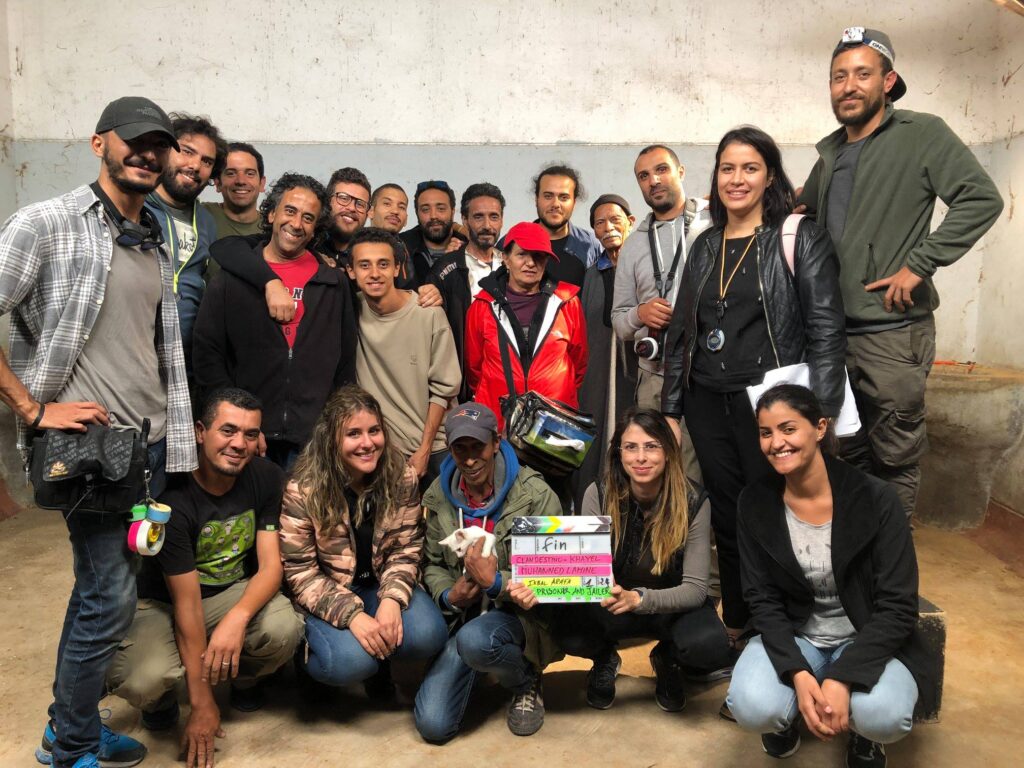
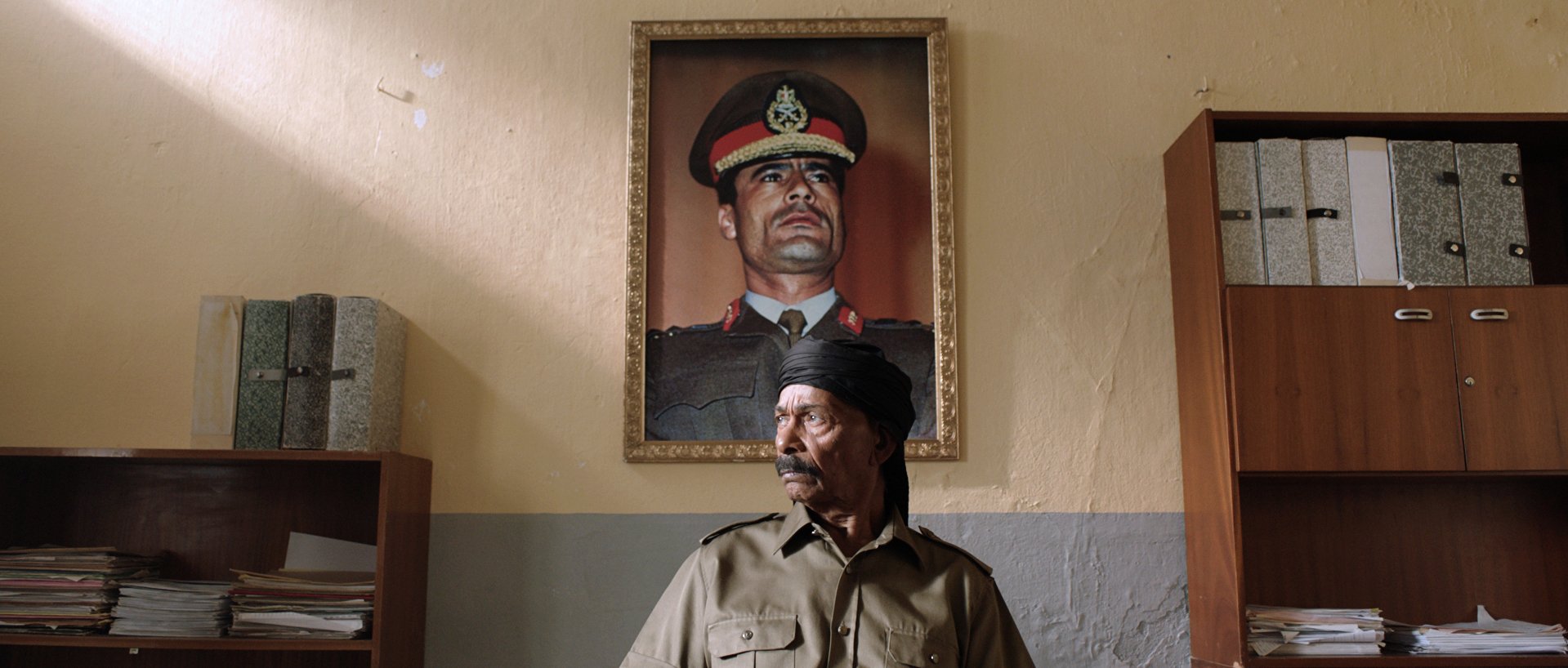
“In 2018, I completed my first short narrative film, “The Prisoner and the Jailer,” which tells the story of two opposing Libyan figures: one a senior official in the former regime, and the other a prominent figure in the post-revolution period.”
“Then, in 2021, I completed my feature documentary Donga, which tells the story of a fighter amidst the conflict in Libya who chose the camera as his weapon. Growing up under a dictatorial regime that glorified Gaddafi, the film Donga captured everything, covering war and daily life for nearly ten years. Currently, I’m working on a new feature film inspired by the novel The Bleeding of the Stone by the renowned Libyan writer Ibrahim Al-Koni.”
3- Has the war influenced your choice of films?
“My root interest in cinema initiated prior to the war, but Libya’s situation has been unstable ever since, which is why the films are on war-related themes. It’s inevitable for war to be one of the themes that are addressed by Libyan cinema.”
4- Your films always relate to political and real-life issues from Libyan society. How can cinema be a tool for human rights advocacy or social issues?
“Films can be a tool that encourages viewers to discuss various topics and ideas related to humanitarian, cultural, and social issues, in an objective and intellectual manner.”
“For example, in The Prisoner and the jailer, the two main characters are contradictory, each with a different ideology. As a director, I did not pick sides or choose who was right; I tried to let each character present their perspective, leaving the decision up to the viewers.”
“In my opinion, a film that becomes an ideological discourse loses its artistic value. The director must respect the viewer’s intelligence and not impose a specific perspective.”
5- Libya’s film infrastructure is fragile and has almost no theatres. How can films still aid to raise and discuss issues?
“This indeed is a relevant yet a complicated question, working in the film industry in a country without a single cinema hall is odd. How can you reach audiences and get them to watch films?”
“In my opinion, the only way to reach an audience inside and outside the country is by telling the stories of Libyans, Libya, narratives inspired by Libyan folklore and literature. The only way to do so is through online platforms.”
“We also need cinemas, film production facilities, and festivals. This requires work space, strong state governance, and active civil society institutions. For example, Saudi Arabia became a country producing cinema both domestically and internationally in less than a year, which confirms that political will is the key to creating a cinematic culture in Libya.”
“The state isn’t the only one to be held responsible for the field’s deficit. Businessmen too, play a vital role in supporting culture and cinema, especially when authorities (politics) fail to provide support. Early 20th-century, Egypt is a clear example: investors and businessmen played a pivotal role in establishing cinemas and building an integrated film industry, turning Egypt into a hub of Arab cinema. Unfortunately, Libyan businessmen have shown no real interest in culture or cinema support, except for limited individual attempts that do not meet the real needs.”
6- What are the most prominent challenges you face as a filmmaker in Libya?
“Working in Libya is not easy; filmmakers face several challenges, such as production and support aspects that aid in bringing ideas to life in an artistic manner in order to reach audiences creatively. The biggest challenge today is not funding but the difficulty of filming within Libya due to security conditions and almost absent infrastructure. Local fundings are non- existent, as there isn’t a national cinema fund. Ironically, the Ministry of Culture, despite its large number of employees, produces little to nothing, so the only options that remain are outside of Libya, through development programs, support funds, and film festivals. This requires filmmakers and producers to search seriously, understand exactly what they need, and build relationships with funding bodies through direct communication, asking questions, and careful preparation.”
“Despite these difficulties, they remain necessary challenges on the path to achieving our dreams and making films that reflect real human issues and resemble us Libyans, to present a truer image of our society.”
7- How were you able to secure funding for your films, especially since many filmmakers consider obtaining grants nearly impossible?
“Applying for these grants requires work and producers that we lack. It requires effort and time, and our situation isn’t as flexible as in other countries that have their own funds to help filmmakers apply for these grants.”
“I believe that participating in Arab and international festivals allowed me to meet producers, expand my network, and work based on the advice of experts. I recall meeting a producer in 2013 at a foreign festival. He asked if there were any producers in my country. I answered no, and he advised me to open a production company and produce my own films, since I wouldn’t find anyone to produce my films—he added. “you are not in Hollywood.'”

8- Based on your experience in funding, what advice do you have for the new generation seeking support for their projects?
“Firstly, you have to learn to apply for these grants on your own. Many Libyan filmmakers find the application process complicated and time-consuming. The process requires time and patience. In simple words, if you don’t put in the effort, you won’t make a film.”
“Applying for these grants isn’t that hard, especially for Arab grants, which don’t require a second language and offer easy and simple communication methods. The main criterion is the film’s idea, not the script or the resources. You have to explain the idea while applying for the grant. The second most important aspect is your motivation behind making the film, which requires a two page explanation of your reason behind choosing a film.”
9- Do grants influence a film’s idea or the director’s vision, especially if they come from specific foreign entities?
“Regarding Arab grants, such as AFAC and Culture Resource and based on my personal experience, none of them interfered with the film’s concept nor the direction or its presentation. Primarily, if the evaluation committee selects the film, they will provide support. If not, it will be rejected.”
“These funds support a vast number of films; therefore, they aren’t interested in intervening in every project. On the contrary, they aspire to ensure the success of each film. We must keep in mind that these institutions are independent of the state. Generally, foreign entities are also included in deciding on either selecting or rejecting a film. They then refrain from interfering in its content, leaving complete freedom to the director.”