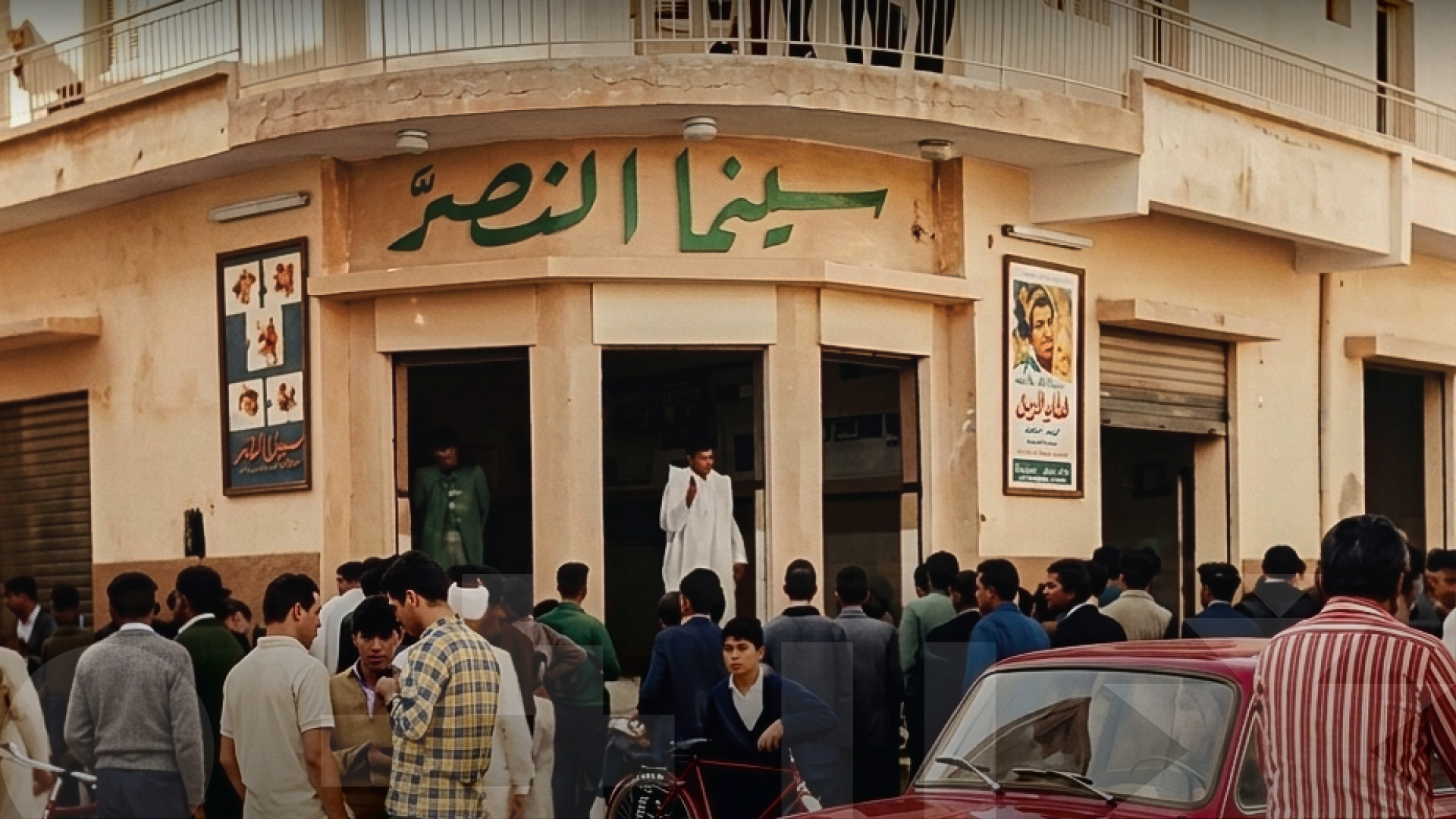
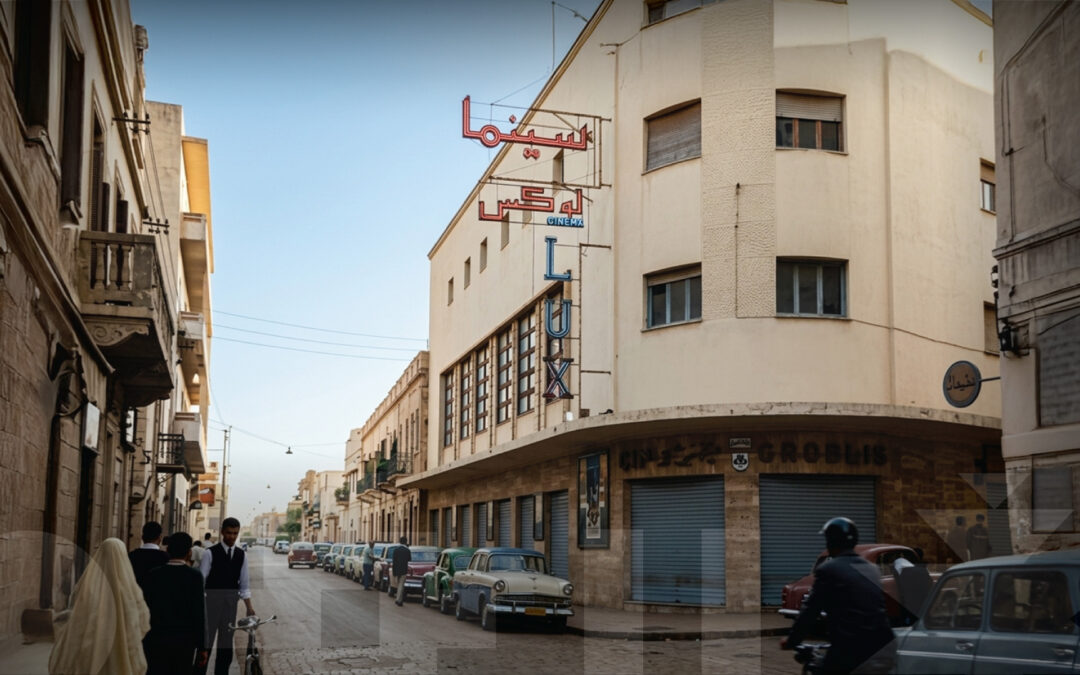
In Tripoli, memory does not need maps to find its way back to places that have vanished. On Al-Wadi Street, Cinema Lux once stood as one of the most prominent landmarks of the city’s daily life during the 1960s. It was more than just a hall for screening films; it was a social and cultural space where stories met and different eras intersected. Today, nothing remains of this venue except faint traces in the minds of its former patrons. The building has been converted into commercial shops and has disappeared from the urban landscape, taking with it the details of a cinematic experience that witnessed the life of an entire generation.
This loss occurred within a broader context in which Libyan cities like Tripoli and Benghazi saw a wide spread of cinemas, including Al-Waddan, Catania, Rivoli, Gabi, Berenice, Al-Hurriya, and Al-Nasr. Following the political shifts after 1969, particularly in the 1970s, cinema entered a period of decline. At that time, it was viewed as a tool for “cultural invasion,” which led to the closure of most theaters or the changing of their activities. Despite scattered attempts to revive the sector, Libya still lacks modern and active cinemas. Many old halls have turned into abandoned buildings or were demolished, losing their cultural purpose.
As time changed, Cinema Lux was no longer just a screening hall; it became a part of Tripoli’s urban and cultural memory. The disappearance of such cinemas was not an isolated event but part of a wider transformation in the city. Exhibition halls declined in favor of commercial projects. However, what remains is the memory of buying a ticket, walking down the aisle to the hall, the numbered seats, and the long discussions after the credits rolled.
The Sound of Music
Cinema Lux was located on Amr Ibn Al-Aas Street along the Al-Wadi road. In its early days, it was primarily dedicated to foreigners, especially Italians, during the Italian presence in Libya. Historical sources indicate that most pre-World War II theaters were built by Italian investors. The construction of Cinema Lux is attributed to the Italian architect Antonio Cichirico. The era of Italian colonization and the years following it were famous for Italian architects and engineers who designed many landmarks in Tripoli, such as Cinema Waddan, Rivoli, and Catania.
Cinema Lux was known for being both a screening house and a theater. it was one of the finest winter cinemas in the city, distinguished by its cleanliness and the buffet services it provided to guests. It was famous for showing major American films, such as The Great Escape and The Sound of Music. Owned and founded by Haj Suleiman Mustafa Al-Zunni, Cinema Lux rivaled and was often compared to the major cinemas in Cairo and Beirut. It screened the latest American films just a month after their release in the United States.
Visual entertainment
In Libya, cinema was not just a screen; it was part of the city’s daily rhythm. Along its streets, theaters acted as large windows open to the world. Cinema Lux held a special place in the hearts of its visitors. Evenings were measured by the number of shows, and stories were formed in the shadows as people walked past the glowing posters on the facade.
Cinema Lux was not very different from other theaters of its time, but like them, it gave the city moments of Visual entertainment. it opened doors to distant worlds, from Cairo to Rome and from Mumbai to Hollywood. As those theaters declined and their lights gradually went out, Lux remained a witness to an era when cinema was a part of life, not just a story to be told.
Mustafa Al-Ghamari, one of the theater’s regulars, recalls that Cinema Lux was known for its relative quiet. A balcony ticket was sold for a quarter of a dinar. Before the main feature, a short cartoon was shown, usually featuring beloved characters like Mickey Mouse. This tradition was not just a prologue; it was part of a complete entertainment experience, especially for families and children.
He adds that Cinema Lux was ranked second only to Cinema Waddan. it consisted of two halls, one on the ground floor and another on the upper floor. It was considered one of the most prestigious cinemas in Tripoli, featuring numbered seats and a formal dress code among many patrons. The Golden Eagle Hotel stood across from it. At the beginning of the street was the Al-Hamra cinema, and before that was Mario’s Italian grocery, which sold olives and cheeses. During the intermission, one could buy light snacks from Haj Mukhtar’s buffet, such as cold Pepsi for five piasters, almond chocolate for five piasters, or a small cone of pistachios for five piasters.
The story of Cinema Lux meets the stories of other theaters that disappeared without a trace. No archive preserves their details, and no records document what passed across their screens. It is as if these halls, which were once the beating heart of the city, quietly withdrew from history, leaving behind a void in the narrative. They left hanging questions about a time when the light from the screen was a part of people’s lives, not just a distant memory.
The Absence of Documentation
The disappearance of cinemas in Tripoli was not merely a decline in entertainment; it was the disappearance of an entire unwritten memory. Over time, theaters that were once full of life were closed. They left behind nothing but happy scenes in the minds of their patrons. There are no precise dates for their founding, no records preserving the names of the films shown, and not even enough photos to document their presence in the fabric of the city.
In the absence of an archive, oral stories become the only alternative. These are scattered accounts of crowded evenings, laughter in the dark, and faces that discovered the world through a white screen. However, this memory is threatened by fading, just as the buildings themselves faded or changed their functions.
Thus, it is not just the theaters that vanish, but a part of the city’s cultural history. This creates a vacuum that can only be filled by nostalgia and questions about those places and what they meant to people. The presence of a place is not measured only by what remains physically, but by what is preserved in documents and memory. Many cultural landmarks, including cinemas, now seem as if they passed through time without leaving a written trace.
This gap is not unique to Cinema Lux. It reveals a wider flaw in cultural archiving in Libya. Documentation is either weak or marginalized due to the lack of specialized institutions or political shifts that rearranged priorities at the expense of cultural memory. Oral memory remains almost the only source for reclaiming that era. This memory is fragile because it is linked to individuals rather than institutions. This creates a paradox: a vast cinematic experience across many Libyan cities is met with very little documentary material.
The absence of an archive does not just mean losing information; it means losing the context needed to understand social and cultural changes. Cinema Lux was more than a screening hall; it was a space for debate and a sign of the city’s openness to the world. When its documents are lost, a part of the city’s own story is lost with them. There is an urgent need today to reclaim this archive by collecting testimonies, searching for scattered photos, and documenting what remains of the memory of these places. Between what was and what was never written, Cinema Lux stands as a silent example of a memory that was never given a chance to survive.
Kholoud Elfallah