May 22, 2026
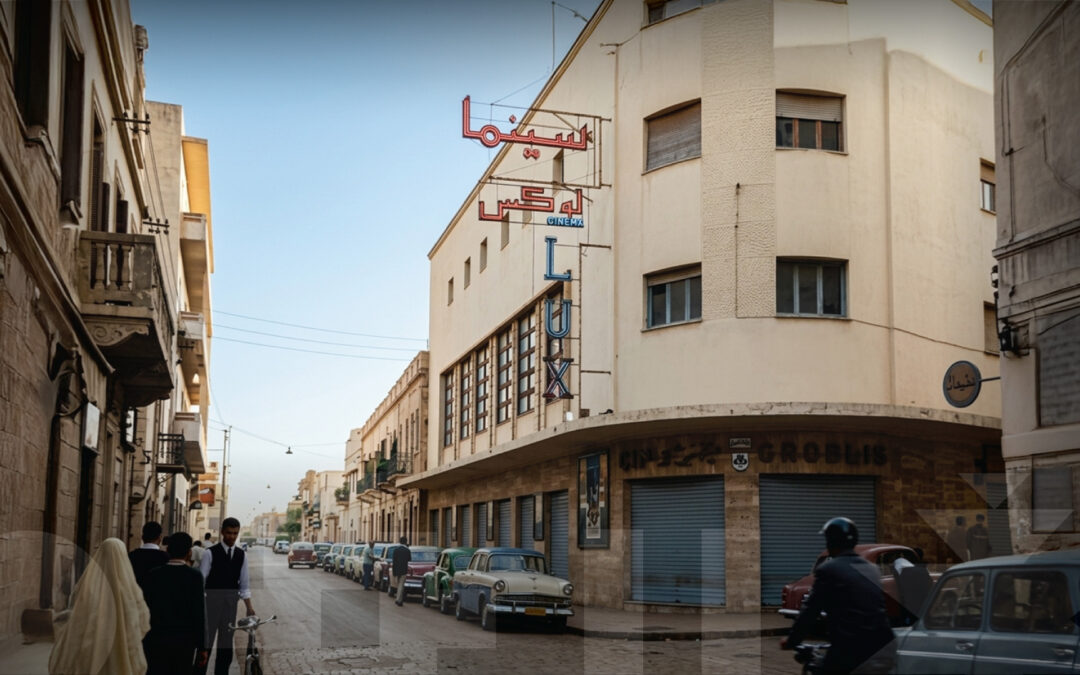
In Tripoli, memory does not need maps to find its way back to places that have vanished. On Al-Wadi Street, Cinema Lux once stood as one of the most prominent landmarks of the city’s daily life during the 1960s. It was more than just a hall for screening films; it was a social and cultural space where stories met and different eras intersected. Today, nothing remains of this venue except faint traces in the minds of its former patrons. The building has been converted into commercial shops and has disappeared from the urban landscape, taking with it the details of a cinematic experience that witnessed the life of an entire generation.
This loss occurred within a broader context in which Libyan cities like Tripoli and Benghazi saw a wide spread of cinemas, including Al-Waddan, Catania, Rivoli, Gabi, Berenice, Al-Hurriya, and Al-Nasr. Following the political shifts after 1969, particularly in the 1970s, cinema entered a period of decline. At that time, it was viewed as a tool for “cultural invasion,” which led to the closure of most theaters or the changing of their activities. Despite scattered attempts to revive the sector, Libya still lacks modern and active cinemas. Many old halls have turned into abandoned buildings or were demolished, losing their cultural purpose.
As time changed, Cinema Lux was no longer just a screening hall; it became a part of Tripoli’s urban and cultural memory. The disappearance of such cinemas was not an isolated event but part of a wider transformation in the city. Exhibition halls declined in favor of commercial projects. However, what remains is the memory of buying a ticket, walking down the aisle to the hall, the numbered seats, and the long discussions after the credits rolled.
The Sound of Music
Cinema Lux was located on Amr Ibn Al-Aas Street along the Al-Wadi road. In its early days, it was primarily dedicated to foreigners, especially Italians, during the Italian presence in Libya. Historical sources indicate that most pre-World War II theaters were built by Italian investors. The construction of Cinema Lux is attributed to the Italian architect Antonio Cichirico. The era of Italian colonization and the years following it were famous for Italian architects and engineers who designed many landmarks in Tripoli, such as Cinema Waddan, Rivoli, and Catania.
Cinema Lux was known for being both a screening house and a theater. it was one of the finest winter cinemas in the city, distinguished by its cleanliness and the buffet services it provided to guests. It was famous for showing major American films, such as The Great Escape and The Sound of Music. Owned and founded by Haj Suleiman Mustafa Al-Zunni, Cinema Lux rivaled and was often compared to the major cinemas in Cairo and Beirut. It screened the latest American films just a month after their release in the United States.
Visual entertainment
In Libya, cinema was not just a screen; it was part of the city’s daily rhythm. Along its streets, theaters acted as large windows open to the world. Cinema Lux held a special place in the hearts of its visitors. Evenings were measured by the number of shows, and stories were formed in the shadows as people walked past the glowing posters on the facade.
Cinema Lux was not very different from other theaters of its time, but like them, it gave the city moments of Visual entertainment. it opened doors to distant worlds, from Cairo to Rome and from Mumbai to Hollywood. As those theaters declined and their lights gradually went out, Lux remained a witness to an era when cinema was a part of life, not just a story to be told.
Mustafa Al-Ghamari, one of the theater’s regulars, recalls that Cinema Lux was known for its relative quiet. A balcony ticket was sold for a quarter of a dinar. Before the main feature, a short cartoon was shown, usually featuring beloved characters like Mickey Mouse. This tradition was not just a prologue; it was part of a complete entertainment experience, especially for families and children.
He adds that Cinema Lux was ranked second only to Cinema Waddan. it consisted of two halls, one on the ground floor and another on the upper floor. It was considered one of the most prestigious cinemas in Tripoli, featuring numbered seats and a formal dress code among many patrons. The Golden Eagle Hotel stood across from it. At the beginning of the street was the Al-Hamra cinema, and before that was Mario’s Italian grocery, which sold olives and cheeses. During the intermission, one could buy light snacks from Haj Mukhtar’s buffet, such as cold Pepsi for five piasters, almond chocolate for five piasters, or a small cone of pistachios for five piasters.
The story of Cinema Lux meets the stories of other theaters that disappeared without a trace. No archive preserves their details, and no records document what passed across their screens. It is as if these halls, which were once the beating heart of the city, quietly withdrew from history, leaving behind a void in the narrative. They left hanging questions about a time when the light from the screen was a part of people’s lives, not just a distant memory.
The Absence of Documentation
The disappearance of cinemas in Tripoli was not merely a decline in entertainment; it was the disappearance of an entire unwritten memory. Over time, theaters that were once full of life were closed. They left behind nothing but happy scenes in the minds of their patrons. There are no precise dates for their founding, no records preserving the names of the films shown, and not even enough photos to document their presence in the fabric of the city.
In the absence of an archive, oral stories become the only alternative. These are scattered accounts of crowded evenings, laughter in the dark, and faces that discovered the world through a white screen. However, this memory is threatened by fading, just as the buildings themselves faded or changed their functions.
Thus, it is not just the theaters that vanish, but a part of the city’s cultural history. This creates a vacuum that can only be filled by nostalgia and questions about those places and what they meant to people. The presence of a place is not measured only by what remains physically, but by what is preserved in documents and memory. Many cultural landmarks, including cinemas, now seem as if they passed through time without leaving a written trace.
This gap is not unique to Cinema Lux. It reveals a wider flaw in cultural archiving in Libya. Documentation is either weak or marginalized due to the lack of specialized institutions or political shifts that rearranged priorities at the expense of cultural memory. Oral memory remains almost the only source for reclaiming that era. This memory is fragile because it is linked to individuals rather than institutions. This creates a paradox: a vast cinematic experience across many Libyan cities is met with very little documentary material.
The absence of an archive does not just mean losing information; it means losing the context needed to understand social and cultural changes. Cinema Lux was more than a screening hall; it was a space for debate and a sign of the city’s openness to the world. When its documents are lost, a part of the city’s own story is lost with them. There is an urgent need today to reclaim this archive by collecting testimonies, searching for scattered photos, and documenting what remains of the memory of these places. Between what was and what was never written, Cinema Lux stands as a silent example of a memory that was never given a chance to survive.
May 14, 2026
For long decades, Libyan cinema has stood bound at the edge of memory. It has remained stagnant between an incomplete message and a canvas waiting behind towering obstacles. While the rest of the world was building palaces for film, the Libyan cinematic infrastructure was severely decaying within walls of neglect, further impacted by the tolls of time and politics. At the height of this collapse, a beam emerged from the world of zeros and ones to declare that cinema is not an entity held hostage by rigid forms. Instead, it is an imagination carrying endless stories, clinging to digital cinema as a lifebelt. Through this medium, the Libyan creator crosses from the shore of absence to the shore of presence.
Once, movie theaters in Libya were beacons that lit up the nights of cities. During the twentieth century, residents of the capital, Tripoli, frequented many halls, most notably the Odeon Cinema. This venue hosted major celebrations documented in the Tarabulus al-Gharb newspaper and several books, such as those by the writer Ahmed al-Fitouri in Libya I Saw, Libya I See. As one of the writers most dedicated to the city’s memory, al-Fitouri described the Odeon as the lung through which Tripoli breathed. He spoke of it as part of a civil school, noting that film at that time was equal in importance to books and newspapers. In the charming hall of the Odeon, the viewer did not just consume a movie; they added exceptional modern values to themselves.
Al-Fitouri also wrote about the Al-Nasr Cinema, also known as the Apollo Cinema. This was one of the pillars of cinematic memory in Tripoli until it was destroyed by a massive fire in the late eighties. Many writers, including al-Fitouri, considered this event the symbolic death of Libya’s golden age of cinema.
On the other hand, Libya was once open to international film productions. The unique landscapes and ancient cities attracted the cameras of world-renowned directors. A prime example is The Message (1976), directed by the Syrian-American Moustapha Akkad. Although filming began in Morocco, the largest and most significant parts of the film, in both its Arabic and English versions, were completed in Libya. The vast Libyan desert was used to film major battle scenes. Similarly, Lion of the Desert (1981) had most of its scenes shot between Benghazi, the Green Mountain, and the desert. This film was an investment in the geography of memory, treating the land as a global stage.
As the physical foundations of the industry cracked, the Libyan director found themselves facing a dead end. Cut off from support and stuck in a massive production gap, the “developing” process that once gave a physical body to imagination died out. Local production pulses stopped behind walls of silence, consumed by war and commercial interests. From this starting point, digitalization became more than just a technical choice. It evolved into an act of resistance and a rescue mission for Libyan digital cinema. It broke the monopoly held by elites and money, turning the camera from a technical monster requiring state budgets into a flexible tool in the hands of the ambitious.
While support remains locked behind walls of thick bureaucracy and the institutional system fails to embrace artistic visions, a creator in the heart of Ghat or the old alleys of Tripoli can now succeed. Using a professional digital camera or even a smartphone, they can film a brilliant movie that competes in major international festivals. They can bypass the hurdle of distribution. In the absence of traditional theaters, digital platforms and social media have provided a free, global box office for the Libyan artist. They can now cross narrow geographical borders and find their way into the hearts of a global audience united by digital screens in a single universal space.
On a parallel level, there is no longer a vital need for massive studios. Editing is done on a laptop, and color correction is accessible through smart software, compensating for the severe lack of film laboratories. By moving past the ancient restrictions that long shackled production paths, the digital space has given the Libyan creator a free outlet away from official guardianship. Relying on features such as CGI and digital visual effects, Libyan directors now have increased opportunities to rebuild cities destroyed by wars and to travel deep into forgotten Libyan history.
Digital cinema is a real opportunity to rewrite the Libyan visual identity. This is especially true because the Libyan people possess a vast treasury of stories, from the Tuareg legends in the south to the tales of sailors in the north. All a director needs is this digital medium to transmit these great secrets and stories to the world. Cinema, in all its various dimensions, is not only what we see with our eyes but what we imagine behind our eyelids. Digital technology is the tool that turns this imagination into a tangible reality.
On the other side, we cannot be overly optimistic without acknowledging the existing obstacles. While digital cinema provides equipment, it does not provide cinematic thought or the wisdom to handle modern developments. It is necessary to educate the youth on various digital editing techniques and modern sound engineering. Furthermore, protecting intellectual property rights in cyberspace is essential to ensure that production remains sustainable.
In truth, cinema in Libya is not a luxury. It is an existential necessity required for the stage of repairing collective memory and the social fabric. Despite the bitterness of lacking infrastructure, this situation provides the advantage of starting from where others ended. Today, Libyan cinema does not necessarily need the construction of classic theaters with thousands of seats. Instead, it can innovate through mobile cinemas and open screening spaces via digital platforms that settle right in the heart of the viewer’s home.
In conclusion, the greatness of cinema in Libya was never a hostage to velvet seats. It is the daughter of an unconquerable spirit and a passion that masters the lens. Today, while traditional infrastructure is absent, digital cinema opens endless doors for minds that know no boundaries and for places mentioned once again so they may remain vibrant and continue writing their history with ink made of light.
May 7, 2026
Once, my brother and I had a long discussion about the rejection of technological progress. He noted how some people view it as a direct cause of moral decay, a waste of time, and the corruption of younger generations. Some even try to prove their superiority by boasting about their ability to live without social media. This perspective intrigued me because technology, at its core, is nothing more than a tool. Tools should not be condemned in themselves; instead, they should be evaluated based on how humans use them. Reducing the problems of an entire generation to the existence of technology is a flawed simplification that ignores the deeper root of the crisis: how do we use these tools, and what values guide that use?
Talking about social media or technical advancement as the direct cause of a generation’s distraction is an incomplete argument because it addresses the result rather than analyzing the mechanism. How can one address the problems of an era by rejecting its tools? It is like trying to understand the world without knowing its language.
This same logic applies to society’s stance on cinema. The problem was never cinema as an art form. Instead, the issue was the social image associated with it in certain societies, like Libya. During specific periods, cinema halls were linked to behaviors or environments that were unacceptable to certain segments of society. Consequently, this rejection was generalized to include the medium itself: the traditional form of cinema consisting of a hall, seats, a screen, and a ticket booth.
This reveals what could be called a cultural stigma. It is a total judgment passed on a tool because of a specific, partial context. No distinction was made between the content being shown and the venue itself, nor between the artistic experience and any external practices surrounding it.
This confusion is not just a social misunderstanding but a silent confiscation of a cultural right guaranteed by Article 27 of the Universal Declaration of Human Rights. The danger is that this deprivation was not imposed by a decree that could be protested; instead, it crept in through a silent cultural stigma that made the absence of cinema feel like a normal state of affairs.
Over time, this separation deepened. When screening halls disappear for a long period, their absence is no longer questioned as a loss. It becomes the status quo. A whole generation has grown up without ever entering a cinema hall or experiencing that collective viewing that forms a part of cultural consciousness in other societies.
This generation does not necessarily reject cinema, but they simply do not see it as a daily option or an important part of life worth fighting to restore. In this case, absence does not produce a stance; it produces a vacuum.
The striking paradox is that this physical absence coexists with a massive consumption of films online. People are watching, following, and being influenced by movies. They are even forming their own cinematic tastes, but they do so outside the traditional framework of cinema. This clearly reveals that the problem was never about accepting the art itself, but rather the way it was presented.
Cinema did not disappear from people’s lives entirely; it only changed its medium. This is precisely where cinema through platforms and open spaces emerges, not just as a temporary alternative but as a qualitative shift that redefines the relationship between the filmmaker and the audience.
In my opinion, even if this shift seems sad because it signifies the disappearance of a unique and essential experience in people’s lives, the liberation of cinema from being a hostage to dark halls and massive screens has made it a flexible experience. It is now personal and collective at the same time, accessible from anywhere.
When I imagined this transformation, I decided to research its potential effects on the reality of filmmaking in Libya. I discovered that cinema through platforms and open spaces does not just compensate for the absence of screening halls; it solves the problem at its roots. The crisis in Libya was not so much the absence of cinema as a physical place as it was the absence of the experience itself. By closing cinemas for so many years, we did not just lose a venue; we lost the audience’s relationship with film, the accumulation of expertise, and the continuity of production.
For a Libyan filmmaker, this shift means they no longer need to revive an old model that no longer exists in Libya, nor do they have to fight an entire system that views cinema only as a threat to its cohesion. Instead, they can start from an entirely new point. Rather than waiting for the return of screening halls to make a full film under traditional conditions, they can work within a flexible, open environment that allows them to reshape their experience gradually. In this way, life returns to cinema even in the absence of its traditional institutions.
Filmmakers can begin with what is already available rather than waiting for the ideal. They can view a smartphone or a simple camera as a true starting point rather than an obstacle. Furthermore, non-traditional spaces like social media are no longer just a means of display; they have become platforms for testing, building an audience, and forming an artistic identity for those who dare to use them with awareness and consistency.
This transformation does not only offer the Libyan filmmaker practical solutions. It can also reshape their creative thinking from the ground up. More importantly, it instills a mindset of continuity and the drive to create beginnings rather than waiting for perfect conditions. The filmmaker moves from being a mere recipient of an opportunity to the creator of one. In the absence of a clear institutional cinematic archive, this environment allows for the gradual accumulation of a Libyan visual memory created from the details of daily life. This strengthens the presence of local stories that were once marginalized. At that point, local specificity can turn from a point of weakness into a source of true distinction.
Consequently, a lack of support does not become a reason to stop; it becomes a motive to redefine the meaning of production itself. A film can be born, develop, and spread without waiting for official recognition or a large budget.
Ultimately, it is clear that the problem was never technology or cinema, but the way we dealt with them. Crises are not solved through absolute rejection, fear of experience, or waiting for the perfect start; such actions only delay understanding. Conscious adaptation is what opens the door to repurposing tools in our favor to achieve what we have always sought.
Between a cinema whose halls have disappeared and whose seats people have forgotten, and a cinema born on small screens in a different environment, there stands an important moment. It gives us a chance to rethink not what we reject, but how we use what we have.

Apr 30, 2026
In the dusk of darkened halls, as a beam of light slips from the heart of the projector to strike the white screen, worlds of shifting echoes are born. Destinies are forged that the viewer never anticipated. We see these stories sometimes transcending imagination and at other times mirroring reality, intersecting with various life issues. Every scene adds a new painting to the recipient’s mind, preserved in their cognitive perception. Often, we find cinema connecting the fragments of the human soul with the diverse issues of its society.
In our time, films are no longer merely an entertainment industry or a way to pass time on weekends. Instead, they have evolved into an exceptional intellectual planet, serving as an educational tool capable of penetrating minds and hearts simultaneously. Modern films have emerged from the light of the first cinema, manifesting the spirit of the Seventh Art with touches capable of transforming dry phenomena and silent data into a tangible pulse and deep emotion. This makes them the most powerful tool in the hands of civil society to reshape collective consciousness.
The human mind, by its nature inclined toward simulation and empathy, responds to images and drama in a way it does not respond to direct moral preaching. The secret lies in identification. Often, we see in these films versions of ourselves or versions of who we wish to be. Cinema grants us the opportunity to cry when we are unable to speak and a chance for heroism when we are shackled by fear. A film does not speak to you about poverty rates as cold statistical figures. Instead, it makes you live the moans of hunger, the heartbreak of a father unable to earn a single penny at the end of his day to feed his children, or the struggle of a mother whose soft features have been worn away by a day of grueling labor. Here, the viewer is transformed from an ordinary recipient into an emotional participant, and the image etches an eternal mark within the folds of their awareness.
Consequently, the power of cinematic simulation surpasses that of other arts and expressive tools, especially in realistic films that resemble our daily stories. When we watch a reality like our own, or see the suffering of a marginalized group, the film breaks the wall of the Other. It creates a state of identification that makes the cause personal, pulling us from the role of the neutral spectator and placing us at the heart of the event. This emotional involvement is what transforms cinema from a tool for entertainment into a mirror that confronts us with our responsibilities toward public issues. True awareness begins in the heart and then moves to the mind through the viewing experience and the subsequent visual effects and acting performances. These tools break down the psychological barriers that people may place against new or controversial ideas, allowing them to view the scene through a clearer lens.
Furthermore, films have contributed to enlightening civil society organizations, acting as an open book that guides both the illiterate and the educated, the young and the old. Films have been employed as a tool to melt various issues into dramatic molds, producing a culture that flows through the veins of society. They teach people how to breathe freedom and protect their rights. Even taboo issues, which remain imprisoned by social stigmas and secrecy, are brought to the light by cinema. It breaks the silence around them and places them on the table for discussion, pointing specifically to issues like domestic violence, women’s rights, child marriage, and administrative corruption. In these cases, the film does not provide ready-made solutions so much as it raises painful questions that force society to review its various harmful traditions.
In addition to the above, heritage and the forgotten eras of the past have been revived by historical films. These works offer a re-reading of humanity through its different stages of war and crisis. Such films serve as an essential tool for young people to learn about the struggles of their ancestors. Their national memory is injected with doses of pride in their identity, protecting them from the erosion of awareness in an era of overwhelming globalization.
In parallel, a single image of melting ice in the Arctic or an animal struggling with death due to plastic pollution is equal in its impact to hundreds of scientific volumes on global warming. Thus, films of all types, whether documentary or scientific, transform science from closed laboratories into a public culture. They become a turning point in a person’s cognitive arsenal, guiding them and forming the basis of their decisions. This is done not out of fear of the law, but out of a belief in the sanctity of life as seen through the director’s lens, far from stereotyping.
Despite this immense power, the awareness-building film faces significant challenges that limit the reach of its message. Purposeful films often lack the commercial support enjoyed by commercial films and superficial entertainment, which hinders their impact. Frequently, the vision for awareness hits the walls of political or social censorship that fears the awakening of feeling. For instance, the film 12 Years a Slave, based on a true story centered on the loss of dignity and racism, won three Academy Awards. However, it faced many obstacles related to social and political censorship due to the extreme realism in depicting scenes of torture and flogging. Director Steve McQueen refused to soften these scenes, considering doing so a betrayal of history.
With the revolution of social media and digital viewing platforms, the film is no longer confined to cinema halls. A mobile phone camera paired with a brilliant idea can deliver a message of awareness to millions in seconds. This democratic shift in image production has made every citizen on the planet a potential cinematic content creator.
Thus, films are not just characters swaying on a screen. They are a visual symphony playing on the strings of the soul, where a narrow frame expands into a vast horizon to quench the thirst of the imagination. If science is the mind of the nation and politics is its movement, then cinema is undoubtedly its living conscience and its unerring compass. Therefore, civil society is called upon today more than ever to support films of all kinds. This support should come not only through funding but by creating film clubs, opening critical dialogues about what is shown, and transforming the act of viewing from consumption into an act of contemplation.

Apr 23, 2026
When the Libyan people rose up in anger across social media because of a scene from a low-quality Ramadan drama, I wondered for the millionth time: if bad acting can cause such a national stir, why haven’t our civil society institutions used this medium to tackle the real issues destroying our society?
If we are a people who claim to fear cinema because it might “offend public modesty,” yet we constantly preach virtue until it loses its meaning, then cinema is actually our most powerful tool for change. Through the lens of shock theory, film can be far more effective than traditional methods. If a single word can cause an uproar and a single scene can turn social media into a battlefield for analysts, why does using film for social progress seem so difficult?
Consider the case of South Korea. Did you know that a law was enacted there because of a movie? It was even named after the film itself. The 2011 film Silenced, also known as Dogani, was based on true events at a school for deaf children in Gwangju where students had been sexually abused in secret for years. The case was already known to the public through traditional media, but the film sparked a massive national outcry. It offered an honest, emotional portrayal of suffering and highlighted the justice system’s failure to punish the perpetrators.
The school’s case was not a secret revealed by the film; the media had already covered it. However, the film’s treatment of the subject made people feel as if they were hearing about it for the very first time. Within a month of its release, the Korean Parliament passed the “Dogani Law,” which removed the statute of limitations for sexual crimes against minors and people with disabilities, significantly increasing the penalties for offenders. One movie and two hours of viewing time pushed a nation to change its laws and protect its citizens.
The Neurological Impact of Film
The impact of films on societies cannot be understood without referring to the neurological and psychological foundations of this impact, for the emotional interaction shown by the audience toward a dramatic scene is not just a superficial impulse, but rather the result of activating advanced neural mechanisms within the human brain.
When we say a viewer was moved by a scene, we are referring to Neural Simulation, where mirror neurons activate, making the brain process the scene as if it were a direct personal experience. This explains why viewers respond to scenes of violence, social injustice, or human suffering with a genuine sense of pain or anger, even though they know they are watching a performance. This is the true power of cinema as an instrument for change.
The Role of Institutions in Transforming Reality
Civil society organizations, with their independence and flexibility, have the power to invest in visual media and films to shape public awareness and direct it toward positive change. As stated previously, the true power of cinema lies in its ability to penetrate emotions and the conscience, making the individual feel, interact, and reconsider their attitudes and behaviors. When these institutions realize that the power of cinema lies not just in its ability to show, but in its ability to move emotions, stimulate thought, and reshape attitudes, they will use it to turn individual empathy into a collective consciousness, and subsequently into tangible actions that contribute to social development.
Personally, I do not see a more important role for these organizations than creating this kind of impact. Their core mission should be to create a healthy environment by controlling the narrative, specifically by reframing social issues in a way that makes the audience interact with them deeply, live the experience, and become a part of the change. When used intelligently, films are not just a way to entertain; they are a tool for building a more just and sustainable future.
Because an experience is only complete when it reaches its audience, institutions should not limit themselves to traditional cinema models. They should redefine screening spaces to include small halls, cultural centers, universities, or even smartphone screens. While we know that everything seems difficult in this country, even with genuine attempts, we cannot wait for a perfect image of the future. A start, even if flawed or incomplete, is better than nothing.
The role of these organizations is not to force cinema upon the public through state decrees, but to create an environment where cinema becomes a necessity. When a broad societal awareness is formed regarding the importance of film, and when visual content becomes a central part of public debate, it becomes impossible to ignore. This is how change happens: from the bottom up, moving from society to the official institutions, not the other way around.
Conclusion: A Crisis of Tools, Not Issues
We do not have a crisis of issues; we have a crisis of tools. Our social problems are well known, but our methods of addressing them remain traditional, direct, and limited in their impact. Words are spoken, posts are written, and lectures are given, yet nothing changes.
People do not change because of what they are told, but because of what they feel. This is exactly where cinema shines. A film does not just explain a problem; it makes you live it. It allows you to see with eyes that are not yours and feel with a heart that is not yours. It places you inside the experience rather than in front of it. This distance between seeing and living is what makes all the difference. When our social institutions grasp this difference and turn it into a tool for public guidance, we will finally see the society we have always dreamed of.
Apr 16, 2026
The emergence of movie theaters in Libya was far more than a luxury. It was a major social transformation that shaped the consciousness of successive generations. Cinema served as a window to the world and a space where people of all classes and interests met. This experience was not individual, but a daily communal ritual shared by the city’s residents, where the initial wonder of the moving image blended with the joy of discovery.
During this journey, these theaters were not just commercial buildings. They were platforms for engaging with the aesthetics of Arab and international cinema and an inseparable part of the city’s social fabric. They became cultural compasses that attracted a diverse spectrum of Libyan society, helping to form their visual and emotional tastes.
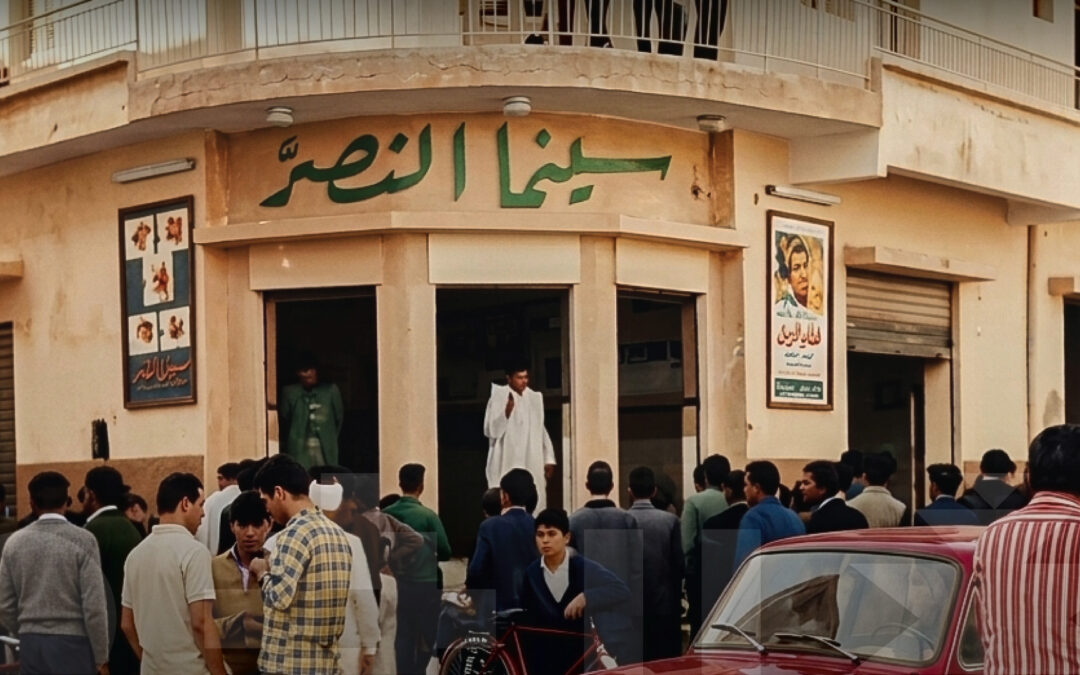
This brings us to Cinema Al-Nasr in Benghazi, located in the Al-Funduq Al-Baladi area. A cultural landmark that opened in 1967 and was demolished in January 2022, it was a destination for a large number of the city’s residents. Major films like The Godfather and Doctor Zhivago were screened there, making it one of the spaces that created a shared cinematic memory across generations.
Today, passing by the site of Cinema Al-Nasr, one is met only with a heavy silence. Its walls have been torn down and leveled to the ground, yet the remnants of the site seem to hold secrets that are no longer told. Between a time when the lights never went out and a reality where only a void remains, memory alone can rebuild what has disappeared. If you listen closely, you might hear the echo of hundreds of footsteps stopping at the ticket window and moving toward the grand hall, where the screen once promised joy and endless laughter.
Cinema as a Part of Daily Life
In a warm recollection of the site, novelist Salem Al-Hindawi returns to his childhood years in Benghazi, where cinema was a living part of daily life. Through his testimony, Al-Hindawi captures the features of a vibrant city and recalls the theaters that shaped the awareness of an entire generation, revealing how personal stories intertwined with the city’s cultural history.
Al-Hindawi recalls that Cinema Al-Nasr, and before it Cinema Haiti and Cinema Istiqlal, were vital landmarks during his youth. He was born in the Sidi Khrebish neighborhood, and the Al-Funduq Al-Baladi area behind his street was constantly bustling with activity. It was filled with restaurants, cafes, popular hotels, and taxi stations. The area was a fertile commercial hub frequented by traders from across the country, serving as the loud heart of the city filled with the calls of vendors and the honking of buses.
In the early 1960s, at the age of nine, Al-Hindawi sold snacks in front of Cinema Istiqlal. He notes that Cinema Al-Nasr was newer than Haiti and Istiqlal, which were built in the 1930s or early 1940s, as evidenced by their Italian architecture. Cinema Al-Nasr was built in 1967 on the former site of a donkey cart station. It was owned by the late Al-Sha’ali Al-Kharraz, who was well known for managing several cinemas and bookstores in Benghazi, most notably the Al-Kharraz Bookstore on Omar Ibn Al-Aas Street.
Al-Hindawi adds that Cinema Al-Nasr was distinguished by screening the latest Arab, American, and Indian films. Competition with its neighbors was minimal because most of these theaters dealt with the Al-Jaouni Company, one of the largest film distributors in the Middle East with major offices in Cairo and Beirut.
A Unique Story in Every Memory
Researcher Abd al-Salam al-Zughaibi provides a living testimony of cinema history through his memories in Benghazi and Al-Bayda. His narrative combines documentation with nostalgia, highlighting the importance of cinemas before the spread of television.
Al-Zughaibi explains that cinema was once the primary and only destination for entering a world of magic and entertainment, especially before television entered homes in 1968. In Benghazi, theaters were concentrated in the city center. Residents and visitors from nearby suburbs frequented them constantly, especially on Fridays, summer holidays, and during Eid. These cinemas were clean and organized, even the popular ones, with orderly seating and designated areas for families.
Among these venues, the Berenice Cinema (Benghazi Cinema House) on Omar Al-Mukhtar Street stood out for its luxury. It began as a national theater in 1928 before being converted into a cinema. Other notable spots included Cinema Rex on Independence Street, known for foreign films, Cinema Al-Nahda, Cinema Al-Huriya, and Cinema Al-Nasr. These theaters screened films ranging from Hercules and Westerns to Egyptian classics.
Cinema Al-Nasr continued to operate until most of the city’s theaters closed in the 1990s. Its demolition in 2022 left deep sadness among residents. It was famous for cowboy films, Bollywood movies, and Egyptian dramas. An elderly man known as Si Ali used to stand outside, selling chocolate, biscuits, and peanuts to moviegoers.
One of the most striking features was the movie posters displayed at the ticket window. They didn’t just show the titles and stars. They included humorous catchphrases to attract crowds, such as “A movie of fighting and smashing,” “A terrifying horror film,” or “A film of thrill and suspense.” These quirky popular phrases were very effective at drawing people in.
The Foundational Phase
Cinema entered Libya at the start of the 20th century, specifically in 1908 in Tripoli, before expanding to Benghazi. The early days were linked to summer theaters or halls belonging to the Italian army, such as Cinema Trieste, where European and local cultures met. In Benghazi, Cinema Eden became a favorite destination for families due to its diverse programming.
In the 1950s and 1960s, Libya experienced an explosion in the number and variety of cinemas. This era saw cinema become part of everyday life. Egyptian and international films became a way to connect with other cultures and a source of knowledge, turning cinema into an informal educational institution.
During the 1970s and 1980s, theaters underwent nationalization and political shifts, as ownership transferred to the state. This changed the nature of imported films and management styles. During this period, cinema faced new challenges, first from the spread of television and later from the emergence of video players, which gradually led to a decline in attendance.
From the 1990s onward, cinema in Libya entered a period of sharp stagnation. Most historic theaters were closed due to neglect, converted into commercial businesses, or damaged by conflict. Cinema Al-Nasr was more than just a building. It was the beating heart of the Al-Funduq Al-Baladi area and a place that summarized the rise and fall of the cinematic dream in Benghazi.
“My Father is Up the Tree”
In 1967, Salem Al-Hindawi’s relationship with cinema evolved from being a viewer to being part of its daily world. At twelve years old, he had the opportunity to work with the cinema’s revenue collector. Later, he sold snacks and gum in front of the theater. His father also obtained permission to set up a bicycle parking station attached to the cinema wall, which Al-Hindawi managed with his brother until the final midnight show.
He shares a humorous anecdote from an Eid holiday when three theaters showed different blockbusters simultaneously, causing massive crowds and road closures. Cinema Haiti showed the Indian film For the Sake of My Children, which was packed with the Indian and Pakistani communities. Cinema Istiqlal showed the Italian film The Ten Gladiators, drawing crowds of young men eager to see the adventures of the heroes Rocha, the Dwarf, and the Mute.
Meanwhile, Cinema Al-Nasr screened the Egyptian film My Father is Up the Tree. The theater was packed with teenagers and older men who spent the entire ten-day run of the film debating the exact number of kisses between stars Abdel Halim Hafez and Nadia Lutfi, arguing whether the count was 100 or 101. Al-Hindawi recalls that the large, bold poster of the two stars was so daring that families would avoid walking in front of the theater during the day, while it served as a visual feast for young men who would watch the movie multiple times.
Tarzan, Hercules, and Samson
Because Abd al-Salam al-Zughaibi worked at the Arab Unity Bookstore during summer holidays, he and his colleagues were allowed to enter Al-Nasr and other theaters owned by Al-Sha’ali Al-Kharraz for free. Kharraz was a self-made man who combined cultural work with business, owning several cinemas in Benghazi including Cinema Al-Hamra and Cinema Al-Firdaws. His activity continued until the nationalization of commercial businesses, when bookstores moved to the press department and cinemas moved to the film department.
Cinema was not limited to Benghazi. It spread to cities like Tripoli, Misrata, Derna, Tobruk, and Ajdabiya. In the city of Al-Bayda, three theaters existed until the early 1970s. The oldest was Cinema Boughandoura in the old market. Another was Cinema Bourbeida behind the main post office.
During his stay in Al-Bayda in the late 1970s, al-Zughaibi and his classmates from the communications institute frequented Cinema Abu Haliema. They watched American war films, Italian Westerns, and movies featuring Tarzan, Hercules, and Samson. They also enjoyed Egyptian films starring Farid Shawqi and Mahmoud El-Meliguy, alongside the works of Farid al-Atrash and Abdel Halim Hafez. Tickets were affordable for everyone, with discounts for students. Sometimes, latecomers or large groups were even allowed in for free due to close social ties. Viewers could stay until the cinema closed, moving between floors or even napping in their seats, and bringing in food and drink was permitted.
The Echo of Stories
Cinema in Libya was never just about entertainment. It was a vital part of social and cultural memory and a mirror reflecting the transformations and aspirations of society. Although production has declined significantly, the testimonies of those who lived through that era still burn brightly. They reveal what Libyan cinema could have been if it had received the support and attention it deserved.
Discussing historic cinemas today is not just about reviving an art form. It is about reclaiming a piece of cultural history and offering future generations a window into their identity. Between the silence of the theaters that closed and the noise of the stories still being told, the question remains open: can Libyan cinemas ever find their light again?