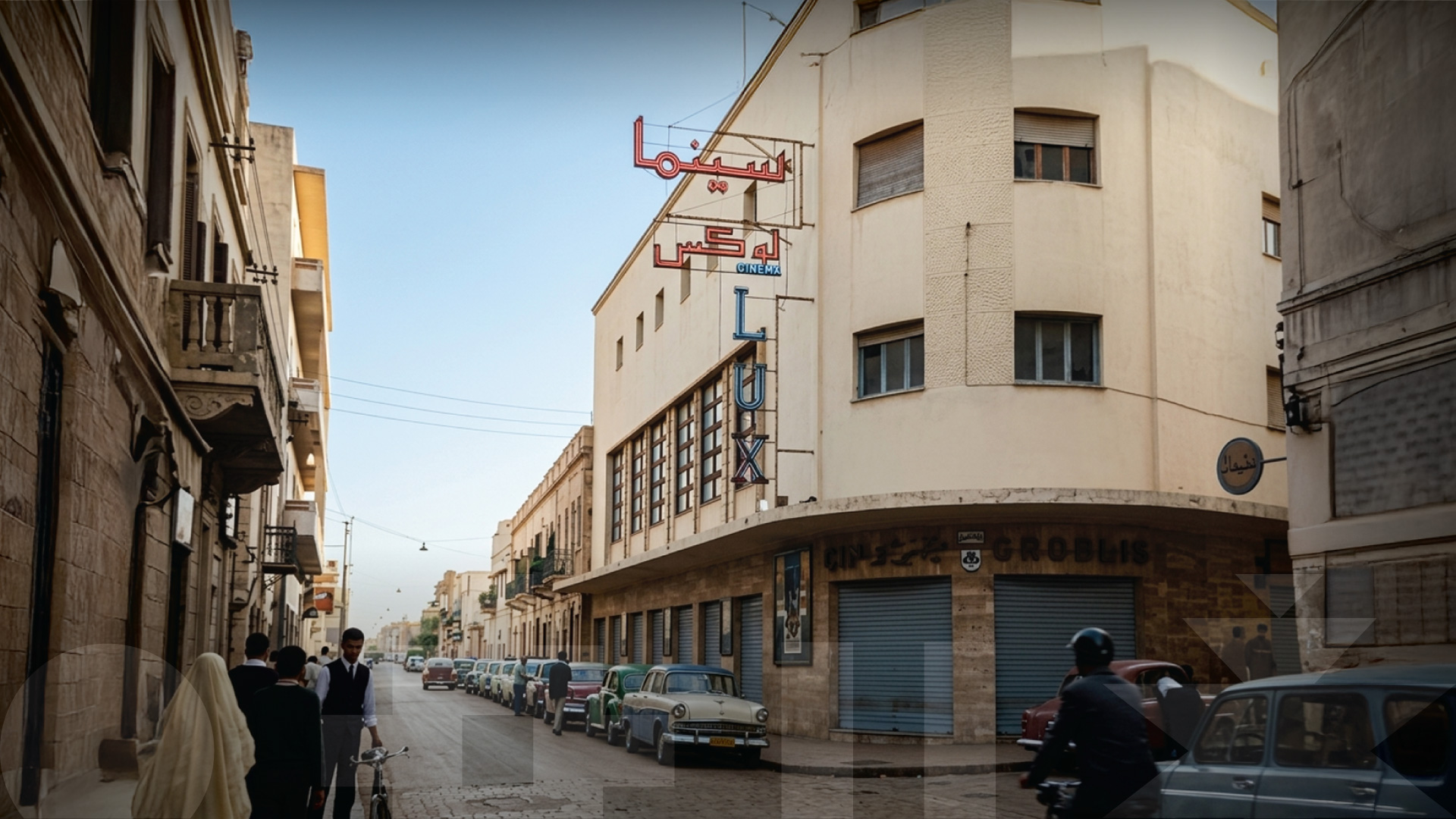
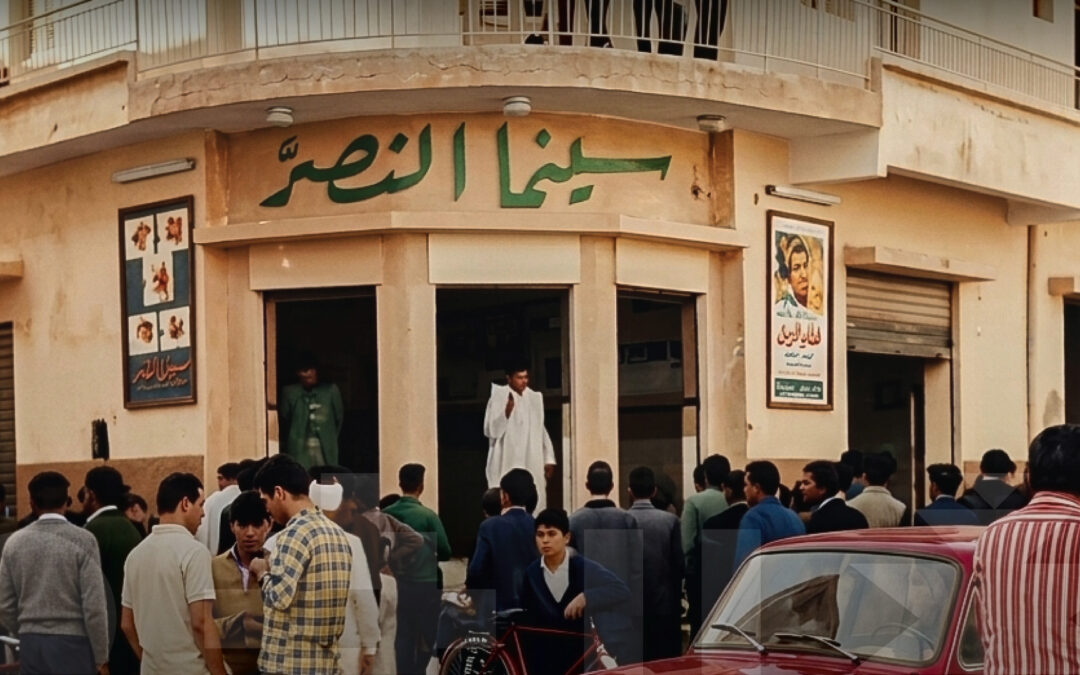
The emergence of movie theaters in Libya was far more than a luxury. It was a major social transformation that shaped the consciousness of successive generations. Cinema served as a window to the world and a space where people of all classes and interests met. This experience was not individual, but a daily communal ritual shared by the city’s residents, where the initial wonder of the moving image blended with the joy of discovery.
During this journey, these theaters were not just commercial buildings. They were platforms for engaging with the aesthetics of Arab and international cinema and an inseparable part of the city’s social fabric. They became cultural compasses that attracted a diverse spectrum of Libyan society, helping to form their visual and emotional tastes.
This brings us to Cinema Al-Nasr in Benghazi, located in the Al-Funduq Al-Baladi area. A cultural landmark that opened in 1967 and was demolished in January 2022, it was a destination for a large number of the city’s residents. Major films like The Godfather and Doctor Zhivago were screened there, making it one of the spaces that created a shared cinematic memory across generations.
Today, passing by the site of Cinema Al-Nasr, one is met only with a heavy silence. Its walls have been torn down and leveled to the ground, yet the remnants of the site seem to hold secrets that are no longer told. Between a time when the lights never went out and a reality where only a void remains, memory alone can rebuild what has disappeared. If you listen closely, you might hear the echo of hundreds of footsteps stopping at the ticket window and moving toward the grand hall, where the screen once promised joy and endless laughter.
Cinema as a Part of Daily Life
In a warm recollection of the site, novelist Salem Al-Hindawi returns to his childhood years in Benghazi, where cinema was a living part of daily life. Through his testimony, Al-Hindawi captures the features of a vibrant city and recalls the theaters that shaped the awareness of an entire generation, revealing how personal stories intertwined with the city’s cultural history.
Al-Hindawi recalls that Cinema Al-Nasr, and before it Cinema Haiti and Cinema Istiqlal, were vital landmarks during his youth. He was born in the Sidi Khrebish neighborhood, and the Al-Funduq Al-Baladi area behind his street was constantly bustling with activity. It was filled with restaurants, cafes, popular hotels, and taxi stations. The area was a fertile commercial hub frequented by traders from across the country, serving as the loud heart of the city filled with the calls of vendors and the honking of buses.
In the early 1960s, at the age of nine, Al-Hindawi sold snacks in front of Cinema Istiqlal. He notes that Cinema Al-Nasr was newer than Haiti and Istiqlal, which were built in the 1930s or early 1940s, as evidenced by their Italian architecture. Cinema Al-Nasr was built in 1967 on the former site of a donkey cart station. It was owned by the late Al-Sha’ali Al-Kharraz, who was well known for managing several cinemas and bookstores in Benghazi, most notably the Al-Kharraz Bookstore on Omar Ibn Al-Aas Street.
Al-Hindawi adds that Cinema Al-Nasr was distinguished by screening the latest Arab, American, and Indian films. Competition with its neighbors was minimal because most of these theaters dealt with the Al-Jaouni Company, one of the largest film distributors in the Middle East with major offices in Cairo and Beirut.
A Unique Story in Every Memory
Researcher Abd al-Salam al-Zughaibi provides a living testimony of cinema history through his memories in Benghazi and Al-Bayda. His narrative combines documentation with nostalgia, highlighting the importance of cinemas before the spread of television.
Al-Zughaibi explains that cinema was once the primary and only destination for entering a world of magic and entertainment, especially before television entered homes in 1968. In Benghazi, theaters were concentrated in the city center. Residents and visitors from nearby suburbs frequented them constantly, especially on Fridays, summer holidays, and during Eid. These cinemas were clean and organized, even the popular ones, with orderly seating and designated areas for families.
Among these venues, the Berenice Cinema (Benghazi Cinema House) on Omar Al-Mukhtar Street stood out for its luxury. It began as a national theater in 1928 before being converted into a cinema. Other notable spots included Cinema Rex on Independence Street, known for foreign films, Cinema Al-Nahda, Cinema Al-Huriya, and Cinema Al-Nasr. These theaters screened films ranging from Hercules and Westerns to Egyptian classics.
Cinema Al-Nasr continued to operate until most of the city’s theaters closed in the 1990s. Its demolition in 2022 left deep sadness among residents. It was famous for cowboy films, Bollywood movies, and Egyptian dramas. An elderly man known as Si Ali used to stand outside, selling chocolate, biscuits, and peanuts to moviegoers.
One of the most striking features was the movie posters displayed at the ticket window. They didn’t just show the titles and stars. They included humorous catchphrases to attract crowds, such as “A movie of fighting and smashing,” “A terrifying horror film,” or “A film of thrill and suspense.” These quirky popular phrases were very effective at drawing people in.
The Foundational Phase
Cinema entered Libya at the start of the 20th century, specifically in 1908 in Tripoli, before expanding to Benghazi. The early days were linked to summer theaters or halls belonging to the Italian army, such as Cinema Trieste, where European and local cultures met. In Benghazi, Cinema Eden became a favorite destination for families due to its diverse programming.
In the 1950s and 1960s, Libya experienced an explosion in the number and variety of cinemas. This era saw cinema become part of everyday life. Egyptian and international films became a way to connect with other cultures and a source of knowledge, turning cinema into an informal educational institution.
During the 1970s and 1980s, theaters underwent nationalization and political shifts, as ownership transferred to the state. This changed the nature of imported films and management styles. During this period, cinema faced new challenges, first from the spread of television and later from the emergence of video players, which gradually led to a decline in attendance.
From the 1990s onward, cinema in Libya entered a period of sharp stagnation. Most historic theaters were closed due to neglect, converted into commercial businesses, or damaged by conflict. Cinema Al-Nasr was more than just a building. It was the beating heart of the Al-Funduq Al-Baladi area and a place that summarized the rise and fall of the cinematic dream in Benghazi.
“My Father is Up the Tree”
In 1967, Salem Al-Hindawi’s relationship with cinema evolved from being a viewer to being part of its daily world. At twelve years old, he had the opportunity to work with the cinema’s revenue collector. Later, he sold snacks and gum in front of the theater. His father also obtained permission to set up a bicycle parking station attached to the cinema wall, which Al-Hindawi managed with his brother until the final midnight show.
He shares a humorous anecdote from an Eid holiday when three theaters showed different blockbusters simultaneously, causing massive crowds and road closures. Cinema Haiti showed the Indian film For the Sake of My Children, which was packed with the Indian and Pakistani communities. Cinema Istiqlal showed the Italian film The Ten Gladiators, drawing crowds of young men eager to see the adventures of the heroes Rocha, the Dwarf, and the Mute.
Meanwhile, Cinema Al-Nasr screened the Egyptian film My Father is Up the Tree. The theater was packed with teenagers and older men who spent the entire ten-day run of the film debating the exact number of kisses between stars Abdel Halim Hafez and Nadia Lutfi, arguing whether the count was 100 or 101. Al-Hindawi recalls that the large, bold poster of the two stars was so daring that families would avoid walking in front of the theater during the day, while it served as a visual feast for young men who would watch the movie multiple times.
Tarzan, Hercules, and Samson
Because Abd al-Salam al-Zughaibi worked at the Arab Unity Bookstore during summer holidays, he and his colleagues were allowed to enter Al-Nasr and other theaters owned by Al-Sha’ali Al-Kharraz for free. Kharraz was a self-made man who combined cultural work with business, owning several cinemas in Benghazi including Cinema Al-Hamra and Cinema Al-Firdaws. His activity continued until the nationalization of commercial businesses, when bookstores moved to the press department and cinemas moved to the film department.
Cinema was not limited to Benghazi. It spread to cities like Tripoli, Misrata, Derna, Tobruk, and Ajdabiya. In the city of Al-Bayda, three theaters existed until the early 1970s. The oldest was Cinema Boughandoura in the old market. Another was Cinema Bourbeida behind the main post office.
During his stay in Al-Bayda in the late 1970s, al-Zughaibi and his classmates from the communications institute frequented Cinema Abu Haliema. They watched American war films, Italian Westerns, and movies featuring Tarzan, Hercules, and Samson. They also enjoyed Egyptian films starring Farid Shawqi and Mahmoud El-Meliguy, alongside the works of Farid al-Atrash and Abdel Halim Hafez. Tickets were affordable for everyone, with discounts for students. Sometimes, latecomers or large groups were even allowed in for free due to close social ties. Viewers could stay until the cinema closed, moving between floors or even napping in their seats, and bringing in food and drink was permitted.
The Echo of Stories
Cinema in Libya was never just about entertainment. It was a vital part of social and cultural memory and a mirror reflecting the transformations and aspirations of society. Although production has declined significantly, the testimonies of those who lived through that era still burn brightly. They reveal what Libyan cinema could have been if it had received the support and attention it deserved.
Discussing historic cinemas today is not just about reviving an art form. It is about reclaiming a piece of cultural history and offering future generations a window into their identity. Between the silence of the theaters that closed and the noise of the stories still being told, the question remains open: can Libyan cinemas ever find their light again?
Kholoud Elfallah