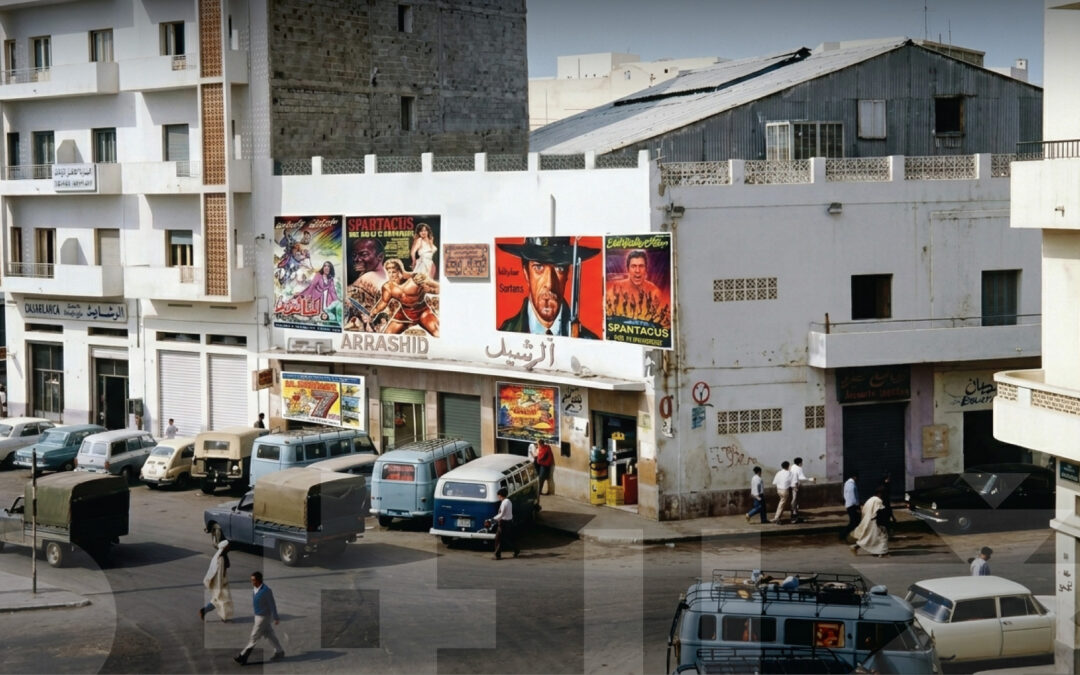
In the heart of Tripoli, Libya, where the lights would dim to signal the start of a show and silence would descend upon an audience facing a large screen open to the world, a visual memory was formed for generations of Libyans throughout the last century, through American, Indian, Italian, and Arab films.
Today, Cinema Al-Rashid returns as a name echoing in the city’s collective memory. It was a building that witnessed Tripoli’s transformations, its shifting artistic and cultural tastes, and the fleeting conversations held outside the theater about influential actors and scenes. It transformed the cinema from a mere venue for amusement into a vibrant social and cultural space of knowledge.
The story of Cinema Al-Rashid built on the 9th of August Square, later renamed Al-Suwayhli Square is not an isolated case. Cinema in Libya has undergone drastic shifts, from changes in the institutions managing theaters to nationalization, eventually leading Libya from a pioneering cinematic nation to one of total closure. Cinema Al-Rashid was demolished in April 2021.
Film critic Ramadan Salim explains that one reason for Al-Rashid’s fame was its prime geographical location in the heart of Tripoli, alongside ticket prices that were affordable for a wide segment of the public. “It was a modest theater with no windows, a roof made of corrugated metal sheets (zinco), and fans that ran constantly but were weak and ineffective,” Salim recalls. “Yet, even with its dim lighting and dirty walls, the theater saw a huge turnout. It was almost the sole outlet for weekly entertainment and pleasure.”
He adds: “In this theater, I watched black-and-white Arab films that were repeated due to popular demand films starring Ismail Yassin, Farid al-Atrash, Anwar Wagdi, Umm Kulthum, Farid Shawqi, Mohamed Abdel Wahab, and others. I still clearly remember the first film I watched, Afritat Ismail Yassin. Perhaps it stuck in my memory because it contained simple special effects that seemed strange to us at the time, especially the way the genie—played by the dancer Kitty would appear.”
When personal memory intertwines with collective memory, the cinema transforms from a public building into a private space of first experiences and wonder. Ramadan Salim notes: “I remember well that the reason I entered Cinema Al-Rashid for the first time was my uncle’s desire for me to accompany him, as he was a weekly regular. Without that, it would have been difficult to convince my family to agree to this step, even though it was considered simple and normal at the time. After that, going to the cinema became a weekly habit. On its screen, I watched many films, including Ismail Yassin in the Army, Ismail Yasin Police Harby, Ismail Yassin in the Wax Museum, and Ismail Yassin Malek Al Betrol. I watched Farid al-Atrash’s musical films like Immortal Song (Lahn al-Khuloud), films by Abdel Halim Hafez, and Umm Kulthum’s movies like A Kiss in the Desert, Fatima, and Salama. I also saw Mohamed Abdel Wahab’s films, such as Forbidden Love, which was presented in a poor copy I believe due to repeated screenings, and perhaps because we were viewed as a third-class audience.
Summer and Winter Cinemas
Cinema houses in Libya were not merely silent buildings; they were standing appointments with knowledge and wonder. On those seats, in darkened halls, the audience of art and literature learned how a film strip could open a window into the details of other peoples’ lives and cultures.
Even with the absence of precise official documentation regarding the construction date of Cinema Al-Rashid, limited available sources suggest it was likely built in the mid-1950s. This was a period when the capital, Tripoli, was catching its breath after World War II and preparing for a new phase of stability and reconstruction during the era of Governor Italo Balbo.
Until February 5, 1959, Cinema Al-Rashid was known as Cinema “A.B.A.”
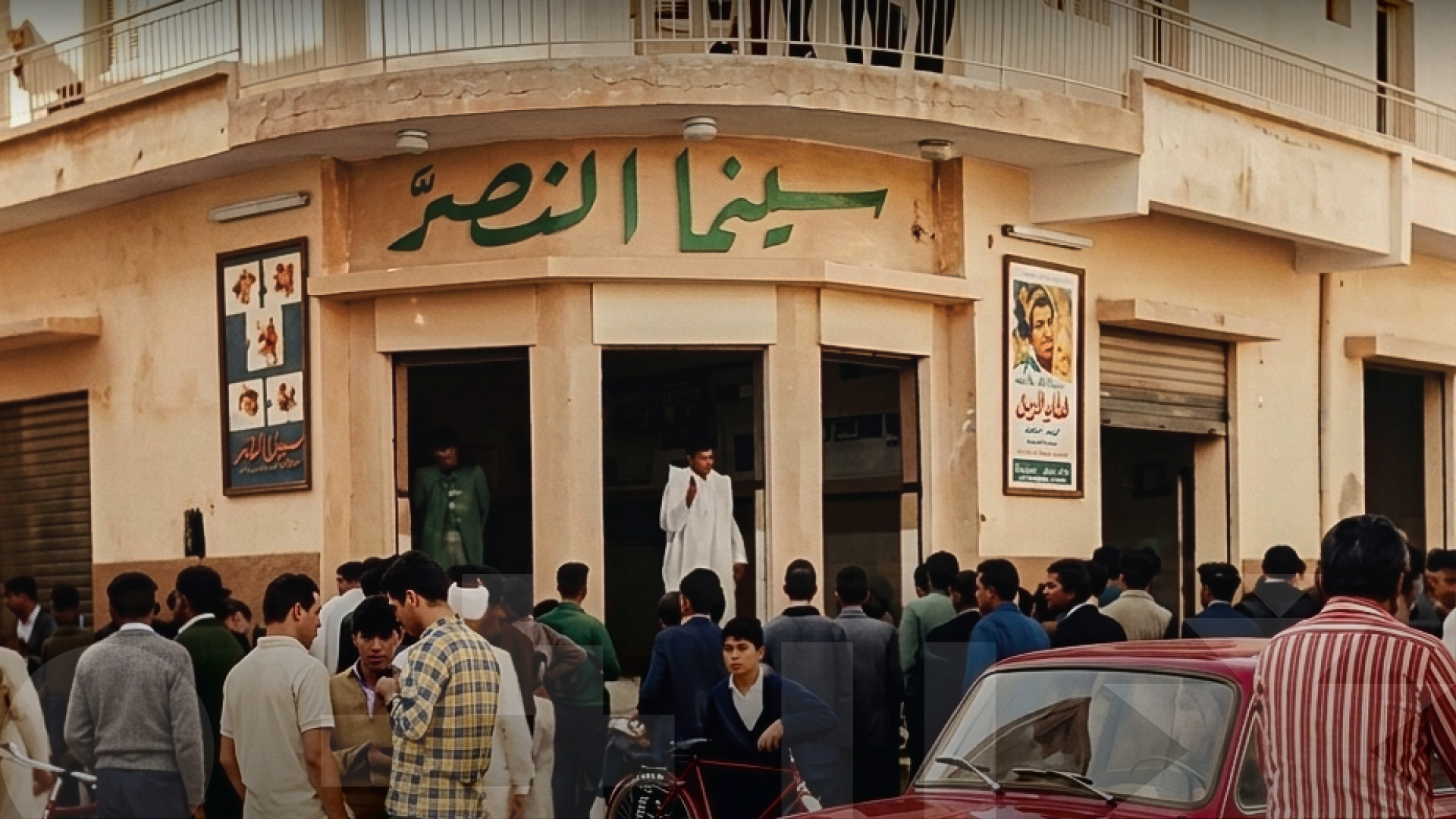
During that era, the cinematic activity in the city was dominated by the Al-Nasr Company, owned by Palestinian businessman Khalil Al-Jaouni. The company owned several prominent theaters, including Cinema Al-Nasr in Souq Al-Turk (known as the Politeama Theater before 1943), Cinema Al-Rashid, Cinema Al-Cursal (opened on July 17, 1958), and Cinema “A.B.T.”
Tripoli’s cinemas were divided into winter and summer venues. Among the winter theaters was Cinema Al-Hamra, which reopened after renovations in a two-story building on November 18, 1950. The list also included Cinema Al-Nasr, established in 1943 in Souq Al-Turk, and Cinema Al-Ghazala, known as Union after its new building opened on September 27, 1947, before being renamed Adriano in April 1951, and later acquired by the Libya Cinema Company in early 1954.
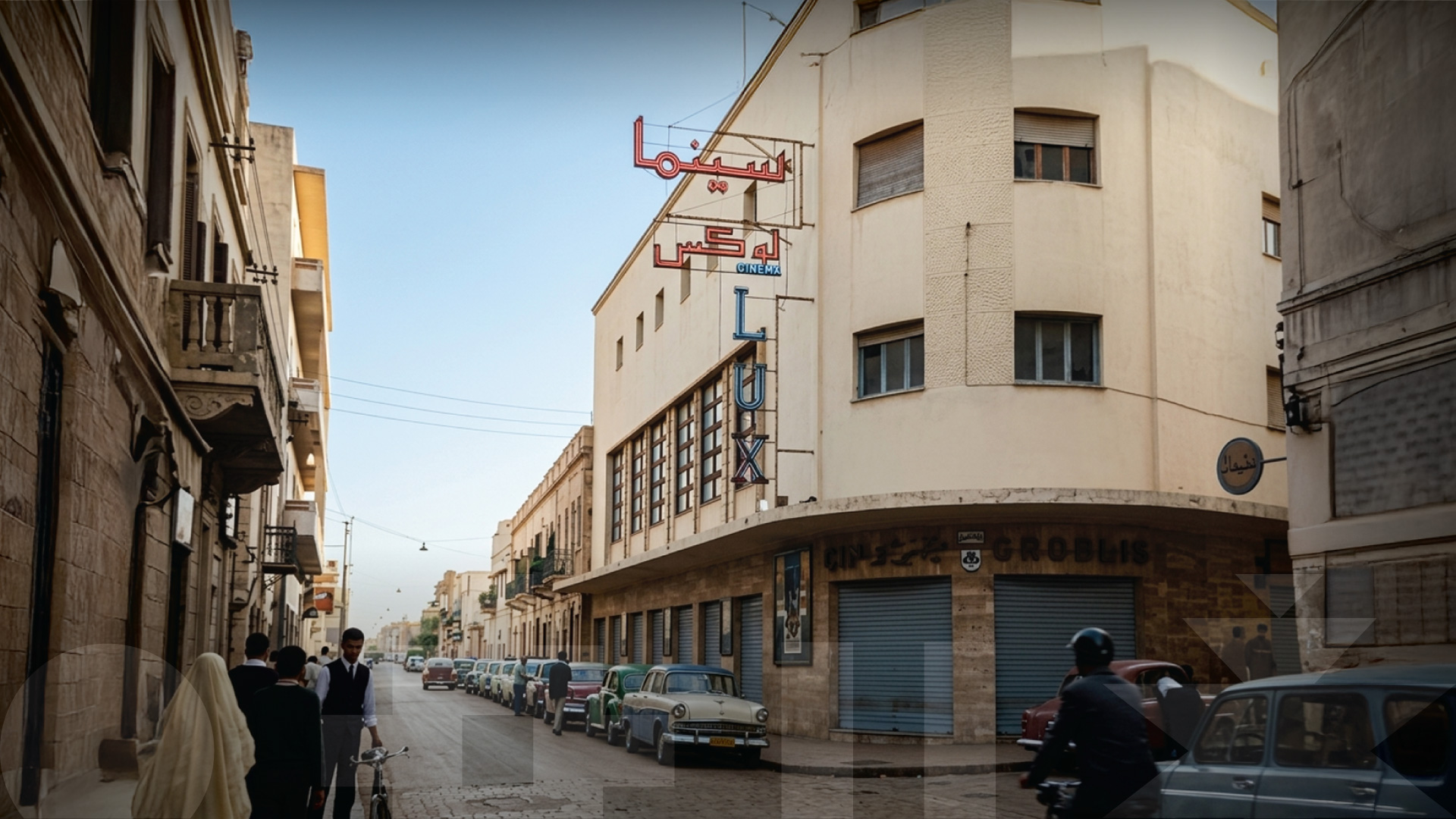
Winter cinemas also included Cinema Lux on Amr Ibn Al-Aas Street, Cinema Al-Rashid in 9th of August Square, and Cinemas Lapi and Gabi on Al-Sarim Street, both owned by the Italian Liverani. Additionally, there was Cinema Waddan on Adrian Pelt Street, Cinema Metropole on Kuwait Street, and Cinema Odeon on Al-Magharba Street (formerly Ricardo Street). The Odeon opened on January 29, 1947, in a two-story building with about 800 seats (later known as Al-Zahra); it featured a theater stage, a café, and a dance hall, and was the first cinema to use a gold curtain.
The list further included Cinema Royal on Mizda Street, Cinema “A.B.T” on Haiti Street, and Cinema Al-Cursal in the Dhahra Al-Kabira area.
As for the summer cinemas, the most prominent were Arena Giardino on Hassouna Pasha Street, Cinema “A.B.A” in 9th of August Square, Cinema Al-Corso on Beirut Street, Cinema Rivoli on Omar Al-Mukhtar Avenue, and Cinema Astra on Ibn Rushd Street.
Furthermore, the Wheelus Air Base (Al-Malaha) contained a cinema hall with a capacity of about 5,000 people. It screened a film every two days but was dedicated exclusively to the American community within the base.
Italian Films and Art Magazines
Ramadan Salim explains that one of the features of Al-Rashid Theater was how it announced films: a frame on the left of the entrance displayed the current film, while a frame on the right announced the coming attraction. Schedule changes were extremely rare. This also applied to the posters inside the lobby, which were hung in a disorganized manner, teasing future screenings that weren’t imminent, except during holidays.
The tickets were small, ejected by a small machine, and were not torn by hand upon purchase but rather at the door. Entry, as was customary in most theaters, was allowed at any time since screenings ran continuously. Some patrons would watch a film more than once—not just for enjoyment, but to kill time, especially in winter, when the sound of light rain on the roof could be heard, though it never drowned out the actors’ voices.
According to Salim, Cinema Al-Rashid was mentally associated with Egyptian Arab films; foreign films were rarely shown there, a change that only happened in relatively later years. However, historical Italian films had a wide audience, particularly movies featuring Hercules, Maciste, The Ten Gladiators, Ursus, and Spartacus.
He continues: “Cinema Al-Rashid in Tripoli was a meeting place for friends. This meeting might be linked to a walk through the city streets or a trip to another theater, but it usually settled on watching the film at Al-Rashid. This was due to the ease of returning home no matter how late it got, and the availability of many amenities in the nearby alleys and streets—especially kiosks selling magazines, particularly art magazines.”
Salim adds: “In later times, Cinema Al-Rashid witnessed diversity in its films, ranging from Arab comedies and musicals to dramas adapted from Arab and international novels. This had a profound impact on comparing the world of cinematic viewing with literary reading, especially novels by Ihsan Abdel Quddous, Yusuf al-Sibai, and Naguib Mahfouz that were adapted into films.
On another note, Al-Rashid screened some films that could be described as ‘orphans’ (rare classics), such as Jungle Book (1942) directed by Zoltan Korda, The Thief of Bagdad (1940), and Ali Baba and the Forty Thieves.
Films of Samira Tawfik and Leila Mourad
Leaving the cinema was an extension of another story, creating small memories that lasted long among film lovers. Salim recalls: “In the sixties, Cinema Al-Rashid did not screen American films; the offerings were mostly Arab and Italian, especially adventure films. It also dedicated significant space to musical films due to their popularity. I remember well that films of the singer Samira Tawfik were shown in this hall successively, such as A Bedu Girl in Love, A Bedu Girl in Paris, and A Bedu Girl in Rome. And I cannot forget the Leila Mourad film series, such as Leila Daughter of the Poor, Leila Daughter of the Rich, Leila Daughter of the Shore, and Leila Daughter of Schools, as well as Antar bin Shaddad in both its black-and-white and colored versions.”
He adds: “No other theater had the distinct popular character of Al-Rashid except for Cinema Al-Ghazala, located in Al-Ghazala Square, which specialized in foreign films, particularly Italian westerns. Cinema Al-Rashid was a transitional stage leading to other theaters later on, such as Cinema Al-Shaab (formerly Royal), Cinema Al-Khadra (formerly Al-Hamra), and Cinema Al-Fatah (formerly Lux), in addition to Cinema Al-Nasr, which rivaled Al-Rashid in the type of old films it screened and its location in the Old City (Souq Al-Turk).”
In Conclusion What does it mean for a cinema to be demolished? Is it merely the fall of a building? Or is it the erasure of a part of a city’s memory? Cinema Al-Rashid was more than a screen and seats; it was an entire era of social, cultural, political, economic, and artistic transformations.
Kholoud Elfallah