The Journey of Libyan Cinema
In my country, I was deprived of the cinematic experience, as an entire generation was deprived of a darkened hall, a voice that seeps into my soul, and a giant screen. I only discovered the pleasure of the experience when I traveled outside Libya.
Thus, I began tracing the history of Libyan cinema to understand the reasons behind its absence, the transformations and changes that Libyan society underwent, and why Libya transformed from a pioneering cinematic nation to having such a faint presence.
According to Libyan film researcher Madghis Oumadi, the early introduction of cinema to Libya wasn’t a mere coincidence. But rather it was primarily due to two factors: the Ottoman presence and the country’s openness to the outside world. Together, these two factors contributed to bringing Libyans closer to the artistic and cultural developments taking place beyond their borders.
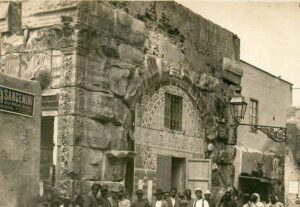
Tograph Bab Al-Bahr Cinema
The first beginnings of cinema in Libya (1908–1947 AD)
Cinematic screenings in Libya began early, with the first movie theater in the Old City of Tripoli dating back to 1908. It was known as “Tograph Bab Al-Bahr“; it presented silent shows, using the ancient Arch of Marcus Aurelius as its entrance. Just two years later, in 1910, the first documentary film shot inside Libya, titled “The Inhabitants of the Libyan Desert,” was produced, reflecting the camera’s early visual presence in documenting the local environment and landscape.
In 1947, Libyan cinema recorded its first local contribution to documentary production through Libyan director Fouad Al-Kaabazi, who produced a documentary about the Zawiya of Sheikh Abdul Salam Al-Asmar in collaboration with Italian director Enrico. The film received attention and critical acclaim, winning several awards at film festivals in Italy.
Some sources indicate that prior to the Italian invasion in 1911, Tripoli had more than 18 movie theaters. By 1966, the capital had 13 theaters, nine catering to foreigners and only four serving Libyan citizens. Overall, the number of cinemas in Libya at that time was estimated at around 30, reflecting a notable cultural activity in hosting cinematic screenings from abroad.
The Flourishing of the Private Sector and the Beginnings of Cinema’s Golden Age
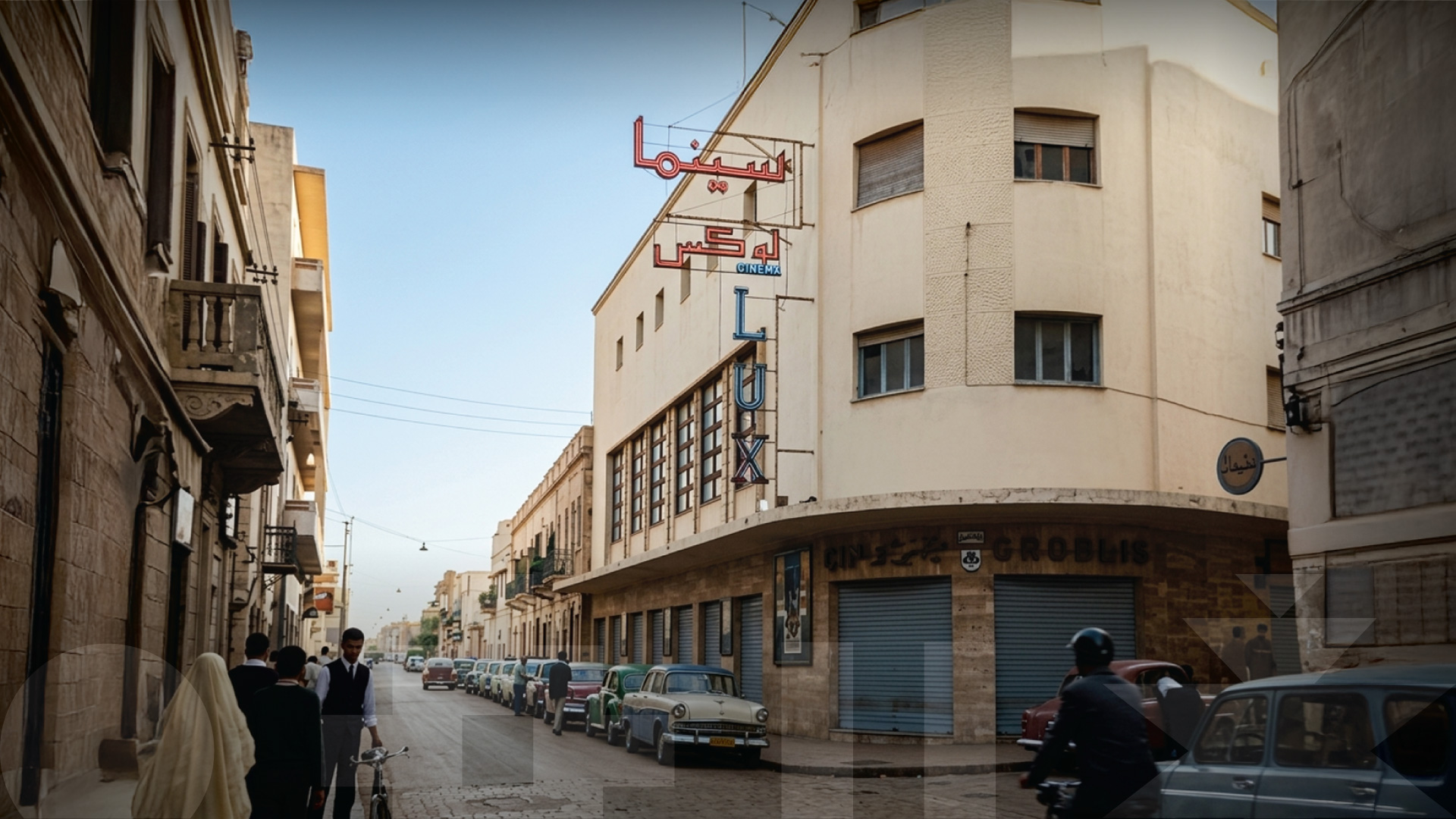
Libyan historical researcher Murad Al-Houni notes that between the mid-1920s and the 1930s, Libya witnessed a boom in the proliferation of cinemas, driven primarily by the private sector, which was dominated by Italians. Among the most prominent names of that period was Giuseppe Salinos, who established the Miramare Theater and used it for cinematic screenings. The Italians also operated the Politeama Theater and the Al Hamra Super Cinema. In 1932, the Bernice Theater was established, which later transformed into an upscale cinema that became a cultural destination for the elite of Benghazi.
According to Al-Houni, the true golden age of Libyan cinema began after the end of British administration and the country’s independence in December 1951. During this phase, Libya witnessed a qualitative expansion in the number of cinemas, and some Libyans began entering the film industry sector as investors, capitalizing on their prior experience in distribution and production companies.
Several local pioneers in this field emerged during this phase, including Suleiman and Awad Al-Zani, Mohamed Bashir Al-Farjani, Mustafa Bin Sreiti, Ali Bin Othman, Al-Hadi Al-Mshareqi, Al-Shaali Al-Kharraz, Helmi Tatanaki, and Khalil Al-Jaouni.
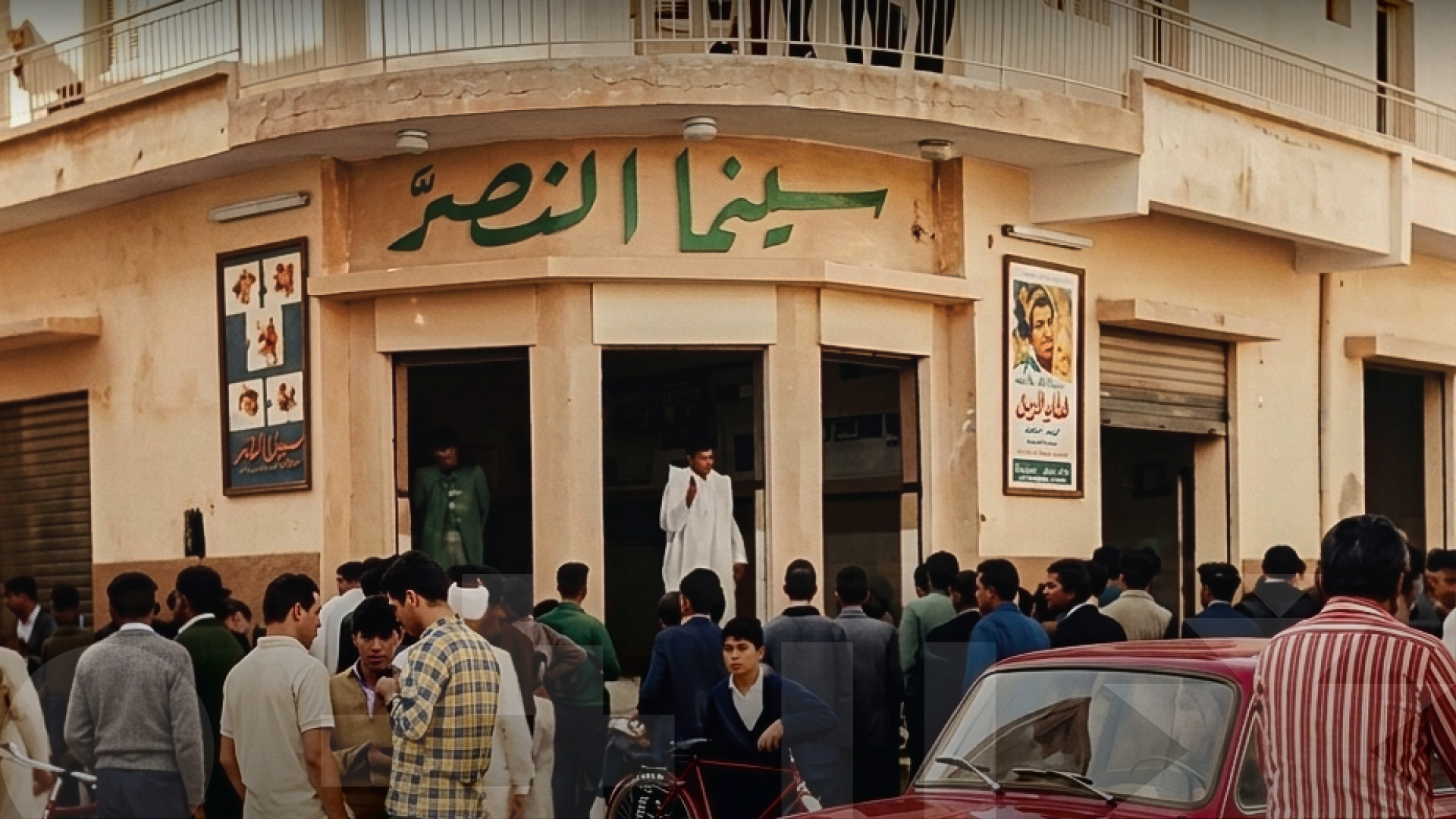
Even after independence, cinematic screenings in Libya remained under the Italian influence. The country had around 30 cinemas at the time, screening approximately 50 Egyptian films, 40 Italian films, and 10 American films. Some cinemas were catered exclusively to foreigners, and the Italian authorities imposed a regulation requiring every theater to show an Italian film every Sunday.
Al-Houni describes this period as a remnant of what he calls “foreign privileges,” which persisted even after independence. For instance, in 1966, the capital Tripoli had 13 cinemas, nine reserved for foreigners, compared to only four for Libyan citizens.
Despite these challenges, cinema gradually began to weave itself into the fabric of Libyan life, with the opening of commercial cinemas showcasing both Arab and foreign films, though the country still lacked genuine local film production.
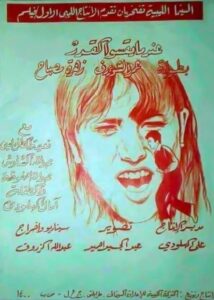
When Destiny is Cruel Film Poster
The General Institute for Cinema: A Lost Hope
Libyan cinema went through two main phases in its history. The first was marked by the establishment of the the General Institute for Cinema on December 13, 1973, a step that represented the beginning of the second phase in Libyan cinema and a turning point toward a professional film industry.
The organization was equipped with advanced infrastructure in terms of technology and equipment. It established a modern sound laboratory fitted with sophisticated recording devices, alongside a state-of-the-art cinema hall, film and sound editing equipment, as well as world-class filming and lighting equipment.
Between April 1974 and April 1979, the corporation produced 134 diverse documentary films, in addition to several issues of “Al-Khayala” illustrated magazine. Seven feature-length films were also produced, some co-financed with other partners, several of which won awards at international film festivals.
By June 1979, work began on the first fully Libyan-financed feature film, created with entirely local artistic talent. On July 21 of the same year, a decree was issued to establish the General Cinema Company as the official body overseeing and supervising film production, with exclusive control over screenings, distribution, import, and marketing, in addition to bringing all cinemas under its management.
The first feature-length film to be screened in Libya was titled “When Destiny is Cruel,” or (‘Indama Yaqsu Al-Qadar), shown at Al-Zahra Cinema in Tripoli on August 1, 1973. Directed by Abdullah Al-Zarrouq and produced by Ali Al-Fallahoudi, it starred Zahra Misbah and Omar Al-Shuwairif, telling a love story set against harsh social circumstances.
In 1976, the first co-production film with Arab-Libyan financing was released under the title “The Green Light,” or (Al-Daw’ Al-Akhdar), directed by Abdullah Al-Misbahi.
With the nationalization of the cinema sector and the establishment of the General Authority for Cinema, support shifted toward certain documentary and political films. Major national-themed cinematic projects emerged, such as “The Message,” or “AL-Resala” in 1976, and “Lion of the Desert,” or “Omar Mukhtar” in 1981, both directed by Mustafa Al-Akkad. Yet, despite the symbolic importance of these works, they didn’t lead to the creation of a sustained local film industry.
Isolation and Stagnation (1990-2010)
By the 1990s, as the escalation of international isolation against Libya intensified, cinema entered a near-complete state of stagnation. Many of them closed, some were converted into commercial shops, and screening halls gradually disappeared from the cultural scene.
By 2010, only a very limited number of cinemas remained in Libya, mostly state-owned and operating at minimal capacity. Public attendance in cinema had sharply declined due to the spread of satellite TV and the internet, and the dream once started by the General Cinema Corporation decades earlier had all but faded.
The Libyan director Abdullah Al-Zarrouq believes that the nationalization decision placed cinemas under the authority of the General Authority for Cinema, which prohibited the import of foreign films. The halls became tools or subjects under the control of the authority, which controlled everything that was screened, whereas, in the past, private companies had competed to bring in the latest Egyptian, Syrian, and foreign films, where films were sometimes shown in Libya even before their release in their producing countries, as happened with “Lawrence of Arabia”, which was screened in Libya before any other Arab country.
He added: “Those private companies were Libya’s gateway to world cinema, with their high-quality halls, their precise organization, and the beautiful promotional campaigns that accompanied the films. But after nationalization, everything collapsed. The cinemas turned into deserted spaces showing poor-quality films that fell far short of even the minimum cultural aspirations or ambitions.”
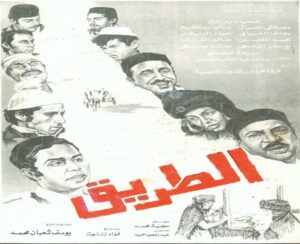
Altariq Film Poster
From Dream to Setback
Director Abdullah Al-Zarrouq recounts part of his personal and professional experience during the early formation of Libyan cinema. He says: “In early 1969, we began working on the film “A Message from Libya,” or (Resala from Libya), a tourism film featuring the late artists Khadija Al-Jahmi, Mohamed Haqeeq, Halima Al-Khodri, Omran Al-Madnini, and Ali Atiya. It was directed by Egyptian filmmaker Ahmed Al-Toukhi, but unfortunately, it was never completed.”
Abdullah Al-Zarrouq continues: “In 1973, I directed and produced the film “When Destiny is Cruel”, or (‘Indama Yaqsu Al-Qadar), which is considered the first feature-length film in the history of Libyan cinema. After that came the film “The Road,” or “Altariq”, directed by Palestinian filmmaker Youssef Shaaban Mohamed.”
A Pioneering Nation, But…
The activity of private companies during that period included:
Mohsen Al-Tamzini Company, which produced two films about Leptis Magna and Sabratha.
Al-Sharq Company, which produced the films “Abu Rabee” and “A Word of Honor”.
Director Abdullah Al-Zarrouq stated, “This momentum was an indication that Libya was on its way to becoming one of the pioneering nations in the field of cinema, especially with the emergence of private companies and visits from Arab producers to the country. But fate reared its ugly head! With the establishment of the General Cinema Corporation at the end of 1973, all the private companies, which had represented the true hope for building a national cinema, ceased operations. The public sector took over everything, and production became bound by a rigid official mindset. The dream of Libya becoming a cinematic competitor to Egypt, Syria, Lebanon, and Algeria was lost.”
“The decision to nationalize cinemas in 1979 marked the beginning of the cinematic setback.”
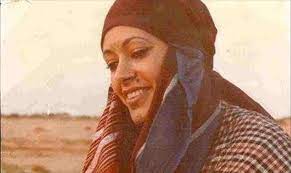
Frame From Al-Shadiyya Film
Bright Milestones
The film “Rain Melody,” or “Ma‘zoufat Al-Matar”, produced in 1981 and directed by Abdullah Al-Zarrouq, is considered one of the most significant Libyan cinematic works, offering a profound vision of Libyan society.
The film “The Shrapnel,” or “Al-Shadiyya,” produced in 1986, addresses the issue of landmines in Libya as remnants of World War II. Which was adapted from a story by renowned Libyan novelist Ibrahim Al-Koni and directed by Mohamed Ali Al-Farjani. Despite challenges related to budget and production conditions, the importance of the issue it tackled helped it win awards and recognition at Arab and international festivals. So “The Shrapnel” stands as a right milestone in Libyan cinema history and an example of the potential of Libyan filmmaking.
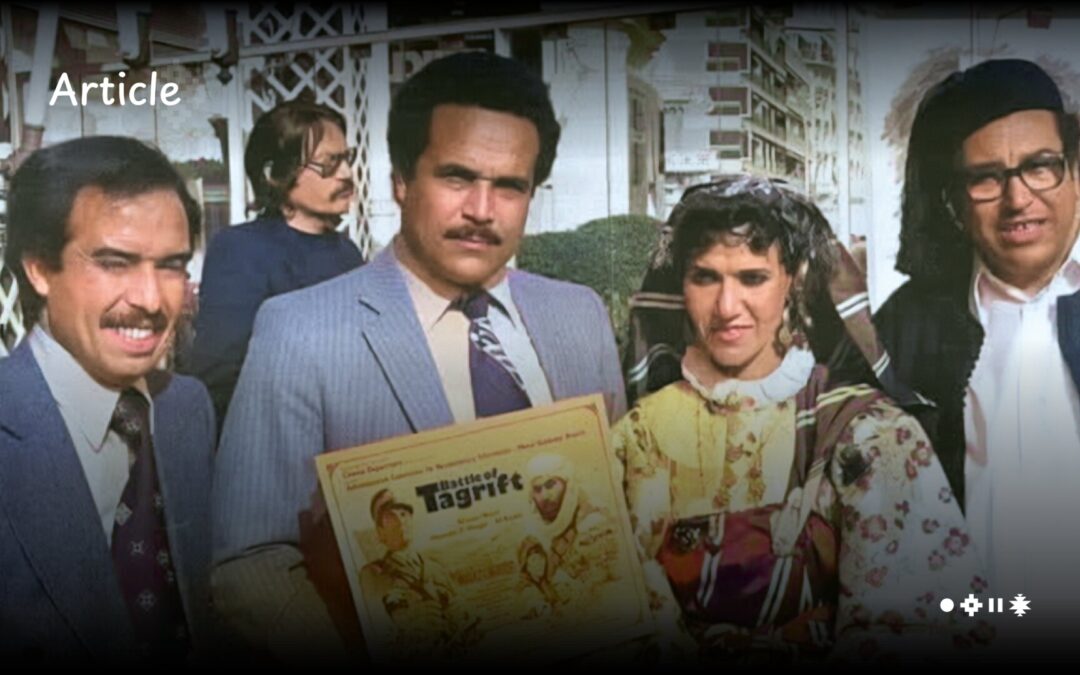
Another notable Libyan production from 1981 is the documentary film “Tagrift”, which portrays the Battle of Tagrift, one of the important battles of the Libyan resistance against the Italian invasion in 1928. Although the battle ended in an Italian victory, it holds great significance in Libya’s history. The film was directed by Khaled Mustafa Khusheim and Mahmoud Ayad Drayza, with the story written by Mohamed Ahmed Al-Zawi and Khaled Mustafa Khusheim, and the script and dialogue by Mahmoud Ayad Drayza.

From Libya Film Institute Initiatives
Individual Cinematic Initiatives
After 2011, several independent youth-led cinematic experiments emerged in an attempt to revive the long-absent Libyan cinema. These took the form of documentary and narrative films, both feature-length and short, addressing issues of war, identity, and memory. However, they remained individual efforts in the absence of institutional support. Nevertheless, a number of festivals dedicated to these independent works were organized, such as “ERATO Human Rights film festival”, “Libya Film Awards”, “the Benghazi Short Film Festival”, “the Mobile Film Festival”, and “the Made in Libya Local Cinema Festival”. These young initiatives have struggled with a lack of funding and the absence of private production companies, hindering the development of a genuine film industry.
Unfortunately, many cinemas in Libya have been damaged or repurposed (into military facilities, commercial shops, or demolished entirely) due to the country’s turbulent circumstances. After the demolition of Al-Rasheed Cinema in 2021, one of the oldest cinemas in Libya, dating back to the royal era, was demolished. As a historical landmark, Libya lost an artistic landmark in its own right, which had already suffered years of neglect before the demolition began.
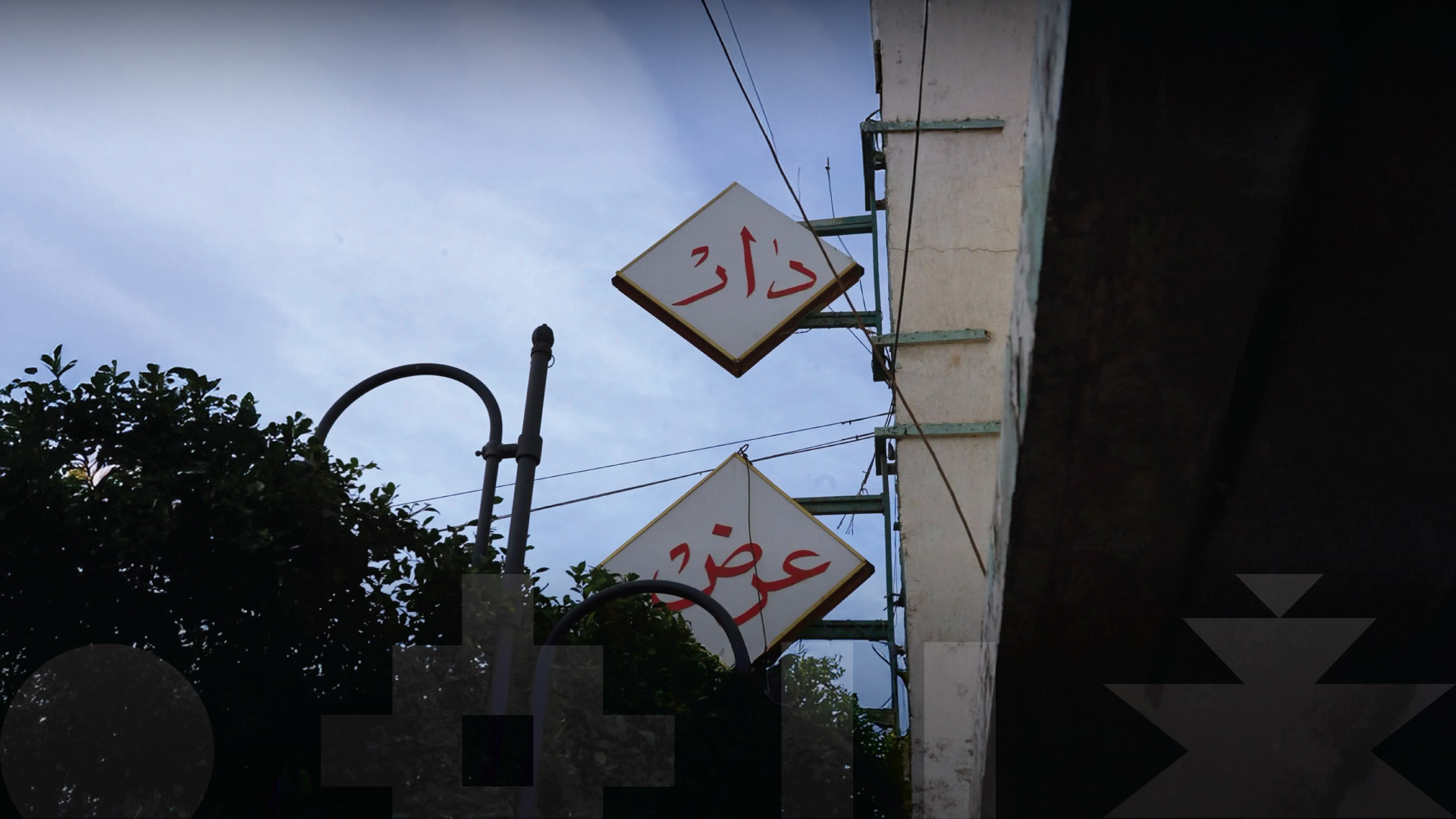
The last functioning cinema was “ALFEEL House” Cinema, which ceased operations in 2012 due to ongoing security unrest. The last film it screened was “X-Large” starring Egyptian actor Ahmed Helmy. Recently, in the city of Benghazi, “Vox Cinema” at the Golden Palm Resort is currently operational, showing recent Arab films.
Arts and literature, including cinema, have never been a priority for successive governments, which has negatively impacted support for the sector, even with the existence of the General Authority for Cinema, Theatre, and Arts. This authority organized the “Libya International Short Film Festival” and the “Libya-European Cinema Festival” in Tripoli in 2024.
Will Libyan Cinema Come Back to Life?
From the silent screenings in the early 20th century, through the beginnings of a private sector that sought to shape the outline of a distinctly Libyan cinematic identity, to the experience of the General Cinema Corporation, cinema in Libya once went through a period of growth and flourishing, only to end in the disappointment of an entire generation of filmmakers.
In the early days of cinema in Libya, the hope was for continuity and a promising cinematic movement. But the state’s policies in establishing and restructuring film institutions, creating one organization only to dissolve another, ultimately crushed the cinematic dream!
Libya still lacks a functioning cinematic infrastructure, where no active cinemas, no stable local production, and no independent institutions to support young talent. While modern technologies, such as the internet and independent filmmaking, have opened new horizons, the absence of infrastructure and institutional support continues to stand in the way of this art’s revival.
Kholoud Elfallah