
Countries of Production: Libya – South Africa – Qatar.
Year of Production: 2021.
Running Time: 73 minutes.
Genre: Documentary.
Written and Directed by: Khalid Shamis.
Awards: Best Director in the Documentary Category, South African Film and Television Awards (the South African Oscars).
Evaluation: Worth Watching.
1
It is almost unnecessary to remind the reader of the diverse spectrum of the Libyan resistance, which began weakly in 1969 and grew stronger as Gaddafi consolidated his power following the Zuwara speech in 1973. The newbie republic transformed from a liberator of the poor into an authoritarian power that, as the speech’s opening declared, “suspended all existing laws.” It remained a republic in name only until it revealed its true face with the declaration of the “people’s authority” in 1977.
Thus, in the 1980s, Gaddafi’s Jamahiriya coined the term “stray dogs” (al-kilab al-dalla): the resistance fighters whom his regime had hunted since the early 1970s. This suspension of laws included a ban on political parties, turning every liberal, communist, and Muslim Brotherhood member into a “stray dog” to be imprisoned by military courts or forced into exile.
It is from this starting point that the Libyan-British-South African filmmaker, Khalid Shamis, begins his excavation into the history of his father, Ashour Shamis, an opposition figure who joined the National Front for the Salvation of Libya in the early 1980s. It may be said, moreover, that the term spread among Libyans with the appearance of Faraj Elasha on Al Jazeera at the dawn of the new millennium. Elasha, too, was a “stray dog,” drawing from a political orientation opposed to that of Shamis. Yet the orientation opposing both of them was the Jamahiriya, which unified their “strayness.”

2
The sound of the sea is not so different from the echoes of war—or so it seems in our imagination, which has been fused to the front lines since they first ignited in 2011. Perhaps the metaphor is cemented by the Arabic phonetic resemblance between bahr (sea) and harb (war). Whatever the case, Shamis begins his film with the sea and the sound of its waves, seen from a moving car. The sound of the waves is accompanied by a recorded child’s voice, reminding his uncle of the sea and of better times.
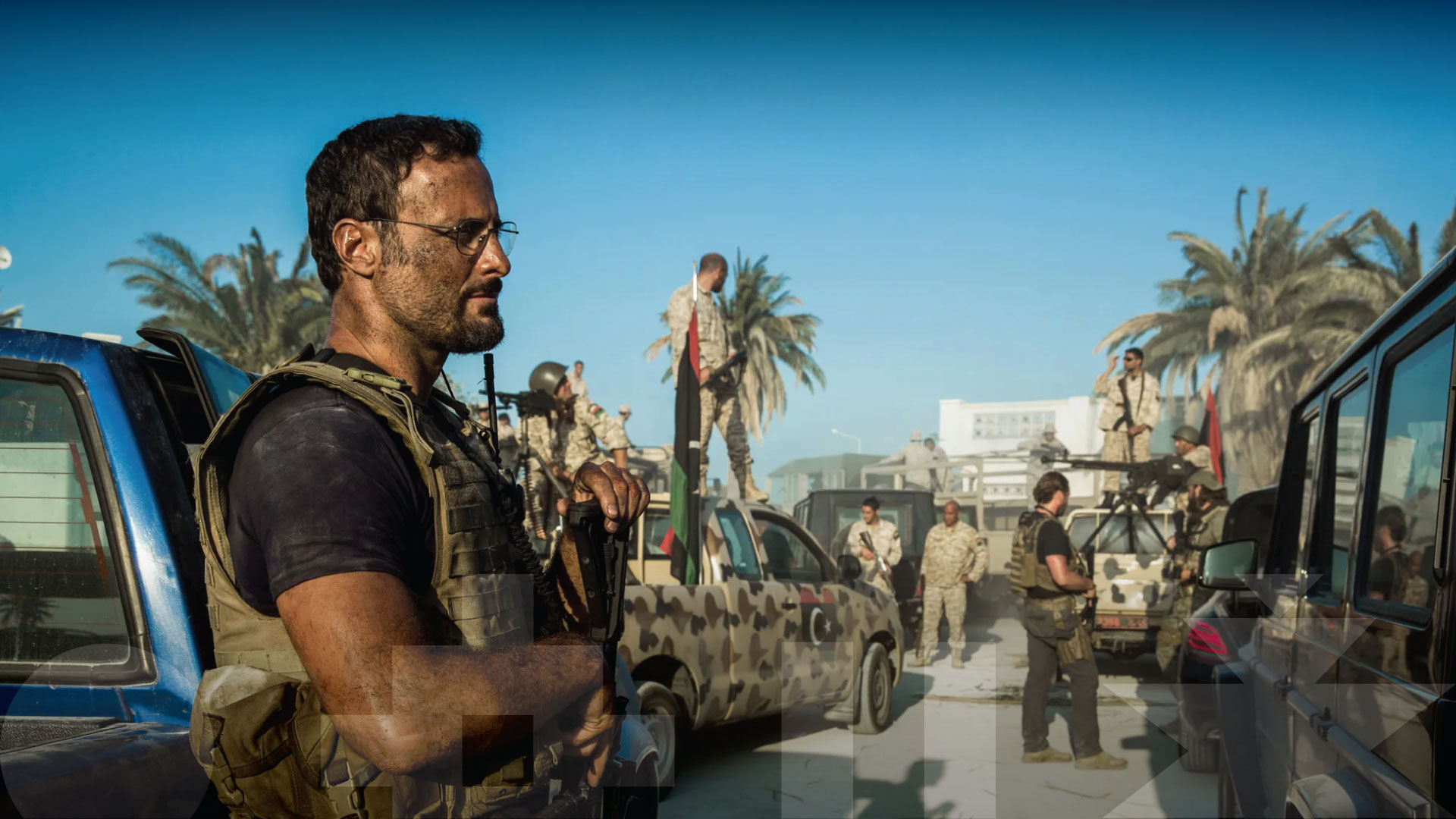
The camera’s movement on the road then shifts to the opposite direction: here, the vehicle transports soldiers on a battlefront. The sound is no longer an accompaniment but an integral part of the image of war—the military advance of the “rebels” during the armed uprising.
This is a conventional opening, one we often see in narratives that intend to investigate the line between peace and war, seriousness and play. When we first hear the news of Gaddafi’s death announced in English, and then see a gleeful Hillary Clinton reading it on her phone, we understand that the film is presenting its subject to the world, not just to Libyans. The third narrative layer comes from Khalid Shamis himself, who comments that his father fought against Gaddafi’s rule to an extent that surpassed his concern for his own family.
The film officially begins with its title card: The Colonel’s Stray Dogs, juxtaposed with the visual paradox of a rose. (Flowers are a recurring visual motif in the film, accompanying the journey between Libya and Britain).
3
We are in London, specifically in the south. The camera is on the road again, recalling the film’s opening, but this time, the peace of the sea is replaced by trees and the tranquility of the English suburbs. From here, Khalid narrates his father’s brief biography through the lens of his own. His dissident father is a son of the Nafusa Mountains, south of Tripoli; he, however, is a son of Croydon, south of London. Just as he reminds us of the mountain’s central role in the resistance against the Italian occupation in western Libya, he notes his own, entirely different upbringing, born far from any Libyan violence, whether against the Italians or against Gaddafi.
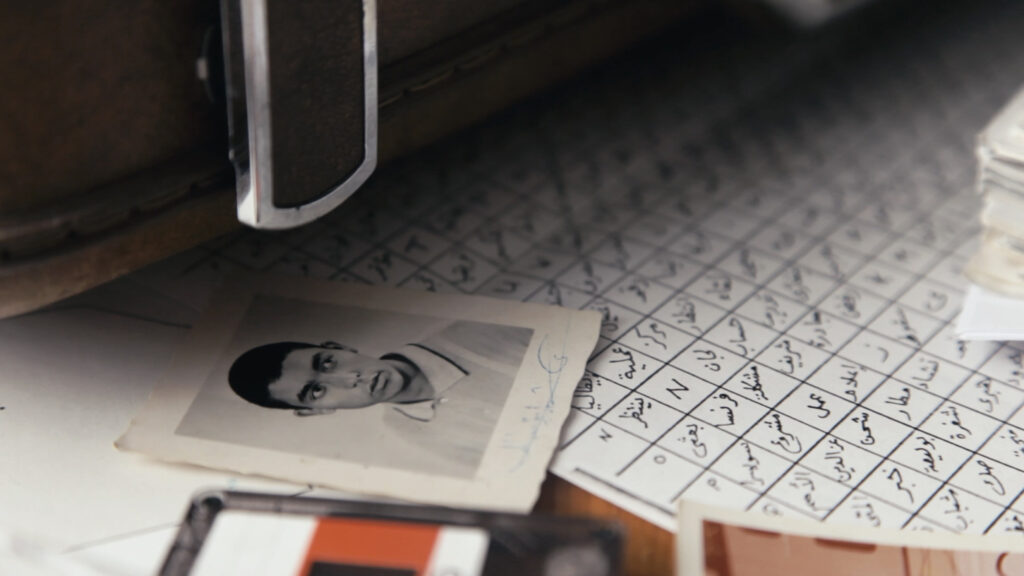
Through the camera, we enter Ashour Shamis’s home and realize that the child’s voice from the beginning of the film belongs to a collection of cassette tapes recorded in the 1970s, sent to him by his family, as was the custom back then. In one of his sessions with his inquisitive son, Ashour doesn’t hide his mockery of the Jamahiriya’s intelligence services, revealing his own file, which he obtained after the 2011 uprising. In the file, which classifies him as a stray dog, we read that he teaches “heresy” in the “city of Manchester United”—which, by the way, is located in London. The foolishness is twofold.
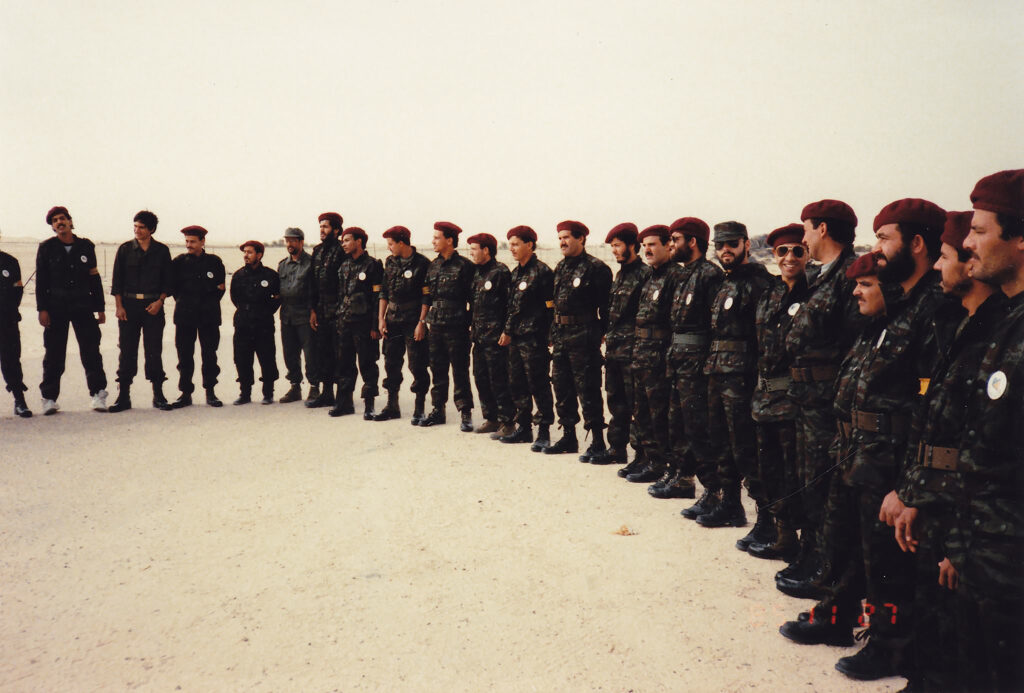
But the foolishness of the Jamahiriya’s intelligence, completely ignorant of world geography, resulted in the murder of dissidents who had spread across the globe, with a concentrated presence in Europe, especially Britain. The assassinations began in the early 1980s, with the killing of Yvonne Fletcher becoming the spark for a diplomatic war with the West. This was followed by the Berlin bombing, the predictable American airstrikes in 1986, and finally, the Lockerbie incident in 1988. It was a decade of violence, crowned by the Chad war, in which the Salvation Front participated against Gaddafi. The documentary reveals the details of the Front’s operations through archives and interviews. As we understand from Ashour’s reflections on those events, that decade may have marked the end of the organized Libyan opposition as a viable alternative.
4
Documentaries about political struggle—at least in mainstream cinema—often navigate the space between the personal and the public. They either start from the director’s own perspective or present their subject “objectively.” We also know that many critics believe that the act of writing or presenting a biography is inherently an expression of the creator’s own autobiography.
Between these two poles, we see the subject alive in the person of Ashour Shamis, unlike filmmakers who must probe the depths of a subject who is no longer living. Here, Ashour himself tells us about the consequences of his choices, as well as facts and testimonies. He clearly states his early affiliation with a political orientation hostile to Nasserism, meaning he opposed the “Al-Fateh Revolution” from its inception. He also doesn’t hide his Islamist political leanings, while emphasizing a constitutional-democratic framework.
On the other side, Khalid’s investigative vision emerges from cinema’s audacity in uncovering a person’s hidden depths. He even resolves to sit with his mother and ask her: “Was my father a terrorist?” He poses this question in defiance of the Western media’s official definition of terrorism, which once saw the fighters against the Soviet invasion as legitimate “mujahideen” and “freedom fighters” (a term for which I have found no official Arabic translation), only to later see them as terrorists. This led to the collapse of any coherent definition, culminating in the “condemnation of Hamas.” Khalid stresses to his mother that he is only questioning whether his father was a terrorist or a freedom fighter. She rejects the question, because terrorism means killing innocent people.
Woven into this courageous exploration is Khalid’s own voiceover, which shifts between poetry and prose. Neither serves to clarify his own opinion on the Libyan issue, but rather to observe the mental reflections created in the far north, with his small family, distant from his extended family in the deep south. He muses on his father’s way of making tea, his snoring naps in the living room of their quiet home, in a second exile—far from the Libya that we, the Libyans imprisoned within it, know.
Saad Elasha