Year of Production: 1981
Running Time: 167 minutes
Genre: Historical / War / Biographical
Directed by: Moustapha Akkad
Evaluation: Worth Watching
It is difficult to speak of Arab cinema without pausing at the legacy of Moustapha Akkad, the Syrian director whose ambitions transcended the limits of the Arab film industry of his time. He sought to create films with profound human and historical depth. Omar Mukhtar – Lion of the Desert (1981) will forever remain a unique work, not only in Akkad’s career but in both Libyan and Arab memory. It documented a pivotal era of the Libyan national resistance against Italian colonialism, articulating it in a universal language with Western cinematic tools, but with a purely Eastern spirit.
The Film: Between History and Cinema
The film is a cinematic biography of Omar Mukhtar, the “Sheikh of Martyrs” and leader of the Libyan resistance against the Italian occupation in the first half of the 20th century.
Akkad presented the story with a cohesive narrative structure, adhering to a linear, historical timeline without the leaps or narrative manipulations that might confuse the viewer. This choice gave the film a documentary-like stability, positioning it as a classic historical epic. At the same time, however, it lent a certain monotony to some of its dialogue-driven scenes.
Dramatically, the director balanced Mukhtar’s heroic dimension with the human side of his character. Mukhtar is not a static legend but a man of faith, convinced of the justice of his cause, who faces death with unshakable conviction. This balanced portrayal allowed the character to transcend his local context and become a universal symbol of the struggle against colonialism.
Performance and Acting
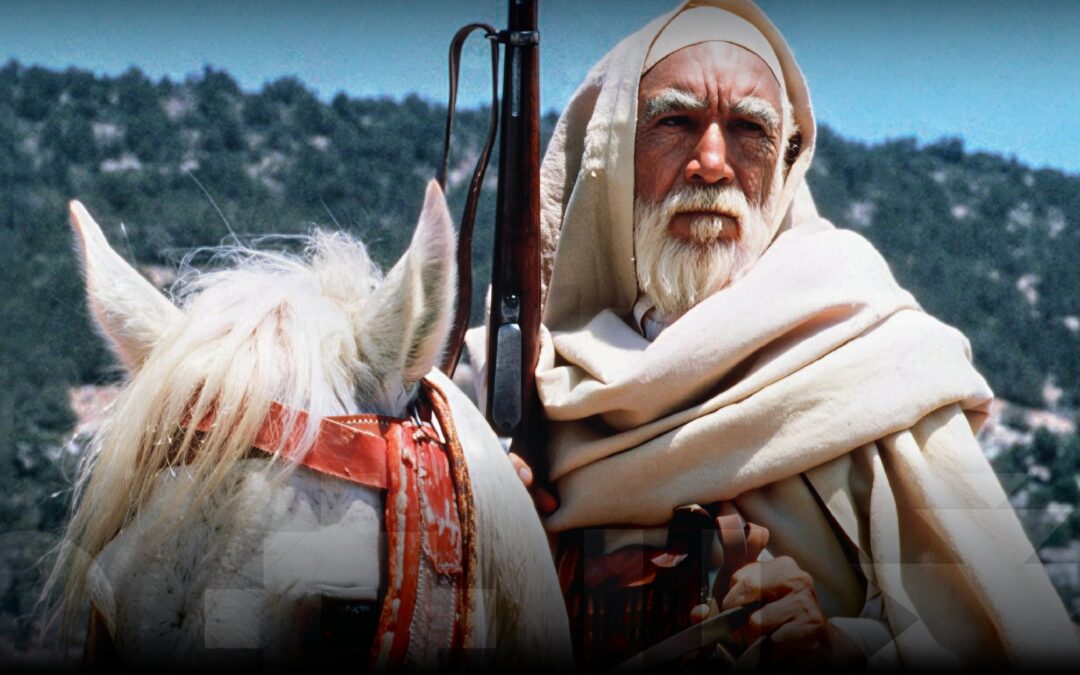
Akkad cast Anthony Quinn in the role of Mukhtar, a choice that sparked controversy but proved to be an artistic success. Quinn conveyed the image of the stoic sheikh with a quiet dignity, free of exaggeration. He relied on his gaze and an internal rhythm rather than overt emotion, which gave the character a rare authenticity in historical cinema.
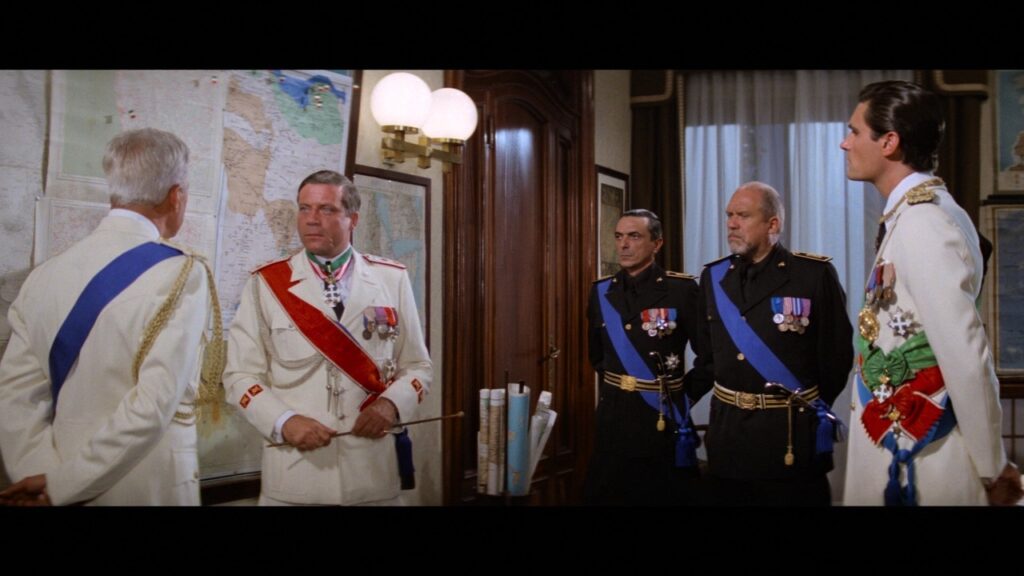
Alongside him, Oscar-winner Rod Steiger excelled as Mussolini, and Oliver Reed as General Graziani, embodying the arrogance of European power and its condescending view of colonized peoples. However, some of the secondary characters appeared to lack depth, their dialogue written to serve a documentary function rather than a dramatic one.
Directorial Vision and Technical Aspects
Akkad deserves credit for delivering a work that rivaled Hollywood productions in its technical scale, at a time when Arab cinema’s resources were limited. The film’s budget reached approximately $35 million, funded directly by Libya, while its box office revenue barely exceeded $1 million due to being banned in some countries and its poor distribution in the United States.
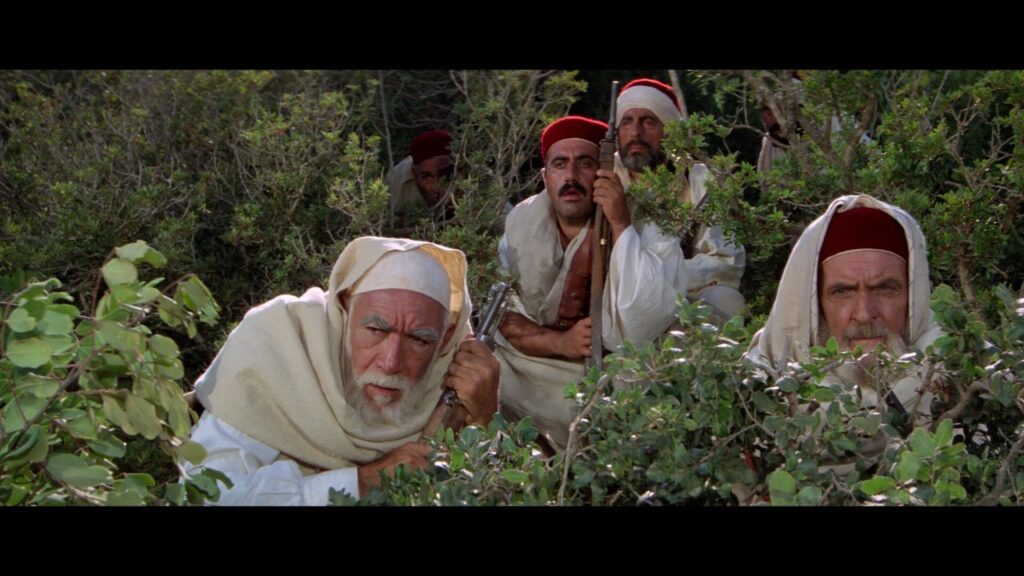
The entire film was shot on location in Libya, specifically in Jebel Al-Akhdar, Benghazi, and the desert of Sirte. Hundreds of Libyan extras were used to depict the resistance battles, lending the work a high degree of visual authenticity.
Technically, Akkad assembled a world-class crew:
- Director of Photography: Jack Hildyard, an Oscar winner for The Bridge on the River Kwai.
- Musical Score: Maurice Jarre, the composer behind the music of Lawrence of Arabia.
- The camera moves slowly in moments of contemplation and accelerates in battle scenes, while the score complements the sense of heroism tinged with sorrow.
Historical Accuracy vs. Dramatic Representation
The film sparked considerable debate over its historical accuracy. While Arab historians praised its precision in conveying the suffering of Libyans under occupation, some Italian historians criticized what they described as an “exaggeration of the brutality of Italian forces.” These criticisms, however, did not undermine the film’s core, as it is a work that seeks to show the truth from the perspective of the victims, not the invaders. I must also mention the talk among some about the film’s portrayal of certain historical Libyan figures as traitors, framed within a particular political vision.
Premiere and Reactions
The film premiered in Tripoli in 1981 at an official ceremony attended by Akkad and several senior Libyan officials. It was met with a wide popular reception in Libya and across the Arab world. In contrast, some Western entities expressed reservations due to its anti-colonialist tone, which only enhanced its symbolism as a voice for the oppressed.
Political Controversy and the Ban in Italy
In 1982, the Italian government issued a decision to ban the film, deeming it “an insult to the honor of the Italian army.” The ban remained in effect for over 25 years. The film was not shown in Italy until 2009, on the Sky Italia channel, coinciding with a diplomatic visit by Muammar Gaddafi to Rome.
National Significance and Libyan Symbolism
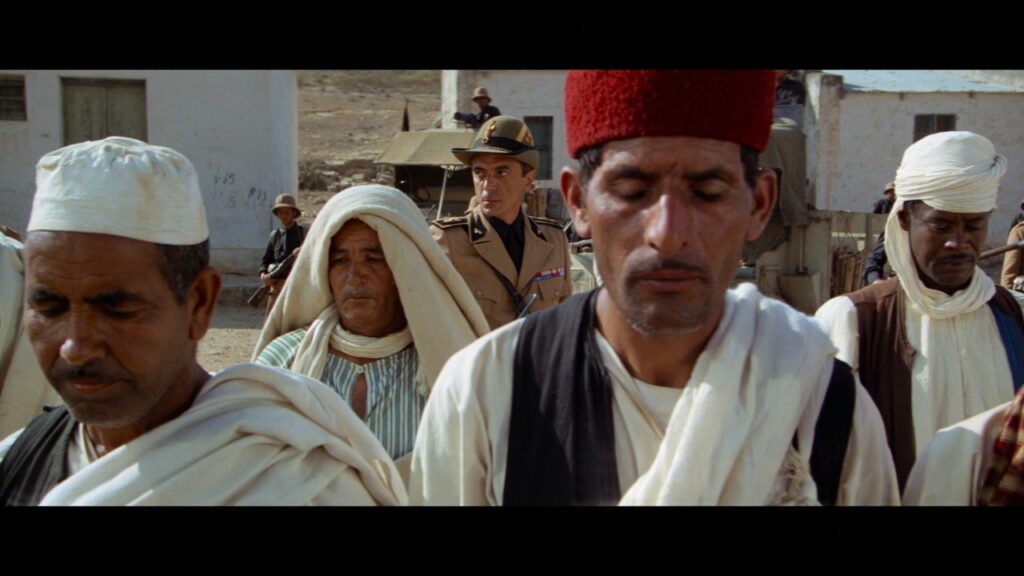
Although the film was an international production with foreign actors, its spirit is purely Libyan. Akkad managed to capture the essence of the Libyan resistance character—a blend of faith, dignity, and stubbornness in the face of oppression. Here, the desert is not merely a backdrop but a living entity that embraces the battle between freedom and colonialism.
The film provided Libyans with a rare visual memory of their ancestors’ struggle at a time when a national cinema was virtually non-existent. It elevated Omar Mukhtar into a universal human symbol, even with the controversy surrounding political interventions in some details of the historical script.
A Balanced Critical Reading
The film has high artistic value but is not without its flaws. The dialogue often felt weak, and the film’s length (nearly three hours) caused the pacing to lag in the middle. Furthermore, Akkad’s focus on the epic scale sometimes came at the expense of developing the psychological depth of the secondary characters. Nevertheless, these observations do not diminish the film’s importance as a unique cinematic achievement.
At the time, international critics praised the quality of the direction and cinematography, but the film was a commercial failure at the box office, grossing only $1 million due to the ban in Italy and its limited distribution in the United States. Over time, however, the film has transcended its financial losses to become one of the most important historical films in the Arab world, maintaining a high rating on specialized websites.
The Film’s Legacy and Relevance
What distinguishes Lion of the Desert is that it was not just a film about the past but a visual document that remains present in the Libyan consciousness. Through it, the meaning of resistance is renewed as a moral value that goes beyond weapons to the defense of dignity and identity. The film has been selected for inclusion in IMDb and Arab Cinema Classics lists as one of the most prominent Arab historical films.
After Moustapha Akkad’s death in the 2005 Amman bombings, interest in the film was renewed as a tribute to his artistic legacy. It is now screened annually on Libyan national occasions and is studied in some media and cinema curricula.
Akkad succeeded in crafting a universal human discourse from Mukhtar’s story without losing its national authenticity. As much as the film carried a global directorial vision, it remained a voice from the Libyan desert, telling the world that freedom cannot be conquered, and that glory is forged not only by victory, but also by steadfastness.
Omar Mukhtar – Lion of the Desert remains an exceptional work in Arab cinematic history because it combined artistic craftsmanship with national depth. Even more than four decades after its release, it still serves as a model for how to transform a national biography into a cinematic work that respects the truth without sacrificing art.
It is not just a film about a hero, but about an entire nation that stood firm in the face of tyranny.
And though Akkad is gone, his legacy endures, reminding us that a camera can be another kind of rifle, and that honest cinema is capable of immortalizing what history sometimes fails to preserve.
Muhammad Ben Saoud