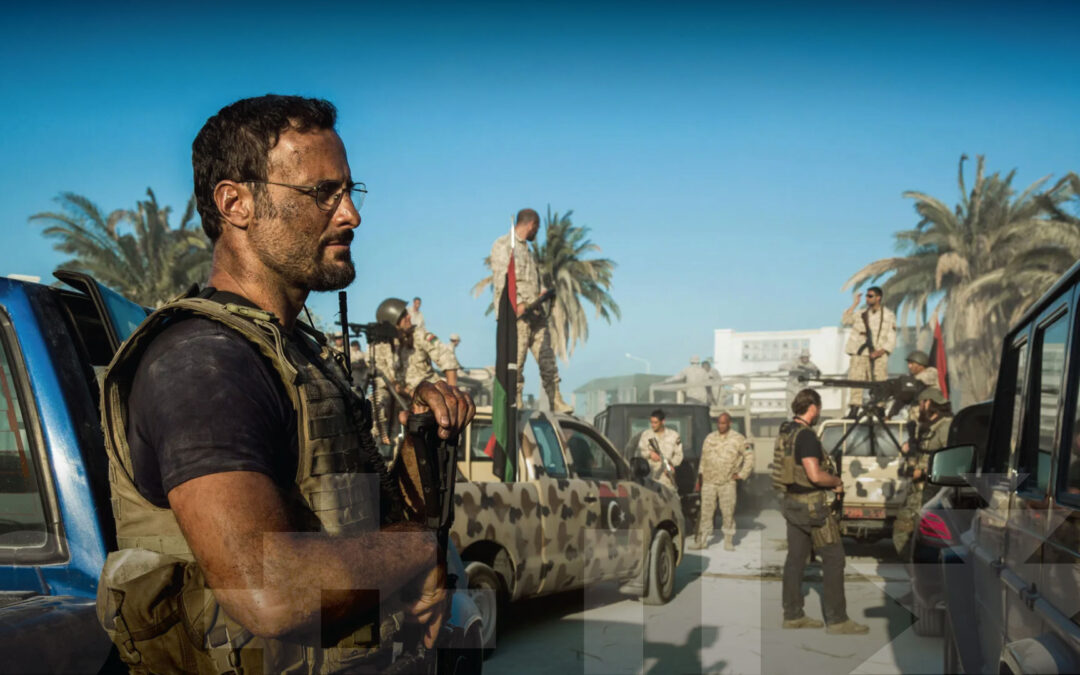
For decades, Libya has been absent from global cinema as a normal place for life or a complete human space. Instead, it has predominantly appeared as a dark backdrop for violence, or an open arena for terrorism and chaos.
This image was not formed by chance, nor was it merely an innocent artistic choice. Rather, it is the product of political and media narratives that found in cinema an effective tool to reproduce fear and cement stereotypes in the global collective consciousness.
In contrast, the Libyan cinematic voice has remained absent, or silenced, opening the door for the “Other” to speak about us, rather than to us, and to draw our features as they wish, not as we are.
Libya Through the Foreign Lens
When tracing Libya’s presence in foreign films, a nearly fixed pattern emerges:
Libya = Desert.
Libya = Armed camps.
Libya = Extremist groups.
Libya = A state without civil features.
In the film Rules of Engagement (2000), although Libya is not explicitly the setting, the Arab world as a whole is presented as a monolithic block of chaos and violence, an image that later appeared in works where Libya was used as a synonym for “danger.”
However, 13 Hours: The Secret Soldiers of Benghazi (2016) stands as the clearest example of reducing Libya to a single security event. Presented from a purely American perspective, the film focused on military heroism while completely neglecting the Libyan human and social context.
The film was less a historical document and more a reformatting of reality to serve a specific political discourse. In most scenes, Libyans appeared without names, without backgrounds, and without motives, simply as a permanent visual threat.
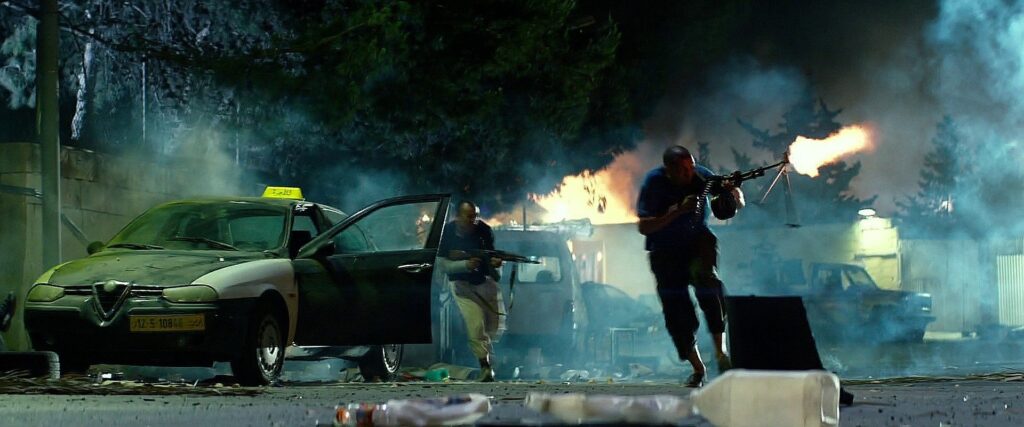
A frame from the film 13 Hours: The Secret Soldiers of Benghazi (2016)
The Problem of Narrative: Who Owns the Story?
The fundamental issue is not that foreign films are produced about Libya, but that these films are the almost exclusive source for painting Libya’s image in the global consciousness. Cinema, as a language that transcends borders, does not merely display events; it manufactures impressions, establishes memory, and defines who is the victim and who is the perpetrator.
When we do not possess our own cinematic narrative, the “Other” becomes the narrator. Their vision, no matter how fragmented or biased, becomes the only circulated truth.
The absence of a Libyan cinema capable of international competition has left a dangerous void, one filled by works that know Libya only through the angle of a gun sight or a news bulletin.
Between “Lion of the Desert” and the Aftermath: A Missed Opportunity
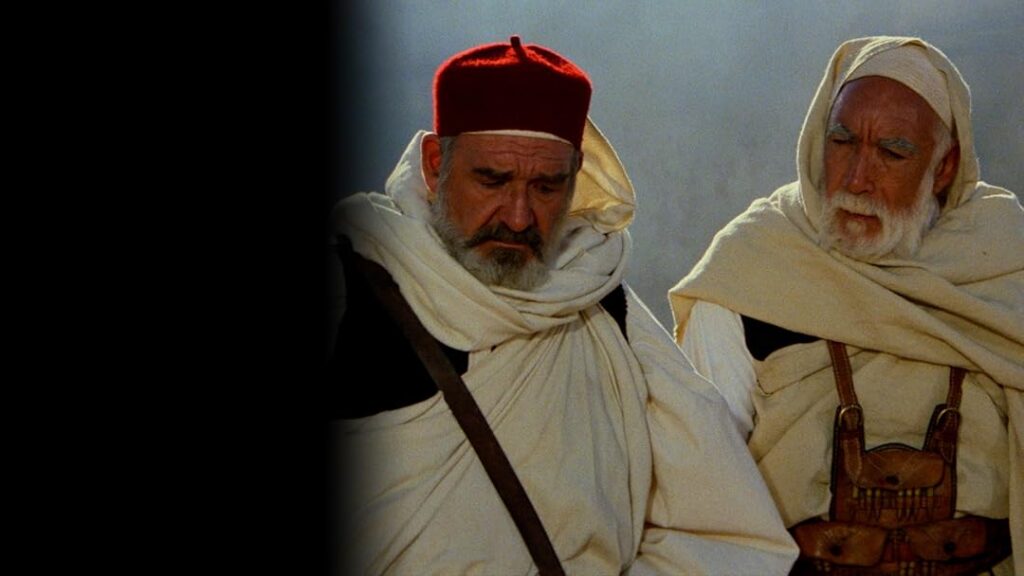
Lion of the Desert (1981) was a rare exception. It presented Libya as a nation of resistance, with a history, a cause, and human faces. Yet, it remained a singular case, an orphaned achievement not followed by a cinematic wave that built upon it.
After that, Libyan cinema retreated to the margins, whether due to political conditions, the lack of production infrastructure, or the absence of sustainable institutional support. Thus, while other nations were rewriting their images through cinema, Libya remained captive to a single image recycled without resistance.
Counter-Cinema: A Necessity, Not a Luxury
Speaking of “counter-cinema” does not mean producing propaganda or apologetic films. It means producing honest, human cinema that acknowledges the complexities of Libyan reality without surrendering it to distortion. It is a cinema that sees the Libyan human in their daily life, in their cities, in their contradictions, and in their dreams, not just in the moment they hold a weapon.
Counter-cinema is that which wrests the right to speak, redefining the place outside the binary of “Terrorism or Desert,” and presenting Libya as a living society, not a fleeting news segment.
The Role of the Libya Film Institute: From Sponsorship to Vision
In this context, the importance of an institution dedicated to cinema becomes clear, not merely as an artistic activity, but as a strategic cultural project. Supporting independent films, encouraging young voices, providing local and international exhibition platforms, and building a Libyan visual archive are all necessary steps to restore balance to the image.
Film institutions do not just make movies; they create the climate that allows for the birth of a national visual discourse capable of addressing the world in its own language.
Towards a Cinema That Defines Us, Not Speaks For Us
Libya does not need its image “polished”; it needs its image reclaimed. It needs a cinema that says: “We are here, telling our story ourselves, with all its pain and hope.”
When we make films about our cities, our women, our youth, and our near and distant history, we break the monopoly on the image. We force our existence into the global scene as “makers of meaning,” not merely background extras in the events of others.
Libya’s continued cinematic absence means the continued distortion of its image without resistance. Cinema, as history has proven, is not a neutral mirror. It is a tool of soft power; whoever holds it holds the ability to influence memory and conscience.
The bet today is not on a single film, but on an integrated project that restores the Libyan camera to its natural role: to be a witness to life, not a tool for falsifying it.
When we succeed in that, we will not only change the world’s view of Libya, but we will also change our view of ourselves, and that is the true victory of cinema.
Muhammad Ben Saoud