The first scene was painful and filled with sorrow. One morning in March 2023, I woke up to a Facebook post advertising the sale of seats from a cinema hall specifically, Cinema Berenice. The items were being sold at one of Benghazi’s popular markets, known as “Souq Jinaheen.”
The question immediately arose: What happened?
The Berenice Theater and Cinema had been demolished, bringing down the curtain on nearly a century of film screenings and concerts featuring Arab and European music.
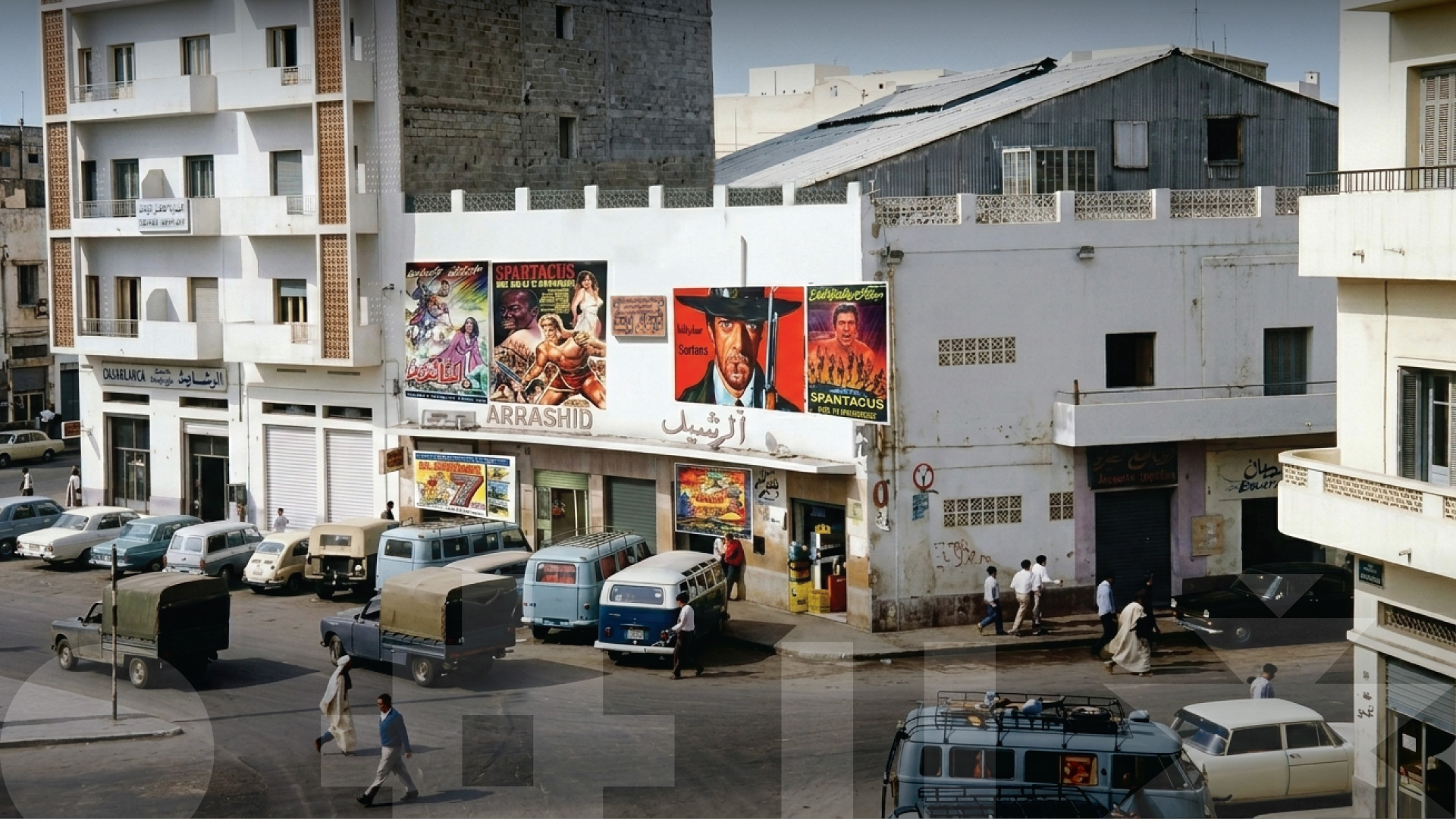
According to Libyan historians, the Berenice stage hosted numerous Italian musical performances before parts of it were destroyed following the outbreak of World War II. It was later converted into a cinema. This same stage welcomed legendary Arab singers, including the “Star of the East” Umm Kulthum in 1969 and Warda Al-Jazairia in 1977. It also screened the iconic film The Message in 1976 and Empire of Ghawar in 1983, along with countless Egyptian, Indian, and Western cowboy films that formed a core part of the city’s cinematic memory.
What Happened?
The Berenice building suffered multiple waves of destruction and ruin. The first occurred in the 1970s, and the second in 1984, when a massive fire ravaged the structure, leaving it abandoned for years. In 2016, during the Libyan conflicts, a significant portion of it was destroyed. Finally, in March 2023, it was completely demolished.
Official authorities in Benghazi state that the decision to demolish the Berenice Theater and Cinema was part of a campaign to remove damaged buildings in the city center. Engineering reports confirmed that the structure sustained extensive damage during the 2014–2017 war, losing much of its structural integrity, which rendered it unsafe for use or restoration.
The municipality also included the building within the scope of the downtown redevelopment project, asserting that its dilapidated condition hindered reconstruction and infrastructure efforts. With no official plans or funding available for restoration or cultural investment, the decision to remove it entirely was solidified in March 2023, viewing it as a structural hazard and an obstacle to urban development.
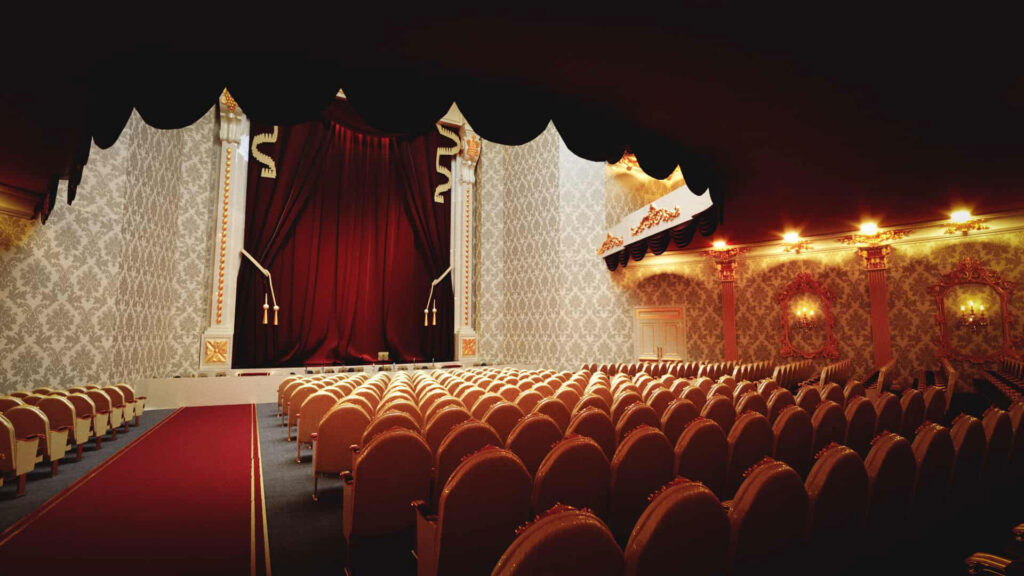
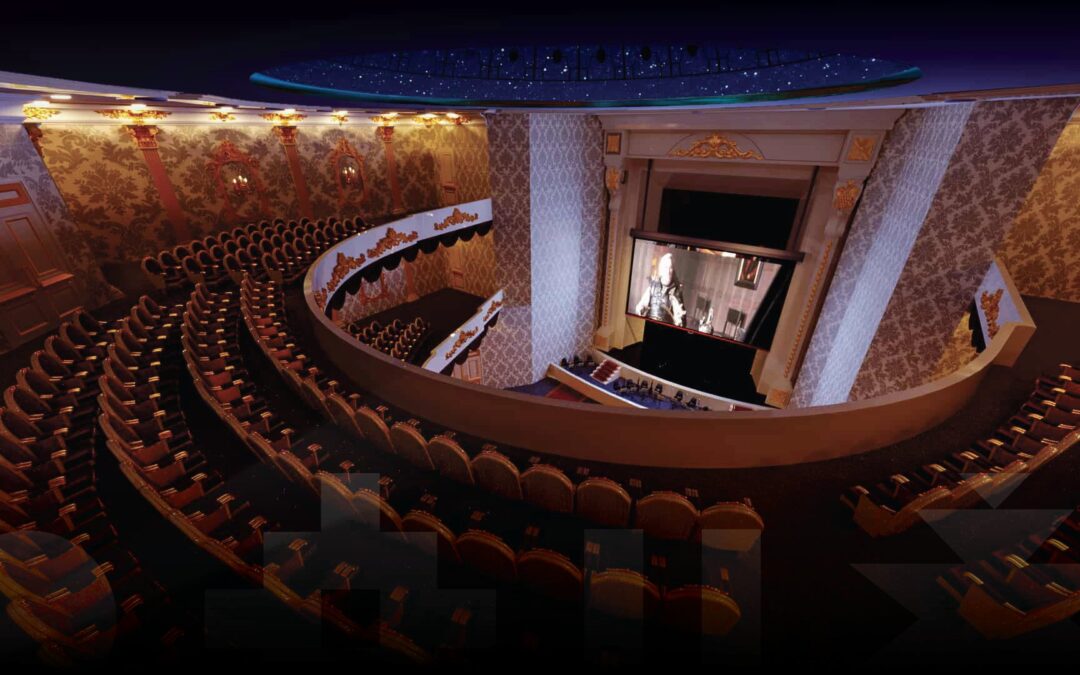
Interior shot of the Berenice Theater and Cinema; Designed by architect Saja Al-Jatlawi, and visualized by Motasim Salama
Remnants of an Ottoman Fortress
According to the book Urban Development of Benghazi: 1911–1940 by Abdul Sattar Mohamed Al-Faqih, the Berenice Cinema and Theater was one of the most significant architectural landmarks on Corso Italia Street (now Independence Street). It was a true Italian masterpiece, considered unique by the standards of the late 1920s.
The theater, later known as the Benghazi Cinema House, was located at the intersection of Rome Street (now Omar Al-Mukhtar Street) and Corso Italia. Built on a large section of the old Turkish fortress grounds, construction began in 1927, and it officially opened on October 28, 1932.
The project started with the removal of the remains of the Ottoman fortress overlooking the Public Garden and Salt Square. Governor Attilio Teruzzi commissioned architects Piacentini and Piccinato to design the detailed plans, while the Fontana company executed the construction.
Why Was It an Italian Masterpiece?
The theater featured a grand hall with 700 seats arranged in a semi-circle, sloping down toward the orchestra pit. It included two main balconies and six smaller box balconies flanking the stage.
Above the hall was a large dome that could be opened for ventilation, featuring a 68-square-meter opening. The theater was equipped with advanced electrical and mechanical systems for the time, and its floors were paved with Slovenian Rovere marble.
Together, the main hall and balconies could accommodate over 1,300 people. The stage itself covered 400 square meters, with a depth of 14 meters and a curtain height of 18 meters. Several small rooms connected to the stage were dedicated to theatrical performances.
To offset the high construction costs and secure additional revenue, a building containing luxury apartments and offices was added to the east of the theater. Another building was added to the west, featuring a café on the ground floor and luxury apartments and offices on the first floor.
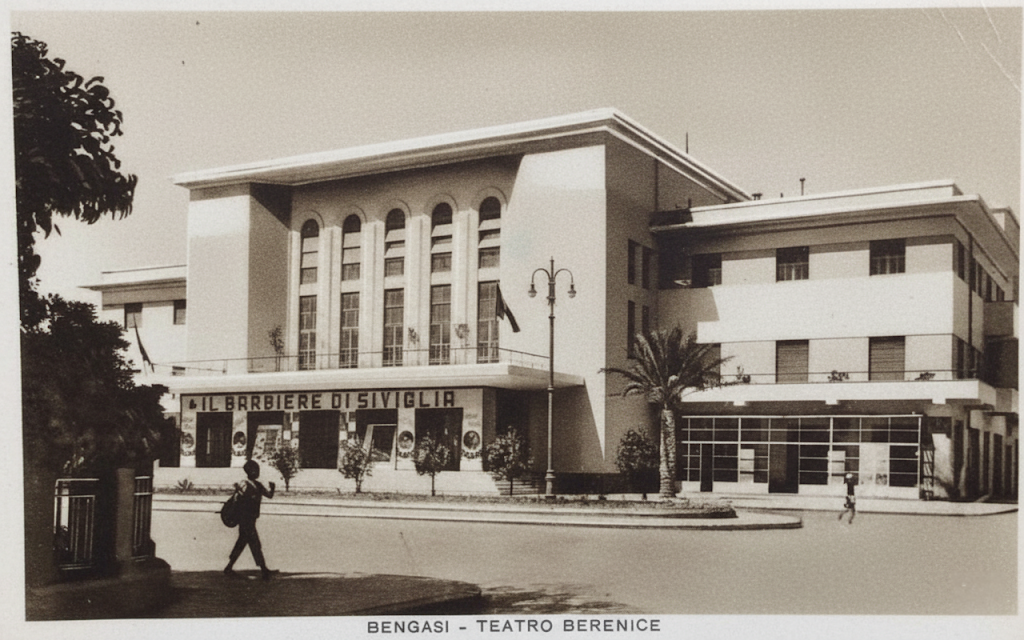
The Berenice Theater and Cinema was established in 1928 and demolished in 2023
Where Are You Going This Evening?
Researcher Abd al-Salam al-Zughaibi recalls: “People loved going to the cinema. They would find out about films through daily newspapers in Benghazi, which dedicated a page titled ‘Where Are You Going This Evening?’. The halls were always packed to capacity. A worker sat at the door leading to the screening hall—known as the ‘Ticket Cutter’—who would check your ticket and tear it, giving you back half.”
He continues: “Outside, vendors would call out their wares: ‘Gaz… Gaz,’ distributing Sinalco, pineapple soda, and Portello drinks. Seeds, peanuts, ‘Seven’ gum, and ‘two cents’ chocolate were also sold outside, along with Khalifa Al-Ghariani’s sandwiches from a kiosk next to Cinema Al-Huriya.”
The Flashlight Keeper
Al-Zughaibi adds: “For us kids, we didn’t have the money to buy a ticket, or ‘Billet.’ So we had to resort to waiting for an older man and using the trick known as ‘Get me in with you, uncle’.”
“We used to seize the opportunity of Eid to go to the cinema, where they showed films like Tarzan, cowboy movies, and Charlie Chaplin films starring famous actors. Going to the cinema was usually a group activity involving two or more people; rarely did anyone go alone.
The seats were arranged according to aisles usually two or three and the chairs were fixed to the floor in rows. There was an usher carrying a flashlight whose job was to guide latecomers quietly to empty seats.”
“Spartacus Film”
Short story writer Fathi Naseeb shares his memories: “My father worked the afternoon and evening shifts at the Berenice and Rex cinemas, where he was responsible for operating the projector. Through the small openings in the projection room, I would watch him change the reels. I learned from him how to manually rethread the film, pass it through the machine’s gears, and splice it when it broke.
Berenice and Rex owned by Suleiman Al-Zunni were among the finest cinemas in Benghazi in terms of order, organization, and cleanliness, featuring padded seats and velvet curtains that opened slowly.”
Naseeb speaks of cinema-going as a widespread social habit, with halls crowded with individuals, groups, and families. He elaborates: “Among the films that influenced me as a child was Spartacus, which taught me that freedom is the most precious thing in existence. There were also the Italian neorealist films of Pasolini and Rossellini, the works of Costa-Gavras, and French cinema weeks.”
He continues: “There were many sources of cultural and literary knowledge that shaped the generation of the sixties and seventies in Libya. These included schools, sports clubs like Al-Hilal Club which hosted evenings featuring poets and writers like Talib Al-Ruwaie, Mohammed Zughbiya, Ali Al-Fazzani, Khalifa Al-Fakhri, Hussein Makhlouf, Nizar Qabbani, Abdul Wahab Al-Bayati, and others.
Then there was theater, cinema, and Libyan newspapers and magazines like Al-Haqiqa, Al-Ra’id, Al-Balagh, Reportage, Al-Basha’ir, Illustrated Libya, Cyrene, Al-Umma, and Al-Raqib, alongside the Egyptian and Lebanese press. We also had radio, television, public libraries, Arab and foreign cultural centers, mobile cinema vans, and cafés most notably Al-Aroudi, Al-Tarhuni, Souq Al-Hout cafés, Al-Ummal, Al-Riyadi, Damascus, Shams, Akram, and Tika.”
He adds: “In schools, from primary to high school, the library was an essential part of the educational process. We would borrow a book every week and be tasked with presenting a summary to the Arabic teacher. We also produced weekly wall newspapers; my colleagues and I published one called ‘Free Thought,’ handling both writing and layout, in addition to contributing to school radio.”
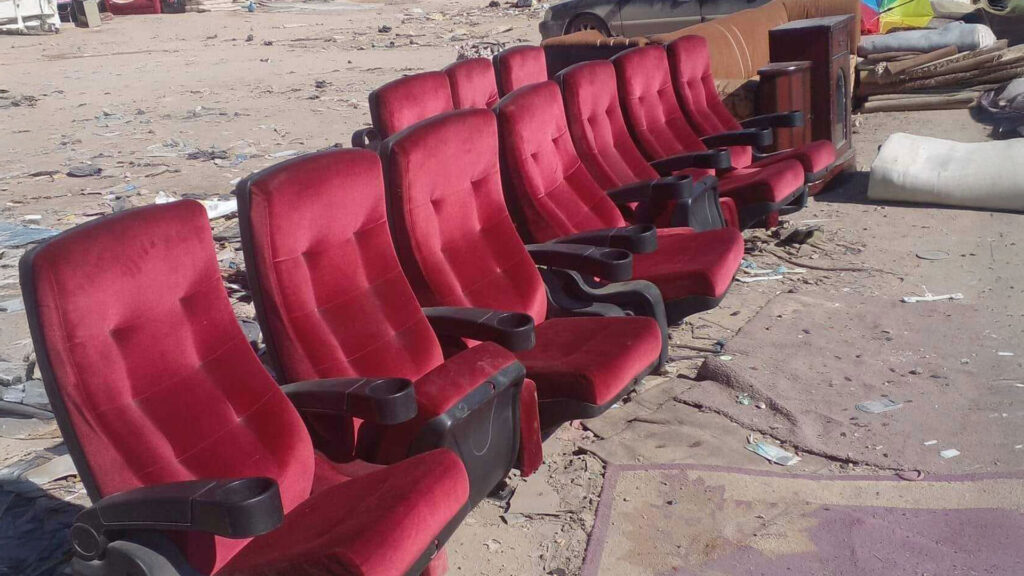
The seats of the Berenice Theater and Cinema being sold in a popular market after its demolition
Theater and Cinema
Naseeb points out that theater also played a crucial role by presenting Libyan masterpieces in writing and direction, alongside Arab and international works by Tawfiq Al-Hakim, Mouin Bseiso, Alfred Farag, Saadallah Wannous, Samir Sarhan, and Dürrenmatt. These were performed in Benghazi, Tripoli, Misrata, Sabratha, Derna, Al-Bayda, and Al-Marj on stages like the Popular, Modern, Arab, National, and Scout theaters.
Egyptian professors also contributed to energizing the theatrical movement, including El-Sayed Rady, Abdel Ghani Qamar, Zain El-Ashmawi, Omar El-Hariri, and Mohamed Tawfik.
He adds: “Regarding cinema, I believe it played an important role in spreading awareness and was not merely a means of entertainment. Through it, like many others, I gained knowledge of other peoples and cultures. We watched Egyptian, American, Italian, French, and Indian films, among others, with all their varying themes and techniques.”
He continues: “If we limit the discussion to Benghazi since that is where I lived my childhood and youth there were several cinema halls, including: 9 August, Al-Nahda, Al-Huriya, Berenice, Rex, Haiti, Al-Wahda, Libya, Al-Hilal, Al-Zahra, Al-Firdaws, and Al-Najma.
I also remember that all cinema halls offered free screenings on Children’s Day, and students had the right to enter any cinema for half price.”
He concludes: “Unfortunately, neglect and marginalization befell the cinemas. In the eighties, some were turned into police stations, and most were demolished in Benghazi, Tripoli, and other cities.”
Kholoud Elfallah