
1
The title itself points to a paradox we see unfolding in our societies: How can we establish “alternative” cinema spaces if we haven’t first established recognized, commercial theaters that meet the standards for showing new films? The answer lies in our tendency to import terminology from the masters of cinema, the Euro-American and Asian worlds. A century ago, the narrative film was already a quarter-century old, a period in which the unique language of cinema was forged through editing experiments in the Soviet Union, Germany, America, and Japan. These experiments went beyond the self-absorption of experimental film, influenced by modernism in literature and theater. In this context, cinema clubs spread across the globe to preserve the “treasures” of the world of cinema and to discover distant voices alongside local productions.
While the landscape has become far more complex than this brief summary allows, it’s worth noting the most famous alternative screening space in our Mediterranean sphere: the French Cinémathèque. The term itself is so influential it has been adopted into English and other languages. (If we were to truly Arabize it, we might call it Al-Masnama, structured like al-Maktaba, our word for library). One of its founders, Henri Langlois, became a cultural legend in European film circles for his tireless work, beginning in the 1930s, to preserve films from every artistic movement on the planet.
In February 1968, the French Ministry of Culture issued an order dismissing Langlois from his post as director of the Cinémathèque. In response, the filmmakers of the French New Wave – who had educated themselves on the very films that Langlois had saved from oblivion by traveling the world to copy them – rose up in protest. These demonstrations would become the seed of the May 1968 revolution that swept through France, transforming its culture, labor, politics, and society.
The takeaway is this: small screenings for a handful of cinema fanatics are capable of creating societal shocks that can lead to cultural, social, and political revolutions. And since revolutions in our beloved society are often equated with civil strife, we will instead turn to our own experiences.
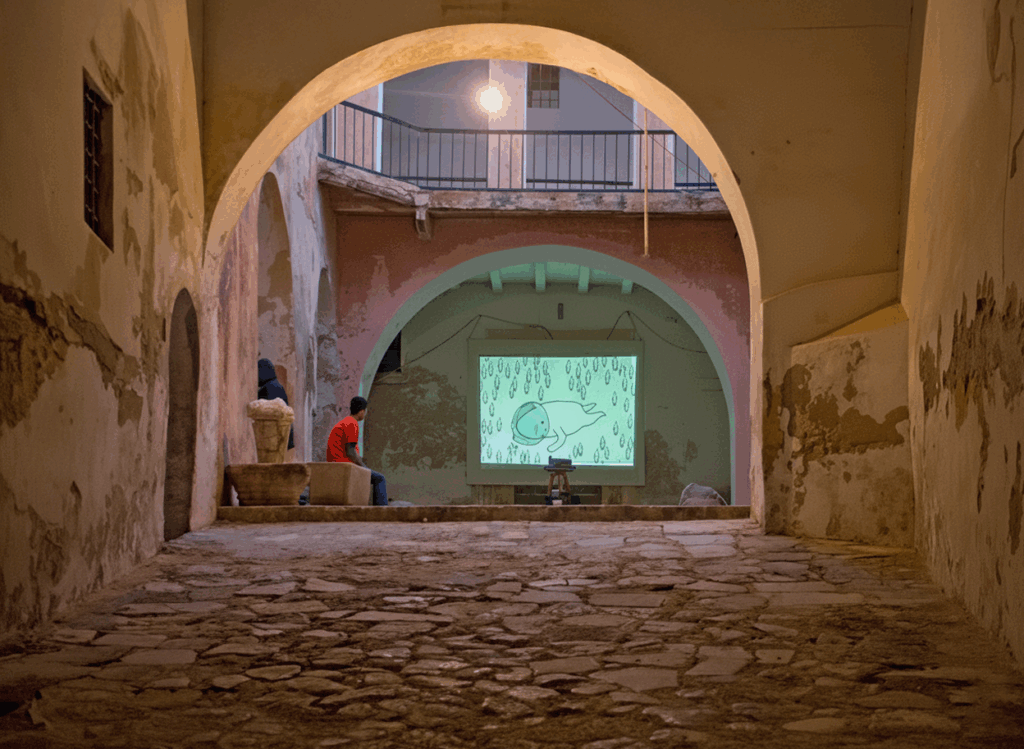
From the First Glance: Video Art Exhibit at Al-Saraya Al-Hamra, Tripoli, 2013
2
We are not concerned here with the history of film clubs and private screenings during the Kingdom, Republic, or Jamahiriya eras. While we hear of cinema clubs and cinephiles from the foundational years of Libyan cinema (1968-1972, before the establishment of the “Khayyala” organization) people who were, like fanatics elsewhere, only human after all—it is difficult to imagine these clubs having the capacity to screen what the French Cinémathèque did. Even neighboring Arab countries had a more solid cinematic foundation. Back then, films were only available on film prints, making their acquisition a heroic and painstaking task, just as it was for Langlois. Screenings were therefore dependent on the efforts of commercial distributors showing what was popular in Cairo and Beirut.
This situation changed after the 17th February revolution with the emergence of the “Arete Cinema Club”, an initiative of the “Arete Foundation for Culture and Arts.” The club began its screenings at the Dar Al-Funun (House of Arts) in Tripoli in 2012 with Asghar Farhadi’s film, A Separation. Fully aware of the cultural sensitivities of society, the club’s program booklet did not mention the film’s nationality, as Libyans have long associated any engagement with Iranian culture with the promotion of Shi’ism.
Khaled Mattawa, one of the foundation’s founders, tells me that the film’s greatest success was not just the number of attendees, but the significance of the screening itself. Screenings of films by Ingmar Bergman, for example – in the final 2014 seasons – attracted only a few of Tripoli’s cinephiles, but a small audience does not necessarily mean an empty experience. The club continued to show classics of world cinema, an achievement that Mattawa believes could be expanded by distributing program guides to film students at colleges and institutes.
That same year, 2012, the club took its screening experience to the Old City for the “Al-Lamha Al-Oula” (The First Glimpse) festival, projecting international video art onto the city’s white walls. This cultural celebration, he says, “connected the old with the new,” because the youth of the capital had not truly engaged with the world of the Old City. The experience of watching became profoundly communal.
In 2013, following the success of the first festival, a second “Al-Lamha Al-Oula” (The First Glimpse) was held, this time inside the Red Castle (Al-Saraya al-Hamra). This continued the experiment of connecting the viewer to their surroundings, as most Libyans had never entered the castle and, as Mattawa recalls, many found it difficult to get in. He added that in this edition, many of the selected works were critical of aspects of Libyan society, voiced through a collection of international art.
Immediately after that festival, I joined the club’s team to program three seasons of screenings. In this role, I experienced firsthand what I had read in the writings of critics and programmers from around the world: amidst the global dominance of Hollywood studio distribution, a deep-seated curiosity to discover the “other” through alternative cinema still possesses the conscience of societies. This alternative cinema does not have a single face; sometimes it hews close to a “traditional” narrative line, other times it rebels against it, and at other times still, it scrambles the formula entirely. Since we were in cinematic education 101, the majority of our selections at the club belonged to the first category, with a few from the second.
One of the most beautiful moments I will never forget was when a viewer approached me after a screening to ask for a copy of the film so he could watch it again. He was a student at the arts institute, and the film was Incendies, the Canadian adaptation of Wajdi Mouawad’s play about the horrors of the Lebanese Civil War and its aftermath in Canada (and, in this case, its resonance in Libya).
In the joyful summer of 2014, fear seized Tripoli’s soul before it seized its body. The cinema club’s screenings stopped without a meeting or a plan. War, after all, comes to us without a plan. We never imagined that the summer season would be our last. The Arete Foundation continues its cultural activities to this day; the cinema club alone remains suspended, a silent echo of that joyful summer.

From one of the film screenings at the Tanarout Collective, Benghazi, in 2018
3
After the catastrophe of that joyful summer, the “Tanarout Collective” was founded in 2015 upon the ruins of the ongoing war in Benghazi. I asked my friend Houssam al-Thani, one of the collective’s founders, to reflect on some aspects of their experience, which, like Arete’s, is a long story. We will focus on a few highlights that reveal both beauty and ugliness.
Houssam used to meet with his artist and writer friends – all cinephiles – at his house every week to screen films with a personal projector. It was here that one of their “elderly” friends reminded them of a cinema club in Benghazi in the 1990s that he used to frequent. And, as is the fate of Libya’s forgotten film clubs, the security services had inevitably shut it down.
Tanarout’s opening film was Timbuktu by the Mauritanian director Abderrahmane Sissako, who has worked primarily in Malian cinema. We can note a similar impulse in the openings of both Arete and Tanarout: a turn toward world cinema, not just in terms of production, but in its mood, its “humanist” themes that serve as a true introduction to alternative cinema.
Remember how Arete avoided mentioning Iran for A Separation? The Tanarout club fell into the trap of “promoting Shi’ism” when it screened an Iranian film. (Incidentally, Libya’s guardians of virtue always conflate Shi’ism with atheism, secularism, Freemasonry, Ibadi Islam, and other concepts that should never be confused, let alone blended). This marked the beginning of a societal clash with the club and its events, which spanned all areas of arts and culture.
Houssam reflects on some of the collective’s choices in dealing with these clashes. He tells me they should have decided on a path of reform instead of revolution, of maneuvering and “diplomacy” with social opposition rather than confronting it head-on. Yet, after harassment engineered by the Islamic Endowments Authority and naturally supported by the security services, the founders and directors decided to shut down the collective completely in 2020, having barely survived legal battles and the COVID-19 pandemic.
Today, there are a number of cultural institutions in Libya that have learned from these two preceding experiences and have become more timid. They walk a fine line, clinging to a delicate balance. But regular, seasonal film screenings have not been revived since Tanarout.
We noted at the beginning the desire of critics and cinephiles to archive world cinema and create a quiet space away from the monopolies of distribution and commercial theaters. In our current era, it has become easy for cinema fanatics like me to watch whatever we please from around the world, from the earliest experiments of the Lumière brothers to this year’s festival standouts. Therefore, the importance of alternative screening spaces in Libya does not lie in archiving, as it’s the mission of the “First World”, but in establishing cinematic references. It is about introducing society to the world through a lens other than massive Hollywood productions, not because they are harmful, but because they are not the only way to express this ever-evolving art form, an art that most of the world’s population has yet to truly discover. It is also about moving beyond the condescension of an elite who claim these films are not suitable for the simple viewer, only to be surprised by that same viewer every single time.
Finally, we must remember the communal essence of any screening, whether in a commercial or an alternative space. Nearly every film screening includes a post-film discussion with its makers or experts. A film’s life cycle does not end when the credits roll. In the cinema clubs we have mentioned, and those we haven’t, screenings were accompanied by discussions that connected the content of the films to social issues in the country. In addition to discussing issues that mirror our own, we engage with those that challenge them. In the end, cinema, like all arts, strives to ask questions. Otherwise, it would lose its power to create societal shocks, and we would have no need for discussion at all.
Saad Elasha