Countries of Production: Canada
Year of Production: 2023
Running Time: 61 minutes
Genre: Documentary
Written and Directed by: Sara Ben-Saud
Evaluation: A must see
Stories of ancestors often revolve within the orbit of veneration, where the image of the grandfather appears polished with wisdom and sayings meant to illuminate the path and strengthen resolve, accompanied by the image of the grandmother, the weaver of tales and icon of chastity. The features of Libyan identity have long been confined to these two icons: the courage of the grandfathers sharply embodied in the image of resistance fighters against the Italian coloniser and the chastity and sacrifices of the grandmothers in the same era. Literature and theatre perpetuated these constants. Since then, every voice diverging from the principles of courage and chastity has been marginalised in youth literature. In cinema too, “preserving identity” remains a loose concept that never truly discovers the essence of identity.
On the frozen shores of a lake in Quebec, Canada, Sara Ben-Saud captures an image of a duck carving its way forward. Through another camera we see her as a child, and hear her narrating the story of her birth in the summer of 1996. She says she was born in Quebec to a Libyan-Tunisian father and a Canadian mother, raised within Canadian Christian culture without any presence of Libya or even Islamic holidays, since her father had severed ties entirely with his homeland. Thus, the film opens its path, as the “protagonist” follows the traces of absent footsteps: what it means to be being Libyan, to be Tunisian, and in a way not directly confessed to be Canadian. The latter itself is divided between French-speaking Quebec and the other nine “English” provinces, as well as the three territories where Indigenous peoples (the First Nations) form the majority in some and the minority in others.
With this Canadian complexity, Ben-Saud turns to another identity-based complexity (is there any identity not wrapped in complexities!), oscillating between Libya and Tunisia two countries once unseparated by borders, as the dust of the Sahara refused to divide its inhabitants. Here Ben-Saud touches upon one aspect of Libya’s ethnic diversity, where her Libyan grandfather married her Tunisian grandmother. The first and last points of contact are the memoirs of the grandfather, Ahmed Ben-Saud, which he left in the 1970s to his son, Sara’s father. Browsing the memoirs with her father, Sara reads a line in which her grandfather speaks of the marginalised, writing: “those to whom the author belongs.” His story, then, is the story of “those without a voice.”
Thus, the narrative identity of the film takes shape: Sara recounts a letter she wrote to her grandfather, absent in body yet present in words buried for decades. If we mentioned at the outset the veneration of ancestors, here the discovery of ancestors comes through Sara’s discovery of herself, via monologue and dialogue, affirming an old phenomenon: biography is nothing but autobiography. Nor should we forget in this context the awe of writing and its power to create a presence that cancels veneration. Writing is present in those memoirs in several languages composed by Ahmed Ben-Saud, who mastered and translated many tongues including English, Italian, French, and Spanish, in addition to Arabic texts most likely predominant which he left as a legacy to his son.
Sara travels to Tunisia to investigate (she could not visit Libya “for security reasons,” naturally). There lies the house of her grandparents and the remaining family in Tunis. There her cousin sketches a family tree, and they recall that their grandfather died a year or two before the outbreak of the 17 February uprising, having left the country in opposition. In one scene that seems to stray yet draws close to the subject, Sara accompanies a relative on a tour of her great-grandmother’s house (the protruding part of her Tunisian identity), who speaks of the importance of the “spirit of family” found in shared memories, and of the family house empty in body yet full in spirit, and what it means to her uncles and aunts “Hoshe el-Eila” in Libyan parlance.
Returning to the memoirs, Ahmed Ben-Saud portrays himself as a Don Quixote, an image from which we draw a dreamy spirit in which identity splinters only to return to a beginning that never began. Therefore, Sara says she is not merely Canadian when she spends four months in Tunisia, learning the Tunisian dialect and falling in love with a Tunisian young man. Yet this statement does not negate her Canadian-ness but enriches it, just as her grandfather’s Tunisian-ness enriched his Libyan-ness.
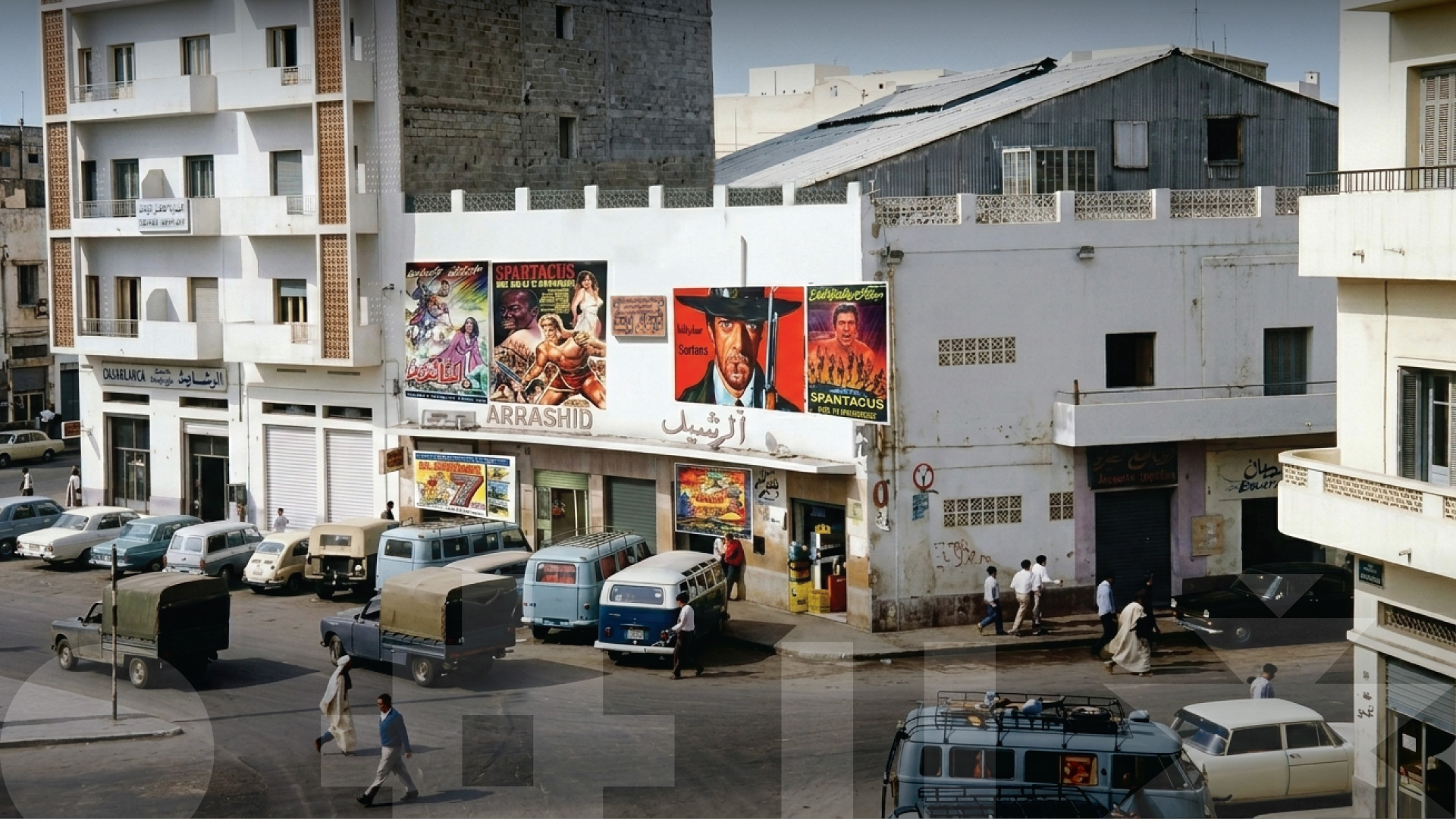
Of that Libya, and of that Tripoli in particular, Ahmed Ben-Saud writes of a world that vanished after 1969, when he speaks of “la dolce vita” — the sweet life — as he roamed the city’s streets, visited its bars and nightclubs, and became entangled in its politics, running four times for office only to fail each time for seemingly tribal reasons. Consequently, he was among the optimists about the coup/uprising of 1969, having lost hope in the monarchy, only to lose hope again in the republic and the Jamahiriya, and to be imprisoned in 1979 for two years. We shall return to this shortly.
Sara finally celebrates Eid al-Adha, telling her relatives it is the first time she has celebrated any Islamic holiday. Her uncles share her joy, telling her that the spirit of Eid lies in giving rather than in eating meat, though they admit that this spirit has faded, as celebrants wallow in indulgence and luxury, and they include themselves in that category.
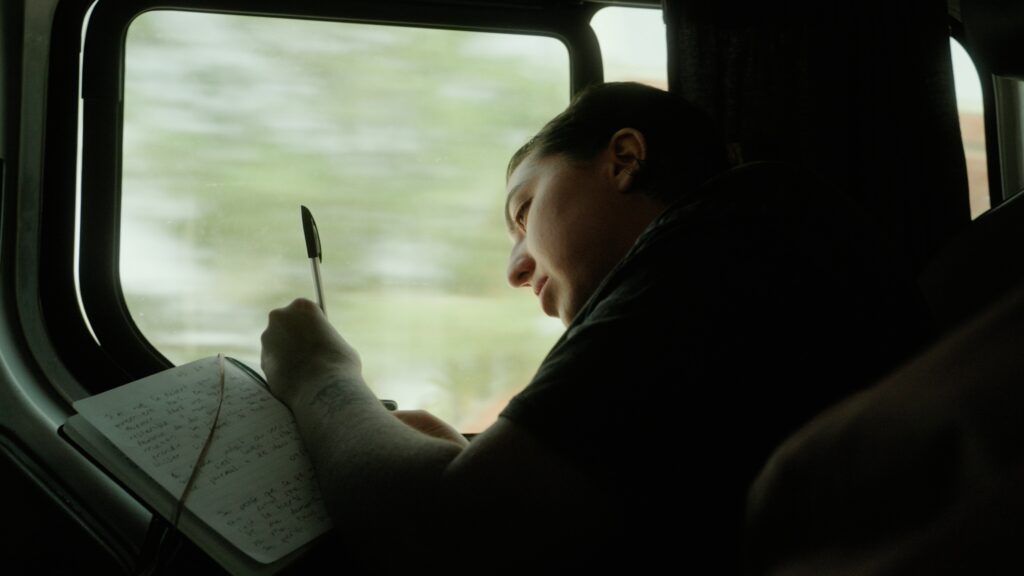
In one of her final letters to her grandfather, she tells him that all his children have left Libya: his three sons settled in Canada and England, and his daughter in Egypt. Yet they now gather for the first time in decades in the family house in Tunis. Her aunt/the daughter brings photos and documents of her father, the amateur writer. In the film’s most powerful scene, Sara sits with her father, uncle, and aunt, hearing them speak of his dream to publish his experiences in a book, but also of his two years in prison the first time candour confronts the darkness of the past. What is easily revealed through grandchildren becomes difficult for sons and daughters who endured the torment of deprivation and absence. She perceives suppressed emotions in their voices and faces. The strength lies also in capturing this harshness without anticipation, with no prelude to the scene. Perhaps this development suggests that the story of exile in Libya remains essentially the story of the prisons of the Jamahiriya, after the prisons of the monarchy and before those of today’s rulers.
In his memoirs, Ahmed Ben-Saud writes of leaving prison in body without spirit (and Sara remembers him as an old man at the beginning of the film, when she was a child seeing him in a wheelchair, defeated and silent). Yet at the end of the narrative, he says he “raises the glass to every Don Quixote in the astute world,” acknowledging to the viewer that prison and his futile struggle do not represent him, but are part of a “sweet life” sometimes tinged with bitterness, so that its sweetness is not trivialised nor its bitterness overwhelming.
I had previously reviewed Khalid Shamis’s film The Colonel’s Stray Dogs about the outcomes of political repression through the living father who speaks to us directly. Khalid told me that one of his motives for producing the film lay in his attempt to draw closer to his father, and Sara expresses the same motive in her film. True, Khalid’s subject became alive and speaking, while Sara’s subject became alive through words gathered from scattered papers. Yet it is also true that both sought, and perhaps still seek, the present absentee, in all places and at all times.
Saad Elasha